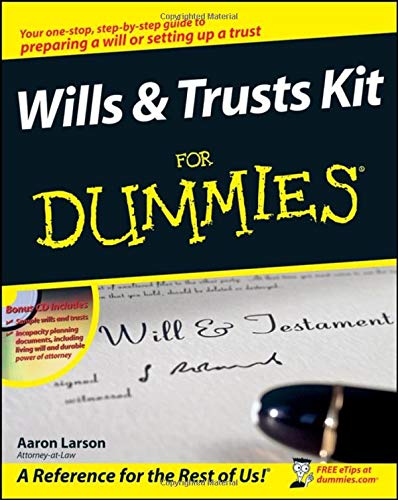
Ebook Info
- Published: 2008
- Number of pages: 384 pages
- Format: PDF
- File Size: 3.64 MB
- Authors: Aaron Larson
Description
Navigate probate, tax issues, and state lawsCreate an estate plan and protect your family’s interestsNeed a will, but have no idea where to start? This friendly guide shows youhow to prepare a legal will or trust — either on your own or with professional help — and ensure that your wishes are honored. You’ll handle everything from planning your bequests and writing and signing a will to selecting a trust and drafting your durable power of attorney.Discover how to:Provide for your childrenHire and work with professionalsMinimize tax liabilitiesAmend or revoke a will or trustAvoid common estate planning mistakesNote: CD-ROM/DVD and other supplementary materials are not included as part of eBook file.
User’s Reviews
Editorial Reviews: From the Inside Flap Navigate probate, tax issues, and state lawsCreate an estate plan and protect your family’s interestsNeed a will, but have no idea where to start? This friendly guide shows youhow to prepare a legal will or trust — either on your own or with professional help — and ensure that your wishes are honored. You’ll handle everything from planning your bequests and writing and signing a will to selecting a trust and drafting your durable power of attorney.Discover how to:Provide for your childrenHire and work with professionalsMinimize tax liabilitiesAmend or revoke a will or trustAvoid common estate planning mistakes From the Back Cover Navigate probate, tax issues, and state lawsCreate an estate plan and protect your family’s interestsNeed a will, but have no idea where to start? This friendly guide shows youhow to prepare a legal will or trust — either on your own or with professional help — and ensure that your wishes are honored. You’ll handle everything from planning your bequests and writing and signing a will to selecting a trust and drafting your durable power of attorney.Discover how to:Provide for your childrenHire and work with professionalsMinimize tax liabilitiesAmend or revoke a will or trustAvoid common estate planning mistakes About the Author Aaron Larson is an attorney practicing law in Ann Arbor, Michigan, where he lives with his wife and daughter. After graduating from the University of Michigan Law School, Aaron started practice as a quintessential small town lawyer, providing legal services that included estate planning, probate, and guardianship services. He subsequently worked for the Institute of Continuing Legal Education in Ann Arbor, Michigan, where he developed professional education programs for lawyers in areas including estate planning, litigation, and family law. His present legal practice focuses on civil appeals. He operates the ExpertLaw Web site (www.expertlaw.com), offering free legal information and assistance to consumers, as well as resources for legal professionals. Excerpt. © Reprinted by permission. All rights reserved. Wills & Trusts Kit For DummiesBy Aaron LarsonJohn Wiley & SonsCopyright © 2008 Aaron LarsonAll right reserved. ISBN: 978-0-470-28371-4Chapter OneEnsuring That Your Last Wishes Are Honored In This Chapter * Understanding the estate planning process * Creating your estate plan * Getting help when you need it * Making your wishes known * Avoiding common estate planning pitfalls You’ve worked hard all your life, have accumulated some assets, and have bought a copy of this book. You’re ready to plan your estate. My best guess? You’re not excited about planning your estate. You have already figured out that you have a lot of work to do. You must also think about unpleasant things, including your death, the possibility of your incapacity, and how your family will cope without you. What’s the primary purpose of an estate plan? Taking care of your loved ones after you’re gone. Why plan your estate now? Because the sooner you start, the more certain you can be that your plan will take care of your family’s needs in the way that you want. As you proceed with this process, you’ll probably find out your estate planning needs aren’t as complicated as you thought. You may discover that all you need is a will, perhaps backed up by a simple living trust. You may discover that your needs are more complicated and enlist the help of an estate planning professional. Yet even then, your understanding of the estate planning process and tools will help you communicate your needs and choose your best options. Having an estate plan also provides a great deal of comfort. You’ll be able to plan for your family’s financial needs. And after your death or incapacity, your loved ones won’t have to fret about what you would have wanted them to do. They’ll know your actual wishes. The Good, the Bad, and the Ugly: What Can Happen When You Don’t Plan Your Estate Simply put, if you don’t plan your estate, the government has an estate plan in store for you. Your state’s laws of intestate succession will apply, and the state will decide who inherits your assets, usually your spouse and children. But that’s not all: In the event of your incapacity, a court may appoint people to make decisions for you regarding your personal and medical care and the management of your money. A stranger may end up deciding where you live, what medical treatment you receive, and perhaps even whether you really need $20 for a haircut. If you have minor children, a court will have to decide who will care for them, but will not have the benefit of your input. The business you spent a lifetime building may end up failing or in the hands of a court-appointed receiver. Planning your estate isn’t a one-time task. Changes in your life circumstances can dramatically alter both your wishes for your estate, and whether your original estate plan even remains viable. Sometimes it seems like your life doesn’t change much, so you may be wondering what sort of changes I am talking about. Consider the following: Your estate will probably grow substantially over the course of your life, although it may also shrink. You may marry, divorce, separate, have or adopt a child, or experience a death in your family. Your children will grow up and establish their own households. You may move between states, buy and sell property, or start your own business. Your designated trustee or personal representative may no longer be available, or your relationship with that person may change. Laws may change. In fact, they will. You can expect a new estate tax bill to be working its way through Congress within the next year or two, and it won’t be the last. In all probability, you’ll update your estate plan several times during your life, and on occasion you may even start over from scratch. WARNING! If you don’t update your estate, over time your estate plan may become largely ineffective. When that happens, you’re not much better off than you were before you created the outdated estate plan. Reaping the Benefits of Planning Your Estate The biggest advantage of planning your estate is that your wishes will be respected, both while you’re alive and after your death. Your estate plan helps you in several ways: Incapacity planning helps ensure that you receive the type of medical care and treatment you want, that your assets are managed according to your own wishes, and that your end-of-life decisions are respected. Your will and trust ensure that your assets are distributed to the heirs you choose, under terms and conditions you define. Your business succession plan helps ensure that your business doesn’t fail following your incapacity or death, and that control of your business passes to a suitable successor. When you don’t plan your estate, your incapacity plan will be defined by a court, and your estate will be carved up according to state law. The result may be far different from what you desire. Planning for your care while you’re alive In addition to planning for the distribution of your assets after you die, a complete estate plan looks at what will happen to your estate if an accident or illness leaves you unable to properly care for yourself. Your incapacity plan includes your durable power of attorney, healthcare proxy, and living will: Your durable power of attorney appoints an attorney-in-fact who can make financial decisions for you if you become incapacitated. Your healthcare proxy appoints a healthcare advocate who can help you make medical decisions if you’re unable to make or communicate those decisions yourself. Your living will describes what care you want to receive, and don’t want to receive, during the final days of your life. If you don’t appoint people to help with your medical and financial needs, your family may have to go to court to have somebody appointed to make decisions for you. Your loved ones will face unnecessary burdens and confusion: Your family will have to go to court to have somebody appointed to manage your personal and financial needs, at a time when they’re already under stress due to your incapacity. The court won’t know who you’d prefer to assist with your medical and financial decisions, and may appoint somebody who you would find unacceptable. Your helpers won’t know your wishes or the limits you’d impose on their choices if you were able to communicate them. They’ll have to try to guess what you would have wanted. WARNING! The impact of these choices may be profound. Whatever your plans, with a court-appointed guardian supervising your medical care, you’re more likely to undergo more intrusive medical care and to spend your last days in a hospital or nursing home. (Chapter 14 discusses incapacity planning in more detail.) Ensuring that your assets go where you want When you plan your estate, you pick your heirs and decide how much you want to leave to them. Although state laws do restrict your ability to disinherit certain heirs, especially your spouse, for the most part you can leave your money to family, friends, schools and charities, or anybody else you choose. In defining your bequests, you may choose to simply distribute your assets to your heirs upon your death. But you may also choose to be very creative in how you distribute your assets. You can defer your bequests to a later date (for example, “When my son turns 25”). You can mete out your gifts in installments (for example, “$20,000 to my daughter upon her 18th birthday, $20,000 on her 23rd birthday, and $60,000 upon her 30th birthday”). You can impose conditions on your bequests, requiring your heirs to satisfy those conditions before they receive the inheritance (for example, “$50,000 to my son upon his graduation from college”). If you don’t plan your estate, the state will make all those choices for you. Your estate will go to your heirs according to your state’s laws of intestate succession, described later in this chapter in the section “Realizing What Happens If You Don’t Have an Estate Plan.” If you have minor children, the probate court may appoint a conservator to look after their assets until they turn 18. But any adult heir will immediately receive their legally defined inheritance. Your wish to support your alma mater or to give to charity? Forget it. REMEMBER The only way to be sure that your assets are distributed the way you want is to plan your estate. (Chapters 3 and 4 detail the process of collecting information about your assets and planning your bequests.) Looking Out for Common Pitfalls Everybody makes mistakes, but some mistakes get made a lot. Actions that may seem like they’ll simplify your estate may in fact make it more complicated, burden your ability to use and enjoy your own assets, or increase the tax burden to your estate and heirs. At the same time, once you understand the common pitfalls, most are pretty easy to avoid. You can avoid some mistakes simply by planning your estate now, rather than putting it off until your health starts to fail. (For more discussion of common estate planning mistakes, see Chapters 8 and 18.) Benefits and dangers of jointly titling real estate, property, and bank accounts A common shortcut to estate planning involves adding your desired heir to the title of your real estate, financial account, or other titled asset. You can choose between a number of different types of joint ownership, discussed in Chapter 17. In all likelihood, when you add somebody as an owner, you’ll create a joint tenancy with right of survivorship, meaning that they automatically inherit your share if you die before them. Some huge risks can arise from joint ownership of a home. Take a common example, where you add your child to the deed as a joint tenant: Your son gets divorced, and his wife asks the divorce court to award him half of “his share” of your house. Your son may decide that the home is “more than you can handle” and ask a court to force the sale of the property. Your son decides to move in. It’s his home too, isn’t it? Your son suffers financial problems or doesn’t pay his taxes, and his creditors or the IRS try to collect against “his share.” Also, adding a joint owner can increase that person’s capital gains tax exposure when the property is eventually sold. Other issues may also arise: What happens if you can no longer afford to support your home, or are no longer physically able to care for it, but your child won’t agree to a sale? What happens if you want to refinance your mortgage to improve the property, get a better interest rate, or withdraw equity from your home, but your child refuses to cooperate? What if you want to sell your house and move into a smaller home or condo, but your child wants to keep “the family home?” What happens if you have to move into a long-term care facility? WARNING! When you give up your full ownership interest, you run the risk that your children will suddenly decide that they know what is best for you, and prevent you from making perfectly reasonable decisions relating to your own home. Similar issues arise with joint ownership of bank accounts. As the law presumes that both you and your joint account holder have equal rights to the money, your co-account holder may empty the account. His creditors may try to garnish the account to satisfy his debts. If it truly is a joint account, with both of you contributing toward the balance, the IRS will still try to include the entire account balance in your taxable estate, and your child will have to prove to the IRS that he contributed part of the money and that his contribution should not be taxed. TIP Possible alternatives to joint ownership include the use of a living trust, or transfer-on-death titles and accounts. (Part III discusses living trusts. For discussion of joint ownership of real estate, see Chapter 17.) Benefits and dangers of life estates You own your home, and you want your children to inherit your home. So how about a life estate? In a life estate, you retain the right to use and control your home for the rest of your life, and you provide for your ownership of your home to pass to specific people upon your death. You’re called the life tenant, and the people who eventually receive your home are your remaindermen. Although I’m speaking in terms of your marital home, you can create a life estate for other property as well, which is called a retained life estate. In a typical arrangement, once you create a life estate, you retain the exclusive right to the use and possession of your home. You pay the day-to-day expenses of your home, including routine maintenance, homeowner’s insurance, and property taxes. You pay the interest on the mortgage, but your remaindermen pay the portion of the mortgage payment that goes to the principal balance. As a life tenant, you face the same type of dependence upon the goodwill and cooperation of your remaindermen as you do with joint ownership (see preceding section). You need your remaindermen’s consent to refinance or sell your home, and difficulties can arise if you become unable to pay the home’s ongoing expenses. A life estate may also appeal to you if you have children from a prior marriage who you wish to eventually inherit your home, but want your current spouse to be able to live in your home following your death. You can provide in your estate plan for your spouse to receive a life estate in your home, with your children as the remaindermen. But consider the consequences: Say that you’re considerably older than your spouse. You die at age 82, and your spouse is 63. At this time, your children are nearing retirement age. If your spouse lives for another 20 years, your children will be elderly by the time they inherit your home. By then, they may have little need for an inheritance. Your spouse may neglect the property, causing your children to have to pay insurance, taxes, and repairs and possibly having to take your spouse to court. You may create acrimony between your spouse and your children, who see your spouse as standing in the way of “their inheritance.” Your spouse may remarry. Do you want to subsidize your spouse’s new family? TIP An alternative? Keep your house in a trust for five to ten years, or whatever other time period you desire, and let your spouse have full use and enjoyment of it during that period. Then have your trust convey your house to your children. Danger of subjecting an asset to Medicaid spend-down rules Medicare is a federal health insurance program that provides payment for certain hospital and medical expenses for people aged 65 and older. But as you age, you face a huge potential expense that Medicare doesn’t ordinarily cover: long-term care. If you’re wealthy enough, lucky enough, or hold sufficient long-term care insurance, you may not need to worry about the cost of your long-term care. But most people, even those with some insurance, can face significant financial hardship from the high cost of residential care. This is where Medicaid comes in. Medicaid is an additional federal program that covers medical costs, including the cost of long-term care, if you’re financially unable to pay for that care yourself. (Continues…) Excerpted from Wills & Trusts Kit For Dummiesby Aaron Larson Copyright © 2008 by Aaron Larson . Excerpted by permission. All rights reserved. No part of this excerpt may be reproduced or reprinted without permission in writing from the publisher.Excerpts are provided by Dial-A-Book Inc. solely for the personal use of visitors to this web site. Read more
Reviews from Amazon users which were colected at the time this book was published on the website:
⭐A necessary read for those who want to pass on their legacy in perfect order. Arm yourself before you see a lawyer.
⭐Very happy with product. Included CD helpful.
⭐I am a Civil Notary in Louisiana. In Louisiana, notaries have the legal power (and legal responsibility) to prepare all sorts of documents and perform all sorts of official personal and authentic acts. In Louisiana, Notaries can basically perform all legal document preparation and notarization, including, but not limited to: deeds, Power of Attorney, small successions, Custody By Mandate, Wills, Trusts, LLC and Corporate documents required for federal and state governmental bodies, etc.), with the exception of preparing divorce papers (most of my clients use legal zoom for that service) and representing clients in court. These acts are practicing law (as defined in Louisiana). Louisiana notaries CAN notarize divorce papers and, as stated above, prepare legal documents, in essence being paralegals. This book is full of practical knowledge, examples, and provides the basis of understanding of Wills and Trusts. This book should be part of the Legal Library that any Notary, Louisiana or otherwise, has in their possession. Rating for completeness 1-10, I’d give it a 10+ !!!!!!!
⭐It was very helpful in a lot of areas. The only drawback was that it is 10 years old. But I really learned a lot of new things.
⭐great book to read before you go to a lawyer.
⭐Bought this for a friend and he found it extremely useful. Since I knew the importance of a will, convinced him to have this book. Time of delivery was very good and the shape of the book was in excellence condition.
⭐The Wills & Trusts Kits for Dummies explained difficult to understand legal rules and laws for our matured selves, or the not prepared early health or death delimas of our parents, that often falls on young adults just getting their own lives underway. I saw the need for my grandsons, but after researching some of my own and recent purchases, I spent too much time trying to show the need to respond, as if the Courts of the future demanded they prove their actions, and whether the choices were legal or not. There was confusion and hurt feelings beginning to surface, so I quickly had Amazon directly mail copies of these amazing Dummies siries to each one of them. The progress is slowly growing forward at everyone’s peace, including their still young parent, who needs to be kept in the loop of choices. The lost of the other stept-parent just a couple of years earlier was too difficult to handle without a good and reliable,reference guide book. Thanks Amazon for quick delivery of these books. BB
⭐Good material and advise. However, this book was listed as used but I can’t remember the condition. It was heavily marked up with a marker all through the book. What I found upsetting was a list made by the previous owner of items she was to take to a “hospital” after reading the book. I hope she survived.
⭐It’s American. Which is utterly and completely useless in the UK isn’t it?
⭐Very good book, increases understanding in essential area.
⭐This is an American Law book nothing to do with the UK.So useless to anybody living in the UK
⭐It is a US addition. not relivant to UK law. Why have a US law book for sale. If I needed a US book I would go to amazon US. I no that the laws in differant counrties do no apply to amazon but they do for the rest of us.
Keywords
Free Download Wills and Trusts Kit For Dummies 1st Edition in PDF format
Wills and Trusts Kit For Dummies 1st Edition PDF Free Download
Download Wills and Trusts Kit For Dummies 1st Edition 2008 PDF Free
Wills and Trusts Kit For Dummies 1st Edition 2008 PDF Free Download
Download Wills and Trusts Kit For Dummies 1st Edition PDF
Free Download Ebook Wills and Trusts Kit For Dummies 1st Edition