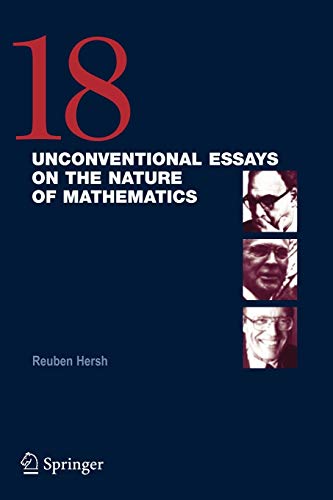
Ebook Info
- Published: 2006
- Number of pages: 348 pages
- Format: PDF
- File Size: 2.61 MB
- Authors: Reuben Hersh
Description
Collection of the most interesting recent writings on the philosophy of mathematics written by highly respected researchers from philosophy, mathematics, physics, and chemistryInterdisciplinary book that will be useful in several fields―with a cross-disciplinary subject area, and contributions from researchers of various disciplines
User’s Reviews
Editorial Reviews: Review From the reviews:”This is not a book about foundations or formal logic. It is … about the philosophy of mathematics, but perhaps more about the human practice of mathematics. … This is a terrific collection of essays. … all of the essays give us new insight into that curious thing we do when we do mathematics.” (William J. Satzer, MathDL, January, 2006)”The current book is destined to become a classic as well for numerous reasons which will soon become transparent. … Reuben Hersh is to be commended for orchestrating this masterful collection of essays from distinguished individuals … . I predict that this book will become a classic for the coming generations of mathematics philosophers as well as for mathematics educators interested in changing dominant conceptions of what is mathematics, finally!” (Bharath Sriraman, Zentralblatt für Didaktik der Mathematik, Vol. 38 (4), 2006)”Editor Reuben Hersh has orchestrated a highly provocative book, particularly for mathematicians, but also for anyone interested in the philosophy and practice of mathematics. … This is a very appealing collection of essays. … I highly recommend this book to those wondering how math is carried out, both mathematicians and laymen. I also recommend it to educators interested in changing the dominant view of math and how to do math.” (Hector Zenil, Computing Reviews, January, 2008) From the Back Cover Advance praise for 18 Unconventional Essays on the Nature of Mathematics:”I was pleasantly surprised to find that this book does not treat mathematics as dessicated formal logic but as a living organism, immediately recognizable to any working mathematician.”- Sir Michael Atiyah, University of Edinburgh”A wonderful collection of essays on the philosophy of mathematics, some by mathematicians, others by philosophers, and all having significant things to say. Most readers will be informed, some will be infuriated, but all will be stimulated.”- John H. Conway, John von Neumann Distinguished Professor of Mathematics, Princeton University This startling new collection of essays edited by Reuben Hersh contains frank facts and opinions from leading mathematicians, philosophers, sociologists, cognitive scientists, and even an anthropologist. Each essay provides a challenging and thought-provoking look at recent advances in the philosophy of mathematics, demonstrating the possibilities of thinking fresh, sticking close to actual practice, and fearlessly letting go of standard shibboleths.The following essays are included:* Alfred Renyi: Socratic Dialogue* Carlo Cellucci: Filosofia e Matematica, introduction* William Thurston: On Proof and Progress in Mathematics* Andrew Aberdein: The Informal Logic of Mathematical Proof* Yehuda Rav: Philosophical Problems of Mathematics in Light of Evolutionary Epistemology* Brian Rotman: Towards a Semiotics of Mathematics* Donald Mackenzie: Computers and the Sociology of Mathematical Proof* Terry Stanway: From G.H.H. and Littlewood to XML and Maple: Changing Needs and Expectations in Mathematical Knowledge Management* Rafael Nunez: Do Numbers Really Move?* Timothy Gowers: Does Mathematics Need a Philosophy?* Jody Azzouni: How and Why Mathematics is a Social Practice * Gian-Carlo Rota: The Pernicious Influence of Mathematics Upon Philosophy * Jack Schwartz: The Pernicious Influence of Mathematics on Science* Alfonso Avila del Palacio: What is Philosophy of Mathematics Looking For?* Andrew Pickering: Concepts and the Mangle of Practice: Constructing Quaternions* Eduard Glas: Mathematics as Objective Knowledge and as Human Practice* Leslie White: The Locus of Mathematical Reality: An Anthropological Footnote* Reuben Hersh: Inner Vision, Outer Truth About the Author REUBEN HERSH is professor emeritus at the University of New Mexico, Albuquerque. He is the recipient (with Martin Davis) of the Chauvenet Prize and (with Edgar Lorch) the Ford Prize. Hersh is the author (with Philip J. Davis) of The Mathematical Experience and Descartes’ Dream, which won the National Book Award in l983, and What is Mathematics, Really? Read more
Reviews from Amazon users which were colected at the time this book was published on the website:
⭐There are only two articles worth reading in this collection, both of which are available eslewhere at less cost. A Socratic Dialogue on Math by A. Renyi and The Locus of Mathematical Reality by L. White. Both these works should be required reading in the earliest stages of math education. They present the nature of math in easy terms and are fun to read. The rest of the articles are unexciting, uncritical and rather boring, because the authors are reluctant to rock the boat of conventional wisdom. It was surprising to see so many typos here, clear evidence that the articles were OCR-ed but not spell-checked. The short, final chapter by R. Hersh deals with the question of why mathematics, a human invention, is applicable to reality, but does not make up for a humdrum collection.
⭐Das Buch enthält 18 Essays von unterschiedlichen Autoren, die im weiteren Sinne der Philosophie der Mathematik und verwandten Gebieten gewidmet sind. Wie bei einem solchen Werk nicht anders zu erwarten, ist die Qualität dieser Essays gemischt. Da ich die Essays, die mir nicht zusagten und mir nicht so gelungen vorkamen, nicht vollständig gelesen habe, widme ich mich hier primär den gelungeneren. Allen Essays gemein ist jedoch, dass sie sich wohltuend von den klassischen Unterscheidungen von Formalisten, Intuitionisten etc. abheben. Im Essay von Carlo Celucci wird die “klassische” Philosophie der Mathematik sehr schön den moderneren Ansätzen, die sich stärker an der Realität des Mathematikbetreibens orientieren, gegenübergestellt.Eines der Highlights ist sicherlich Thurstons “On Proof and Progress in Mathematics”. Thurston, selbst ein weltberühmter Mathematiker, stellt sehr anregend dar, worum es in der Mathematik geht, nämlich viel mehr um Verstehen als um Beweise und Sätze. Angereichert sind seine Ausführungen durch interessante Reflektionen über seine eigene mathematische Laufbahn.Weitere Glanzpunkte sind die Essays von Rota und Schwartz, die “The Pernicious Influence of Mathematics upon Philosophy” und “The Pernicious Influence of Mathematics on Science” betitelt sind. Hier setzen sie sehr schön ins Licht, dass Bestrebungen, die eigene Disziplin an Mathematik als Erfolgskonzept zu orientieren, keinesfalls immer positive Ergebnisse liefern muss.Lesenswert sind auf jeden Fall zusätzlich noch “A Socratic Dialogue on Mathematics” von Renyi, “Does Mathematics Need a Philosophy” von Gowers und ein paar weitere Essays.
⭐
Keywords
Free Download 18 Unconventional Essays on the Nature of Mathematics 2006th Edition in PDF format
18 Unconventional Essays on the Nature of Mathematics 2006th Edition PDF Free Download
Download 18 Unconventional Essays on the Nature of Mathematics 2006th Edition 2006 PDF Free
18 Unconventional Essays on the Nature of Mathematics 2006th Edition 2006 PDF Free Download
Download 18 Unconventional Essays on the Nature of Mathematics 2006th Edition PDF
Free Download Ebook 18 Unconventional Essays on the Nature of Mathematics 2006th Edition