Ebook Info
- Published: 2010
- Number of pages: 429 pages
- Format: PDF
- File Size: 105.31 MB
- Authors: Reuben Hersh
Description
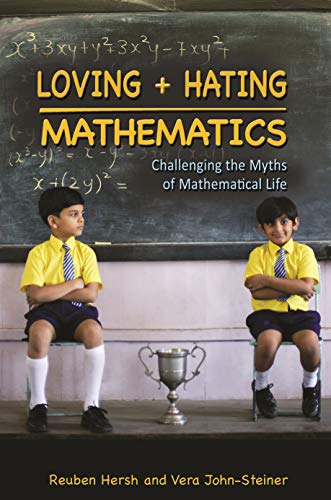
Mathematics is often thought of as the coldest expression of pure reason. But few subjects provoke hotter emotions–and inspire more love and hatred–than mathematics. And although math is frequently idealized as floating above the messiness of human life, its story is nothing if not human; often, it is all too human. Loving and Hating Mathematics is about the hidden human, emotional, and social forces that shape mathematics and affect the experiences of students and mathematicians. Written in a lively, accessible style, and filled with gripping stories and anecdotes, Loving and Hating Mathematics brings home the intense pleasures and pains of mathematical life. These stories challenge many myths, including the notions that mathematics is a solitary pursuit and a “young man’s game,” the belief that mathematicians are emotionally different from other people, and even the idea that to be a great mathematician it helps to be a little bit crazy. Reuben Hersh and Vera John-Steiner tell stories of lives in math from their very beginnings through old age, including accounts of teaching and mentoring, friendships and rivalries, love affairs and marriages, and the experiences of women and minorities in a field that has traditionally been unfriendly to both. Included here are also stories of people for whom mathematics has been an immense solace during times of crisis, war, and even imprisonment–as well as of those rare individuals driven to insanity and even murder by an obsession with math. This is a book for anyone who wants to understand why the most rational of human endeavors is at the same time one of the most emotional.
User’s Reviews
Reviews from Amazon users which were colected at the time this book was published on the website:
⭐Thirty yeas ago, Reuben Hersh and Philip J. Davis revolutionized the public (and self-) image of themathematical experience in the now classic book of that name. In the present book, Reuben Hersh andVera John-Steiner wrote an even better sequel. It should be read by anyone who relates to mathematics,either positively, negatively, or ambivalently. They very compellingly prove their point thatmathematics is a human creation, and since humans will be humans, it is full of passion,good guys, and of course bad guys (although they were a little too easy on the bad guys, and didn’t make themlook as bad, the racists (e.g. R.L. Moore), sexists, and even the murderers!)The last chapter, about mathematics education, was particularly excellent, with a plea to stop makingmathematics an artificial filter for professions where mathematics not needed. Unfortunately, theAMS/MAA would fight tooth and nail against this, and they may have some point.If mathematics would only be taught to those who love it for its own sake, we mathematicians mighthave even a harder time getting academic jobs, and that would be a pity.I wish that they would be more books like this one!
⭐The book gave me a broader, deeper picture of mathematicians than I ever got by studying equations. In a way, the book is a kind of War and Peace, not of course about Napoleon entering Russia but about the wide-ranging, emotional trials of a group of people rarely seen together in one book. I knew about early negative reactions to scientific ideas proposed by Galileo, Darwin, even Einstein, but I didn’t realize that an outstanding mathematician could be so afraid of society’s reaction if he openly disputed… a postulate of Euclid’s! OMG, so to speak, the man might have lost stature in his community. So he refused to release his results for decades and instead buried them in his notebooks, where they remained for half a century before they were in a sense exhumed by later mathematicians and contributed to Einstein’s theories.But some mathematicians were at the other end of the aggression scale. Ted Kaczynski, the Unabomber, a former mathematician, sent mail bombs that maimed or killed those he found troubling. Survivor mathematicians, jailed in wars for crimes committed or imagined, used their time in lockup to envision and extend their areas of math expertise. One, publishing a technical paper soon after his release, appended cheekily: “Research supported by the Federal Prison System.” Hah! Another, in jail, received this odd commiserating note from a colleague: “We’re not all lucky enough to sit and work undisturbed like you.”The book describes a 90-year-old mathematician rising from his deathbed to do more work upon being informed of a new development in his field, the excitement of college students who excel at math (“we would shout excitedly, or stare together at the blackboard in bewildered silence,”), and the awe of one high school student who, measuring a pendulum’s swing,realized his data when graphed formed the curve of a parabola he had learned about in algebra class. “It was as though the pendulum knew math,” he said. And who could believe that a talented 19th-century Russian woman could be turned down because of her sex to study math, do it on her own, make important contributions almost anonymously, and near the end of her life, become recognized enough to become the first woman inducted into the Russian Academy of Sciences? Like the plots of a thousand movies, this book.Then, for jaw-dropping assertion, the book — by two retired educators, imagine that — proposes not to teach math to people uninterested in it. That’s a bomb that will reverberate a long time before the appropriate response is found. The book is definitely worth a read.
⭐For anyone interested in mathematics or its sociology this is a rewarding book. Advanced mathematics is so alien to the bulk of the population that there are several myths and stereotypes about mathematicians. A major goal of the authors is to refute four of these: (1) “that mathematicians are different from other people, lacking emotional complexity;” (2) “mathematics is a solitary pursuit;” (3) “that mathematics is a young man’s game,” and (4) “mathematics is an effective filter for higher education.”The authors demonstrate that mathematicians are human beings who exhibit the full range of human qualities found in other groups and disciplines. Although the intense concentration required gives mathematical culture a unique flavor, mathematicians are usually not isolated eccentrics. They can form close personal friendships, collaborative partnerships, and sometimes even marry each other. The book discusses several examples: the mentorship of Sonia Kovalevskaya (1850–1891) by Karl Weierstrasse (1815–1897), the complicated relationship of G.H. Hardy (1877–1947) with John Littlewood (1885–1977) and Srinivasa Ramanujan (1887–1920), the friendship between the Russian mathematicians Andrei Kolmogorov (1903–1987) and P. S. Aleksandrov (1896–1982), and between Albert Einstein (1879–1955) and Kurt Godel (1906–1978), and the collaborative mathematical marriages between Grace Chisholm (1868–1944) and William Young (1863–1944), Raphael Robinson (1911–1995) and Julia Bowman (1919–1985), and Olga Taussky (1906–1995) and Richard Todd (1911–2007).But like any other group mathematicians have their share of mental distress which sometimes can lead to tragic results. Alexandre Grothendieck (b. 1928), one of the greatest mathematicians of the twentieth century, is now an isolated hermit who has rejected the mathematical community. Kurt Godel, the logician, became paranoid and starved himself to death fearing poison. John Nash (b. 1928) lost many years (but has now recovered) from schizophrenia. On a criminal level there is the Unabomber Ted Kaczynski (b. 1942), who had been a young mathematician of outstanding potential and who had held a position at Berkeley. The intense and lonely character that mathematics can have may become a destructive addiction driving those already inclined over the edge into madness.The last two chapters which deal with mathematics education are particularly interesting. Chapter 8 centers on two radically different styles of teaching. The first is the Moore method, named after Robert Lee Moore (1882–1974), a topologist at the University of Texas. In a course taught by Moore a list of theorems and definitions were presented day by day. The student was expected to prove the theorems by his or her own efforts without consulting any book. The teacher did nothing except to point out gaps in the proof. No hints were given. This was excellent training for future research, and Moore had 50 Ph.D. students, many of whom went on to distinguished careers. Six became either president or vice-president of the American Mathematical Society. Yet the Moore method also had weaknesses. Since one was forbidden to read any mathematical books , one could emerge with a Ph.D. and yet know very little mathematics. The method was especially damaging when used in standard calculus courses or with weaker students. Also, Moore held values common to his time and place. He resisted integration at the University of Texas ,refused to admit Blacks to his courses, expressed low opinions of women and Jews, and never acknowledged his six Afro-American “mathematical grandchildren.” A second method, the polar opposite of Moore’s is the “Potsdam Model” developed by Clarence Stephens (b. 1917), an Afro-American mathematician who taught at (among other places) Morgan State in Baltimore and later at SUNY, Potsdam, where he was chairman. Stephens constructed a particularly nurturing and caring learning environment for all students taking mathematics. At Potsdam more than half the students took calculus and 20% of the BA degrees were in mathematics. Compared with national statistics this was an incredible success. The authors,however, recognize that minds are structured differently so that people may exhibit the same range of interest and ability in mathematics as they do in other fields. Further, they feel that those bewailing the poor mathematical performance of US students in comparison with other countries exaggerate the economic need for academic mathematics. Very few jobs actually require it. Therefore, they oppose using mathematics as the rigid filter it now is for many of the better paying and prestigious fields.Large sections of the book explore gender and racial issues. Several female and Afro-American mathematicians are discussed along with the problems they and women and minorities generally have faced in education, employment and recognition. Particularly interesting is an account of the long but eventually successful struggle of Jenny Harrison for tenure at Berkeley.One of the authors (Hersh) is a retired research oriented mathematician. The fact that he is an “insider” who knows the way mathematics is actually practiced gives the book a feeling of authenticity.In conclusion, “Loving and Hating Mathematics” is quite well-written, requires no mathematical background, and is full of interesting observations and stories. Both mathematicians and non-mathematicians should find it insightful and enjoyable.
⭐Bought as a gift for a maths tutor, as he achieved just what the title says. My son was having difficulty with maths and a private tutor transformed him, this book sums his situation up perfectly.
⭐Excellent book. Has many details about the lives and struggles of many mathematicians.
Keywords
Free Download Loving and Hating Mathematics: Challenging the Myths of Mathematical Life in PDF format
Loving and Hating Mathematics: Challenging the Myths of Mathematical Life PDF Free Download
Download Loving and Hating Mathematics: Challenging the Myths of Mathematical Life 2010 PDF Free
Loving and Hating Mathematics: Challenging the Myths of Mathematical Life 2010 PDF Free Download
Download Loving and Hating Mathematics: Challenging the Myths of Mathematical Life PDF
Free Download Ebook Loving and Hating Mathematics: Challenging the Myths of Mathematical Life