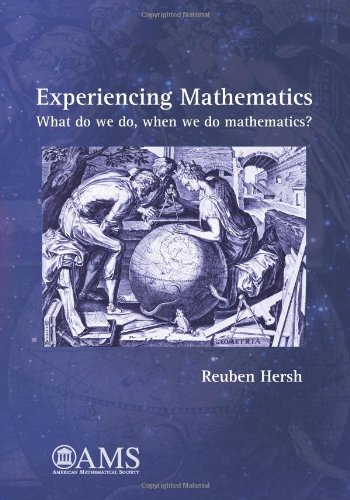
Ebook Info
- Published: 2014
- Number of pages: 282 pages
- Format: PDF
- File Size: 55.48 MB
- Authors: Reuben Hersh
Description
Most mathematicians, when asked about the nature and meaning of mathematics, vacillate between the two unrealistic poles of Platonism and formalism. By looking carefully at what mathematicians really do when they are doing mathematics, Reuben Hersh offers an escape from this trap. This book of selected articles and essays provides an honest, coherent, and clearly understandable account of mathematicians’ proof as it really is, and of the existence and reality of mathematical entities. It follows in the footsteps of Poincaré, Hadamard, and Polya. The pragmatism of John Dewey is a better fit for mathematical practice than the dominant “analytic philosophy”. Dialogue, satire, and fantasy enliven the philosophical and methodological analysis. Reuben Hersh has written extensively on mathematics, often from the point of view of a philosopher of science. His book with Philip Davis, The Mathematical Experience, won the National Book Award in science. Hersh is emeritus professor of mathematics at the University of New Mexico.
User’s Reviews
Editorial Reviews: Review The question “What am I doing?” haunts many creative people, researchers, and teachers. Mathematics, poetry, and philosophy can look from the outside sometimes as ballet en pointe, and at other times as the flight of the bumblebee. Reuben Hersh looks at mathematics from the inside; he collects his papers written over several decades, their edited versions, and new chapters in his book Experiencing Mathematics, which is practical, philosophical, and in some places as intensely personal as Swann’s madeleine. –Yuri Manin, Max Planck Institute, Bonn, GermanyWhat happens when mid-career a mathematician unexpectedly becomes philosophical? These lively and eloquent essays address the questions that arise from a crisis of reflectiveness: What is a mathematical proof and why does it come after, not before, mathematical revelation? Can mathematics be both real and a human artifact? Do mathematicians produce eternal truths, or are the judgments of the mathematical community quasi-empirical and historically framed? How can we be sure that an infinite series that seems to converge really does converge? This collection of essays by Reuben Hersh makes an important contribution. His lively and eloquent essays bring the reality of mathematical research to the page. He argues that the search for foundations is misleading, and that philosophers should shift from focusing narrowly on the deductive structure of proof, to tracing the broader forms of quasi-empirical reasoning that star the history of mathematics, as well as examining the nature of mathematical communities and how and why their collective judgments evolve from one generation to the next. If these questions keep you up at night, then you should read this book. And if they don’t, then you should read this book anyway, because afterwards, they will! –Emily Grosholz, Department of Philosophy, Penn State, Pennsylvania, USA… I found the author’s arguments powerful and compelling, and conveyed with great clarity and concision. … It is refreshing to occasionally step back and talk about mathematics rather than doing it, and this book provides solid rhetorical ammunition. –LMS Newsletter About the Author Reuben Hersh is emeritus professor of mathematics at the University of New Mexico, USA.
Reviews from Amazon users which were colected at the time this book was published on the website:
⭐A new and probably novel approach towards mathematics and its philosophy. Professor Hersh is suggesting a different philosophy of mathematics which he calls it “Philosophy of Mathematical Practice.” He is not rejecting the philosophy of mathematics in the classical sense, but he believes with good justifications that current philosophy of mathematics has nothing to do with the practice of mathematics. So it has very limited significance to most people including mathematicians, scientists, and engineers or people who are “doing/developing” math all the time.In a sense, his method in analysis falls in between phenomenology and pragmatism. Phenomenology, as practiced by Husserl, Heidegger, and others, is a fascinating way of seeing mathematics and its philosophy. Since everything that we perceive, comprehend and do, happens in our field of consciousness (whatever it is) or there is always a “thing” like being there as a subjective experience, and Mathematics is part of our “Lebenswelt” or “living-world” as Husserl put it (at least for mathematicians). Therefore it is subject to phenomenological analysis. I personally always had a lot of problems with these questions like “what it means to BE a mathematician?” or “what it is like to practice mathematics?”. Questions like this are all phenomenological in nature. The tricky thing about these problems is the fact that you either know the answer and cannot communicate it properly or the other way around.The book also has a lot of amusing articles. Like the story of the marriage of Logic and Geometry which I laughed my head off! In general, I think this book delivered what it had promised. The language of the book is, to me, another strength, down to earth and honest.
⭐A wonderful and readable account for what mathematicians do.A philosophical/sociological/phenomenological account of mathematics that would make a great crucial companion along with a more technical oriented survey of math book: Russian schools Mathematics: It’s Content. Methods, and Meaning
⭐A clear presentation of mathematics as socially constructed, and very well and amusingly written.
Keywords
Free Download Experiencing Mathematics: What Do We Do, When We Do Mathematics? in PDF format
Experiencing Mathematics: What Do We Do, When We Do Mathematics? PDF Free Download
Download Experiencing Mathematics: What Do We Do, When We Do Mathematics? 2014 PDF Free
Experiencing Mathematics: What Do We Do, When We Do Mathematics? 2014 PDF Free Download
Download Experiencing Mathematics: What Do We Do, When We Do Mathematics? PDF
Free Download Ebook Experiencing Mathematics: What Do We Do, When We Do Mathematics?