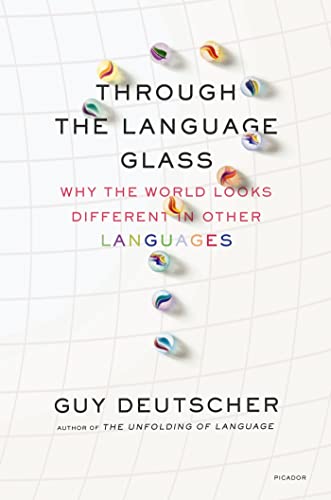
Ebook Info
- Published: 2011
- Number of pages: 320 pages
- Format: PDF
- File Size: 1.98 MB
- Authors: Guy Deutscher
Description
A New York Times Editor’s ChoiceAn Economist Best Book of 2010A Financial Times Best Book of 2010A Library Journal Best Book of 2010The debate is ages old: Where does language come from? Is it an artifact of our culture or written in our very DNA? In recent years, the leading linguists have seemingly settled the issue: all languages are fundamentally the same and the particular language we speak does not shape our thinking in any significant way. Guy Deutscher says they’re wrong. From Homer to Darwin, from Yale to the Amazon, and through a strange and dazzling history of the color blue, Deutscher argues that our mother tongues do indeed shape our experiences of the world. Audacious, delightful, and provocative, Through the Language Glass is destined to become a classic of intellectual discovery.
User’s Reviews
Editorial Reviews: Review “Fascinating reading.… Deutscher does not merely weave little-known facts into an absorbing story. He also takes account of the vast changes in our perceptions of other races and cultures over the past two centuries.” ―Derek Bickerton, The New York Times Book Review“An informative, pleasurable read… A gifted writer, Deutscher picks his way nimbly past overblown arguments to a sensible compromise.” ―Amanda Katz, The Boston Globe“A thrilling and challenging ride.” ―Christopher Schoppa, The Washington Post“Brilliantly surveys the differences words and grammar make between cultures.” ―Carlin Romano, The Chronicle of Higher Education“A most entertaining book, easy to read but packed with fascinating detail.” ―Michael Quinion, World Wide Words“Through The Language Glass is so robustly researched and wonderfully told that it is hard to put down… Deutscher brings together more than a century’s worth of captivating characters, incidents, and experiments that illuminate the relationship between words and mind… He makes a convincing case for the influence of language on thought, and in doing so he reveals as much about the way color words shape our perception as about the way that scientific dogma and fashion can blind us.” ―Christine Kenneally, New Scientist“Entertainingly written and thought-provoking… Deutscher has a talent for making scientific history read like an engrossing adventure… I recommend this intelligent and engaging book to anyone seeking an introduction to the relationship between language, thought, and culture.” ―Margery Lucas, PsycCritiques“This fabulously interesting book describes an area of intellectual history replete with brilliant leaps of intuition and crazy dead-ends. Guy Deutscher, who combines enthusiasm with scholarly pugnacity, is a vigorous and engaging guide to it… A remarkably rich, provocative, and intelligent work.” ―Sam Leith, The Sunday Times (UK)“A brilliant account of linguistic research over two centuries… As befits a book about language, this inspiring amalgam of cultural history and science is beautifully written.” ―Clive Cookson, Financial Times (UK)“A delight to read.” ―Christopher Howse, The Spectator (UK)“Fascinating and well written… Deutscher’s scholarly and eloquent prose made the book an enjoyable read and I learnt lots of great anecdotes along the way.” ―Alex Bellos, The Guardian (UK)“Deutscher writes as clearly and engagingly as can be… Will this study of language make you giddy? Oh, absolutely.” ―Craig Brown, The Mail on Sunday (UK)“Jaw-droppingly wonderful… A marvelous and surprising book. The ironic, playful tone at the beginning gradates into something serious that is never pompous, something intellectually and historically complex and yet always pellucidly laid out. It left me breathless and dizzy with delight.” ―Stephen Fry, presenter of Stephen Fry in America, host of QI, and author of Moab Is My Washpot“At once highly readable and thoroughly learned… Here is an important and original new history of the struggle to understand how language, culture, and thought are connected.” ―Joan Bybee, Distinguished Professor of Linguistics, University of New Mexico About the Author Guy Deutscher is the author of The Unfolding of Language and Through the Language Glass. Formerly a fellow of St. John’s College, Cambridge, and of the Department of Ancient Near Eastern Languages at the University of Leiden in the Netherlands, he is an honorary research fellow at the School of Languages, Linguistics and Cultures at the University of Manchester. He lives in Oxford, England. Excerpt. © Reprinted by permission. All rights reserved. PROLOGUE Language, Culture, and Thought “There are four tongues worthy of the world’s use,” says the Talmud: “Greek for song, Latin for war, Syriac for lamentation, and Hebrew for ordinary speech.” Other authorities have been no less decided in their judgment on what different languages are good for. The Holy Roman Emperor Charles V, king of Spain, archduke of Austria, and master of several Europe an tongues, professed to speaking “Spanish to God, Italian to women, French to men, and German to my horse.”A nation’s language, so we are often told, reflects its culture, psyche, and modes of thought. Peoples in tropical climes are so laid-back it’s no wonder they let most of their consonants fall by the wayside. And one need only compare the mellow sounds of Portuguese with the harshness of Spanish to understand the quintessential difference between these two neighboring cultures. The grammar of some languages is simply not logical enough to express complex ideas. German, on the other hand, is an ideal vehicle for formulating the most precise philosophical profundities, as it is a particularly orderly language, which is why the Germans have such orderly minds. (But can one not hear the goose step in its gauche, humorless sounds?) Some languages don’t even have a future tense, so their speakers naturally have no grasp of the future. The Babylonians would have been hard-pressed to understandCrime and Punishment, because their language used one and the same word to describe both of these concepts. The craggy fjords are audible in the precipitous intonation of Norwegian, and you can hear the darkl’s of Russian in Tchaikovsky’s lugubrious tunes. French is not only a Romance language but the language of romance par excellence. English is an adaptable, even promiscuous language, and Italian—ah, Italian!Many a dinner table conversation is embellished by such vignettes, for few subjects lend themselves more readily to disquisition than the character of different languages and their speakers. And yet should these lofty observations be carried away from the conviviality of the dining room to the chill of the study, they would quickly collapse like a soufflé of airy anecdote— at best amusing and meaningless, at worst bigoted and absurd. Most foreigners cannot hear the difference between rugged Norwegian and the endless plains of Swedish. The industrious Protestant Danes have dropped more consonants onto their icy windswept soil than any indolent tropical tribe. And if Germans do have systematic minds, this is just as likely to be because their exceedingly erratic mother tongue has exhausted their brains’ capacity to cope with any further irregularity. English speakers can hold lengthy conversations about forthcoming events wholly in the present tense (I’m flying to Vancouver next week . . . ) without any detectable loosening in their grip on the concepts of futurity. No language—not even that of the most “primitive” tribes—is inherently unsuitable for expressing the most complex ideas. Any shortcomings in a language’s ability to philosophize simply boil down to the lack of some specialized abstract vocabulary and perhaps a few syntactic constructions, but these can easily be borrowed, just as all Europe an languages pinched their verbal philosophical tool kit from Latin, which in turn lifted it wholesale from Greek. If speakers of any tribal tongue were so minded, they could easily do the same today, and it would be eminently possible to deliberate in Zulu about the respective merits of empiricism and rationalism or to hold forth about existentialist phenomenology in West Greenlandic.If musings on nations and languages were merely aired over aperitifs, they could be indulged as harmless, if nonsensical, diversions. But as it happens, the subject has also exercised high and learned minds throughout the ages. Philosophers of all persuasions and nationalities have lined up to proclaim that each language reflects the qualities of the nation that speaks it. In the seventeenth century, the Englishman Francis Bacon explained that one can infer “significant marks of the genius and manners of people and nations from their languages.” “Everything confirms,” agreed the Frenchman étienne de Condillac a century later, “that each language expresses the character of the people who speak it.” His younger contemporary, the German Johann Gottfried Herder, concurred that “the intellect and the character of every nation are stamped in its language.” Industrious nations, he said, “have an abundance of moods in their verbs, while more refined nations have a large amount of nouns that have been exalted to abstract notions.” In short, “the genius of a nation is nowhere better revealed than in the physiognomy of its speech.” The American Ralph Waldo Emerson summed it all up in 1844: “We infer the spirit of the nation in great measure from the language, which is a sort of monument to which each forcible individual in a course of many hundred years has contributed a stone.”The only problem with this impressive international unanimity is that it breaks down as soon as thinkers move on from the general principles to reflect on the particular qualities (or otherwise) of particular languages, and about what these linguistic qualities can tell about the qualities (or otherwise) of particular nations. In 1889, Emerson’s words were assigned as an essay topic to the seventeen-year-old Bertrand Russell, when he was at a crammer in London preparing for the scholarship entrance exam to Trinity College, Cambridge. Russell responded with these pearls: “We may study the character of a people by the ideas which its language best expresses. French, for instance, contains such words as ‘spirituel,’ or ‘l’esprit,’ which in English can scarcely be expressed at all; whence we naturally draw the inference, which may be confirmed by actual observation, that the French have more ‘esprit,’ and are more ‘spirituel’ than the English.”Cicero, on the other hand, drew exactly the opposite inference from the lack of a word in a language. In hisDe oratore of 55 bc, he embarked on a lengthy sermon about the lack of a Greek equivalent for the Latin wordineptus (meaning “impertinent” or “tactless”). Russell would have concluded that the Greeks had such impeccable manners that they simply did not need a word to describe a nonexistent flaw. Not so Cicero: for him, the absence of the word was a proof that the fault was so widespread among the Greeks that they didn’t even notice it. The language of the Romans was itself not always immune to censure. Some twelve centuries after Cicero, Dante Alighieri surveyed the dialects of Italy in hisDe vulgari eloquentia and declared that “what the Romans speak is not so much a vernacular as a vile jargon . . . and this should come as no surprise, for they also stand out among all Italians for the ugliness of their manners and their outward appearance.”No one would dream of entertaining such sentiments about the French language, which is not only romantic andspirituel but also, of course, the paragon of logic and clarity. We have this on no lesser authority than the French themselves. In 1894, the distinguished critic Ferdinand Brunetière informed the members of the Académie française, on the occasion of his election to this illustrious institution, that French was “the most logical, the clearest, and the most transparent language that has ever been spoken by man.” Brunetière, in turn, had this on the authority of a long line of savants, including Voltaire in the eighteenth century, who affirmed that the unique genius of the French language was its clearness and order. And Voltaire himself owed this insight to an astonishing discovery made a whole century earlier, in 1669, to be precise. The French grammarians of the seventeenth century had spent decades trying to understand why it was that French possessed clarity beyond all other languages in the world and why, as one member of the Académie put it, French was endowed with such clarity and precision that simply translating into it had the effect of a real commentary. In the end, after years of travail, it was Louis Le Laboureur who discovered in 1669 that the answer was simplicity itself. His painstaking grammatical researches revealed that, in contrast to speakers of other languages, “we French follow in all our utterances exactly the order of thought, which is the order of Nature.” No wonder, then, that French can never be obscure. As the later thinker Antoine de Rivarol put it: “What is not clear may be English, Italian, Greek, or Latin” but “ce qui n’est pas clair n’est pas français.” Not all intellectuals of the world unite, however, in concurring with this analysis. Equally distinguished thinkers— strangely enough, mostly from outside France—have expressed different opinions. The renowned Danish linguist Otto Jespersen, for example, believed that English was superior to French in a whole range of attributes, including logic, for as opposed to French, English is a “methodical, energetic, business-like and sober language, that does not care much for finery and elegance, but does care for logical consistency.” Jespersen concludes: “As the language is, so also is the nation.” Read more
Reviews from Amazon users which were colected at the time this book was published on the website:
⭐This seems to be worth 4.99 stars for content and I would round up to 6.0 (if possible) for Deutscher’s style and humor, even if the content were not as good. This is an excellent introduction to the current state of investigation of the relationship between thought and language. While there are no in-line references, the Notes section in the back of the book provides references to the 19 page Bibliography ( 300 entries).I do have a few minor gripes that I want to get off my chest.1) I feel that Deutscher presents Whorf’s most extreme position -almost a caricature. Whorf was an M.I.T. graduate in Chemical Engineering whose entire career was as a safety engineer for The Hartford Fire Insurance Company. Linguistics was his avocation. Whorf died at the age of 44 and many of his papers were published by his friends and colleagues after his death. We cannot know what changes he might have made prior to publication had he lived. His defenders point out that his written statements include many more moderate statements of position; indeed it is difficult to discern the exact limits of his position. In fairness to Deutscher, personifying the extreme position seems to be an effective pedagogical technique, and Whorf did take extreme positions at times.I consider myself a moderate Whorfian; I find the most succinct expression of my position is an adaptation of the astrologer’s formulation concerning the stars: “Languages impel, they do not compel.” Perhaps one attribute of genius is the ability to overcome the impulses and promptings of language. This leads to an expansion of the language that permits non-geniuses to share in the genius’ insight. And, this provides the mechanism by which we all augment our cognitive toolboxes and “stand on the shoulders of giants”.2) Deutscher gives an excellent explanation of “factive vs. non-factive verbs” (P-150). He uses this to support his claim that people can learn new concepts that were not previously present in their individual languages and to argue that therefore language does not constrain thought.HOWEVER, before Deutscher explained the concept I would not have realized verbs could be categorized in that manner. Now I do. Previously, I would never have thought of that characteristic when analyzing a verb; in the future I shall. Now that Deutscher has expanded my language by adding the concept of factive, my language is different and I think differently. Deutscher’s argument has actually confirmed Whorf! -moderately!3) Although Deutscher writes excellent English, it is not his native language and in a couple of cases he seems to lack a native speaker’s feel for the Whorfian underpinnings and nuances of English.Deutscher asks “Or think about it another way, when you ask someone …something like `are you coming tomorrow?’ do you feel your grasp of futurity is slipping?” (PP. 145 -6)When I compare “Are you coming tomorrow?” with “Will you come tomorrow?” I feel, in the first case the query asks: “Is it your current intention to come tomorrow?” and in the second “Do you believe your plans and external circumstances will result in your coming tomorrow?” The first one is rooted in the present, the second in the future. I will accept that this has elements of connotation vs. denotation, but the language still impels me to address either the present state of affairs or the future. I will also grant that the answer to the first might be “I intend to come, but it looks like the creek’s going to rise and I may not be able to get across the ford with my old car.”, but that is a different matter -providing as much information as is necessary for the purposes of the exchange. (H.P. Grice’s Maxim of Quantity). Language does not compel me to ignore the future, it merely nudges me. Perhaps being a native English-speaker leads me to see nuances second-language speakers do not. (And, by the way, I used futurity will twice, when I was really speaking about the present, to indicate a concession -“I will accept.”) I just heard a Yale Economist speculating that the reason the Germans save for the future is that they habitually use the present tense for future events: Es regnet am Morgen (literally “It rains tomorrow” for English “It’s going to rain tomorrow.” Or “It will raan tomorrow.”As Hebrew has gender (Masc. Fem. Neu.) for all nouns, Deutscher finds the use of he or she to be “poetic” and even “arch” for English nouns that are normally neuter. He has not met the farmer, miner or assembly line worker whose favorite rifle or tool is a she, or tried calling someone’s household pet or favorite horse “it”. I have heard computer programmers describe the operation of a piece of software as “he wants to …”. I have a 24-year old sports car that has acquired personhood over the years, as have some of the quirkier computers I’ve worked on. I also must wonder whether a native speaker of a language with two genders (e.g. Spanish) would find this natural or “arch”? -or a native speaker of two languages with contradictory genders?However, when everything is considered this book has my highest recommendation for style, content and humor -every star amazon will allow!
⭐I guess it is considered somewhat of a cliche when people use differences in language to talk about differences in cognition. Not being a linguist by training I did not realize that the idea that language influences perception and cognition had been “refuted” within the field of linguistics. This book revisits the idea that language influences thought processes. It uses several specific examples of how differences in color gradients, gender description and handedness can impact peoples cognition in a very real sense.The book starts with a study of color. It takes arguments from 1.5 centuries ago about the lack of color in Homer’s Illiad to construct a framework for analysing how differences in color recognition manifest themselves. This was news to me personally, I had no idea (naively) ancient peoples did not have the same descriptions of colors as we do today. The book then goes into Whorf and his theory of language and thought and the hyperbolic conclusions Whorf drew on scant evidence. The author is very keen to distance himself from Whorf’s lines of reasoning. The author describes studies aboud differing cultures and their distinctions of colors and also the progression of color recognition (ie red is the first color to be recognized) and then about how differeng color boundaries exist from culture to culture. In particular it is argued that as long as color distinctions are logical in the context of speech there is no reason to have blue green boundary at some well defined points.The book also describes aboriginal cultures who use an orientation of fixed coordinate systems, ie N/S/E/W vs that of most of us, which is left right. Examples of differing cognition is demonstrated pictorally by including the reader in psychological games where the reader is told to spot the difference (which seems obvious) only to be told the aboriginal culture sees it differently (due to orientation). In addition the memories of such people reflect a different knowledge base than of the way many of us remember things.The author uses a final example of how the gender of objects in many languages can affect perception. The authors ideas are backed up by linguistic statistical studies of tests on whether the genderization of nouns affects their thoughts.Through the Language glass goes through the history of linguist’s theory of language and is careful to point out flaws in historic reasoning about language and cognition. In particular the authors main point is that language does not impact capacity for thought and any average individual is capable of framing thoughts in the capacity of some other language but that does not change the fact that language can still impact perception. Not being a linguist by any means this doesnt seem contentious to me. I dont see how people shouldnt think that language, as a means of communication, doesnt impact the way a user thinks themselves… We all need a definitions and logic chains to come to conclusions and both definitions and logic chains can have uniqueness in languages. The book can be read by all, though I think those who are more of a blank slate to the subject will be less critical of the conclusions which seem pretty intuitive in the first place.
⭐In general I found this a useful and interesting read, though perhaps not quite up to “The unfolding of language”.I didn’t find the book particularly overlong nor Deutscher’s language too verbose (I’ve come across far worse), and perhaps there was too much on colour and not enough on gender or other language differences. That said, the journey was perhaps more interesting than the destination. Of course our language affects the way we think: language is part of our culture and our culture certainly has an impact on our social mores. The converse is also true: changes in our culture will effect changes in our language. Foreign words are adopted to discuss new ideas, the uses of gender are modified, new words are created by the “pop” generation, new poetries are invented.Investigation of the impact of language on culture could be investigated by studying bilingual children, for instance do they choose which language to use for a specific task?Deutscher thinks we should be surprised that the English concept of “we” can have multiple words in other languages. I don’t find this surprising as “we” is so often ambiguous: does it or does it not include the person being spoken to? Multiple words for “I” might be more interesting.Homer’s use of colour is superficially strange, but we also use colour in very poetic ways: from Coleridge’s Rime of the ancient mariner we have “All in a hot and copper sky, The bloody Sun at noon, Right up above the mast did stand, No bigger than the Moon”. And there’s a wonderful line from Tom Jones’s Delilah, “Her golden lips like cherries”. In discussing colours Deutscher perhaps misses a trick: colour has a well-defined scientific meaning, however I think a popular language definition of colour would be difficult. Does “colour” have the same meaning in all languages?I found it interesting that some colours were named before others, with “blue” being relatively recent and I’m dying to ask my grandchildren if they can identify the sky as blue. Deutscher states that the bible makes no direct mention of blue, however the colours turquoise (techelet, (תכלת, purple, and scarlet are mentioned in Exodus 25:4 and in many of the following verses. Also in Numbers 15:38 is the commandment to wear turquoise “tzizit” (fringed garment). There is an interesting Wikipedia article on techelet: the exact colour of techelet is not known and might be any colour from midnight blue to turquoise.My guess is that detailed colour naming happens on demand, for instance when people start to use pigments for dying clothes or in art. Ascribing names to colours by hue is only one option. Even in English we use value and saturation: brown is orange with a lower colour value, and white through grey through black represents a change in value. Pink, on the other hand, is a desaturated red. The appendix provided a useful primer on colour vision: I hadn’t realised how close the frequency responses of the “red” and “green” cones were to each other and how much they overlapped.I like Deutscher’s argument that whilst any language can be used to express any idea (Turing complete, anyone?), languages vary in what they require is expressed. Take the sentence “a neighbour visited him”: French and many other languages would reveal the sex of the neighbour. Hungarian (and Finish) and other languages would not reveal the sex of the subject (male in this example). In Chinese the tense can be omitted so we would have no notion of when the visit happened. In the Matse language the tense reveals how recently the visit occurred and how certain the reporter was about the event.Deutscher clarifies the distinction between gender and sex. The former just means type or genus, and is used to classify nouns; the latter reflects an animal’s physical characteristics (technically the female animal provides eggs, the male provides sperm: with the difference between egg and sperm being solely a matter of the cell size).Why does English not have gendered nouns? In general language simplification is a consequence of invasion resulting in Pidgin and then a Creole. English did have three genders, but these were lost following the Norman conquest.Overall, a useful book.
⭐I’m about half way through… What a read!If I learned anything already it would be that culture doesn’t have the power to make you blind, but it has the power to make you indifferent, and the way this book is written let’s you see how that works within the language we speak.It challenges a lot of preconceptions about language and grammar between cultures. Its also very inspiring and informative, pulls out a lot or raw data and reexamins possible biases in interpretation and therefore also their alternative conclusions.Ridiculing some opinions in the fashion of “as it was when people thought the other thing”, sounds genuine at first, and seems to be there only to appeal to both sides, but gets a bit annoying.Well worth a read!
⭐A very interesting book severely let down by the writer’s verbose style. He could lose one quarter of the word count by employing a good editor – and the book would be immeasurably improved.
⭐Guy Deutscher has written a magisterial study of language that shows that it is not the product of biological evolution but cultural development. Moreover, he introduces the reader to languages that overturn the prejudices of speakers of English and other global languages. His writing is clear and not without humor. I found myself astonished several times, even though I have written articles and books whose arguments rest upon language as a human cultural artifact. One precious gift of this book is the peeks at fast-disappearing languages that have very different ways of expression that are much more sophisticated than English or French. It deserves a very wide readership.
⭐It’s very good, and I enjoyed reading it, though it’s hard work remembering all the technicalities, language, (dictionary and internet access necessary, to look up all the words I don’t use). While reading, i marvelled at how much information there is in this book. Chapo senor ! Learnt a lot, and retained none of it. The last chapter was just impossible to get through, the language, structure, and reasoning – impossible to make sense off.Duetscher just got too showy offy.
Keywords
Free Download Through the Language Glass: Why the World Looks Different in Other Languages in PDF format
Through the Language Glass: Why the World Looks Different in Other Languages PDF Free Download
Download Through the Language Glass: Why the World Looks Different in Other Languages 2011 PDF Free
Through the Language Glass: Why the World Looks Different in Other Languages 2011 PDF Free Download
Download Through the Language Glass: Why the World Looks Different in Other Languages PDF
Free Download Ebook Through the Language Glass: Why the World Looks Different in Other Languages