

Ebook Info
- Published: 2009
- Number of pages: 388 pages
- Format: PDF
- File Size: 3.73 MB
- Authors: Jean-Louis Dessalles
Description
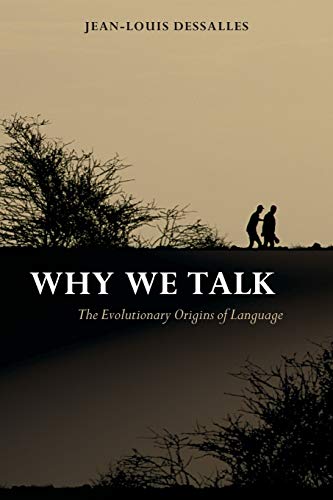
Jean-Louis Dessalles explores the co-evolutionary paths of biology, culture, and the great human edifice of language, linking the evolution of the language to the general evolutionary history of humankind. He provides searchingly original answers to such fundamental paradoxes as to whether we acquired our greatest gift in order to talk or so as to be able to think, and as to why human beings should, as experience constantly confirms, contribute information for the well-being of others at their own expense and for no apparent gain: which if this is one of language’s main functions appears to make its possession, in Darwinian terms, a disadvantage. Dr Dessalles looks for solutions in the early history of human species and considers the degree to which language evolved as a means of choosing profitable coalition partners and maximizing individual success within a competitive social environment. The author opens with a discussion of the differences between animal and human communication and the biological foundations of language. He looks at the physiological preconditions for language evolution and the early evolution of meaning and communication. He then embarks on an important and original account of the natural history of conversation. Here he considers the roles of language in supporting social cohesion and information exchange. This challenging and original account will appeal to all those interested in the origins of language and the evolution of human behaviour.
User’s Reviews
Editorial Reviews: About the Author Jean-Louis Dessalles is Associate Professor at Telecom ParisTech, where he organized the Third International Conference on the Evolution of Language in 2000. He is author of L’ordinateur génétique, Aux Origines du langage and La pertinence et ses origines, all published by Hermès-Science. He has published numerous articles in English and French on cognitive science, communication, and language evolution. James Grieve is an Emeritus Reader at The Australian National University, Canberra. His major translations include works on autism, language and linguistics, myrmecology, Lacour-Gayet’s Histoire de l’Australie, books for children, and two parts of Proust’s À la recherche du temps perdu. He has published a Dictionary of Contemporary French Connectors and two novels for Young Adults .
Reviews from Amazon users which were colected at the time this book was published on the website:
⭐This is definitely one of the best books on language produced within the perspective of evolutionary science. The author skilfully combines a number of disciplines, including biology, semantics, linguistics, computational science, and ethology among others, to present an original hypothesis concerning the evolutionary causes of the development of key human attribute, the use of language.I consider the book especially worthy of reading primarily because of a very original and inspiring account of the element of meaning: Dessalles emphasizes that the element of meaning is produced in any language through two key mechanisms: one is the mechanism of scenic expression, or representation; and another is the mechanism of thematic segmentation which reflects a more abstract structure that allows the speaker/hearer to focus on logical and syntactical relations between words. He has, in my view, managed to demonstrate to a sufficient extent that the latter mechanism can be explained only by considering the use of language in an argumentative mode. Actually, to Dessalles argumentative mode is the key characteristics of human languages, in contrast to protohuman, that evolved out of the need to check and detect lies (see in particular the table 16.1 on page 333).However, the reader should also be aware of the fact that over the last decade Dessalles has gradually abolished his former view that the evolution of language can be explained by the reference to the status of the speakers; formerly he claimed that the use of language should be conceptualised, and that it evolved, as a kind of advertisement by which the speaker attempts to obtain a prominent social status – the speaker displays some special abilities through talk and thus earns a special social standing. However, Dessalles has changed this view – today he is more inclined to consider language as simply a device to form social coalitions by talking relevantly. This change in approach is reflected in this book, but rather slightly, in its Afterword. Also, Dessalles is today probably much more inclined to treat the role of hearer, who needs to check and detect inconsistencies in the speaker’s verbal presentations of relevance, as very significant. In fact I would go as far as saying that Dessalles today views language as a medium through which both speakers and hearers negotiate, based on joint skills, some political coalitions to primarily avert some political/social dangers.How does Dessalles depict those dangers? His idea is that language skills became very important and prominent when the use of primitive weapons enabled some individuals to kill, or endanger, others. Language developed primarily out of the need to counter successfully such situations.Of course, I do not believe that we should take this mono-causal ‘story’ as a full depiction, and I think Dessalles may be a bit naive in his belief that we should take it so. But, it is a very pertinent, though not full story, and it is verifiable and very encouraging to further scholarly analysis. Secondly, I find the author’s emphasis on the role of the speaker a bit overdrawn. On some pages he seems to suggest that there are two distinct groups of speakers and hearers who draw different benefits, and make different investments, into the process of talk. Hence, in the author’s view, the need to explain the ‘paradoxical nature’ of the speaker’s motivation at talk. I do not think that the author presents a plausible view in this particular regard. It is impossible to find the speaker who does not do hearing, and the alleged fact that people compete for speaking, and nearly fully neglect their role of hearer/listener, is a kind of mystery to me in Dessalles’ analysis. But, overall, the book is very good, with a clear and succinct style, written with obvious enjoyment and analytical mastery. I have not a single moment regretted for having bought it.
Keywords
Free Download Why We Talk: The Evolutionary Origins of Language (Oxford Studies in the Evolution of Language) in PDF format
Why We Talk: The Evolutionary Origins of Language (Oxford Studies in the Evolution of Language) PDF Free Download
Download Why We Talk: The Evolutionary Origins of Language (Oxford Studies in the Evolution of Language) 2009 PDF Free
Why We Talk: The Evolutionary Origins of Language (Oxford Studies in the Evolution of Language) 2009 PDF Free Download
Download Why We Talk: The Evolutionary Origins of Language (Oxford Studies in the Evolution of Language) PDF
Free Download Ebook Why We Talk: The Evolutionary Origins of Language (Oxford Studies in the Evolution of Language)