Ebook Info
- Published: 2010
- Number of pages: 372 pages
- Format: PDF
- File Size: 4.16 MB
- Authors: Guy Deutscher
Description
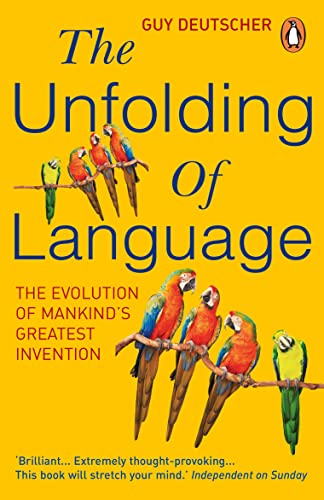
A persuasive and beautifully written take on how languages are constantly evolving… an enthralling read about human psychology and anthropology as well as linguistics.’ ALEX BELLOS___________________________________’Language is mankind’s greatest invention – except of course, that it was never invented’. So begins Guy Deutscher’s fascinating investigation into the evolution of language. No one believes that the Roman Senate sat down one day to design the complex system that is Latin grammar, and few believe, these days, in the literal truth of the story of the Tower of Babel. But then how did there come to be so many languages, and of such elaborate design? If we started off with rudimentary utterances on the level of ‘man throw spear’, how did we end up with sophisticated grammars, enormous vocabularies, and intricately nuanced shades of meaning?Drawing on recent, groundbreaking discoveries in modern linguistics, Deutscher exposes the elusive forces of creation at work in human communication. Along the way, we learn why German maidens are neuter while German turnips are female, why we have feet not foots, and how great changes in pronunciation may result from simple laziness…_____________________’Powerful and thrilling’ SPECTATOR’Really ought to be read by anyone who persists in complaining that the English language is going to the dogs’ SUNDAY TELEGRAPH’I was enthralled’ A.S. Byatt, for GUARDIAN ‘Books of the Year”Highly original… clever and convincing… this book will stretch your mind’ INDEPENDENT ON SUNDAY’Fascinating’ BOSTON GLOBE
User’s Reviews
Reviews from Amazon users which were colected at the time this book was published on the website:
⭐Answered many questions i have had for years about the ongoing genesis and basic nature of language. Top flight here!
⭐Deutscher is a scholar, educated at Cambridge. He is knowledgeable in a wide range of languages from different language groups, e.g, from Niger-Congo to Medieval Chinese, from Cushitic (Somalia) to Berber and Semitic languages. This book is well-written, not in a ponderous style, but it is loaded with material and hence is more challenging than a relaxing mystery novel. But for those interested in the development of languages, it is well worth it. As he says, “make yourself a strong cup of coffee, and read on.”Pros:* He does not make assertions without evidence. He clearly distinguishes what is knowable, what is not.* He provides the viewpoints of other scholars. Estimates for language origins range from 40kya years ago to as much as 1.4mya.* We do not know when language began. His focus is on how language could have began and on how languages continue to change.* Some examples: the change in word consonants, first systemized by one of the Brothers Grimm. And why the spelling of words differs from how words are pronounced today.I have read a number of books on the evolution of language, and this is by far the best one I have come across.
⭐I’ve read a goodly amount of material on linguistics, so I expect each new book to go over much the same ground as previous books, but this one took me by surprise — it’s chock full of new and interesting ideas. Other reviewers have already explained the basic structure of the book; allow me to offer some of the tidbits that stuck to my mind:1. The concept of erosion. People always shorten words, cut off consonants, simplify vowels. His working example, and an excellent one it is, is “gonna”, an eroded form of “going to”. Erosion wears down words to the point that they start to lose expressiveness, at which point people tack on something else to clarify their meaning. He presents one case of a French word; I can’t recall the details but here’s an analogy: suppose that “gonna” someday gets eroded to ‘gon’ and later to ‘g’. At some point, people will need to flesh it out, so perhaps they’ll tack ‘will’ onto it to get ‘gwill’, which in turn might get eroded down to ‘gill’. And so on and on and on. Many of the words in our language are eroded, compressed, multi-layer fossils of much longer original expressions.2. Complementing erosion is back-formation, a process by which people extend patterns in the language to other words. One example might be the child who says, “I goed with mommy.” The trick is, there are lots of patterns scattered all through the language, and ofttimes a pattern can be recruited to a word when that word has been dangerously eroded. This is especially likely when two words are similar in pronunciation. “sing sang sung” leads to “ring rang rung” — but should past tense of the fairly new verb “wing” be “winged” or “wang” or “wung”? With so many patterns to choose from, there’s always grist for language change.3. He starts off with a delightful point on the common plaint that English is going to hell, that people nowadays don’t know how to use it properly, how just 30 years ago the language was so much more pristine. He presents a modern quote to this effect; then another quote from 30 years ago saying the same thing; then another quote from 30 years before that saying the same thing; and so on all the way back to 1620. The more things change, the more they stay the same.4. I was particularly impressed by his explanation of how the weird Semitic word system (every word has a root of three consonants, and the vowels that are filled in specify its gender, case, number, and so forth.) He starts by pointing out that this system is too intricate, too well-ordered, to have simply arisen by chance. Or is it? He proceeds to demonstrate just how it could have happened using erosion and back-formation.5. Vowel coloring. This is another concept that I had seen mentioned but never explained. Some vowels can affect vowels near them in a word. The example he gives is the Germanic “gest”, whose plural was “gestiz”. [I’m probably screwing up the spelling here.] The ‘i’ in the plural form “colored” the ‘e’ and caused it to shift into an ‘a’. Later on, the ‘iz’ was eroded down to a schwa (spelled as an ‘e’, but pronounced as a short “uh”). Thus, the singular is “Gest” but the plural is “Gaste”.All in all, a surprising and fascinating book. This guy is definitely on my list of authors to watch.
⭐Guy Deutscher will be your new favourite linguist. His sincerity and wide-ranging admiration for linguistic achievement win one over. As a bonus, Deutscher is truly funny, no smart-ass élitist like Steven Pinker or John McWhorter. An eccentric feature of Unfolding is its incorporating fictional dialogues among two non-professional linguists and a linguistics professor. Not the character in the dialogue Deutscher hovers nearest to but only by his sufferance present in the dialogue at all is a representative of the (also fictional) “Royal Society for the Protection of English.” Elsewhere, in a similar vein, Deutcher recalls the great 19C romantic-linguist August Schleicher with qualified approval. Compare such allowances to the up-front hostility of Bas Aart’s Modern Grammar: “Readers hoping to find confirmation [here] that the so-called split infinitive is odious…will be disappointed” (Preface). Deutscher’s relative openmindedness in these regards bodes well for our opinion of the book as a whole.The thesis of Unfolding is that changes in language are the work of opposing cyclical forces. The Gothic word for “guest” was “gast,” and the plural of “gast” was “gastiz.” The “a” and “i” of “gastiz” requiring different mouth positions in quick succession, “gastiz” underwent what is known as a-mutation: the colouring of an “a” by a subsequent “i” that makes the “a” easier to pronounce (120). After a-mutation, which made {a} into {eh}, the singular-plural pair became gast/gestiz. Emphasis being on the first syllable of “gestiz” and the pair already being distinguishable from each other by this vowel-shift, the terminal “z” wore off leaving only “i,” which was soon even further eroded to “ə” (schwa). The mid-word a/e feature caught on as a paradigm—as students of modern German know, or wish they knew, all too well. Thus did one “blind change” (194), which destroyed part of German word structure, prompt analogical extension and lead, ultimately, to the shining new edifice of nominal German umlaut.Deutscher’s is a brilliant model of language change, but I have a few questions for him. One involves the fact that some blind changes seem to have lead to permanent destruction. According to Benjamin Forston III, a barrage of syncope and apocope “[devastated]” Old Irish verbs and especially verbs compounded with one or more preverbs (323); as a result, the absolute and conjunct forms even of relatively simple verbs can look entirely and preposterously unalike (324). What but confusion did such erosion bring for the Insular Celts and the students of the Celtic language thereafter? Shouldn’t they have fought (negative) change off insofar as they could? And regarding the possibility of fighting off change, isn’t Sanskrit, whose very name means “[carefully] assembled,” an instance of a language consciously defying erosion? And isn’t conservative Senatorial Latin another instance? Deutcher needs standards of positive and negative change.
⭐Having spent a large part of my life studying languages, living and dead, I didn’t find much in the terms of new information in the first half of this book, but I kept on reading out of sheer admiration for the Author’s skill with words. Not only does he know a lot about language; he’s an expert in using it, too! The first half of the book is devoted to the history of languages and linguistic research, and it depicts the familiar landscape of continuous erosion, splitting, merging, change. The second half I found much more enlightening. There, the Author argues that the erosion of language is also its building force, and he illustrates it with many examples wrapped neatly around a short story about a girl, her father, and a mammoth, presented at various stages of language development. The fascinating topic and the Author’s excellent writing make this book a very pleasant read.
⭐I am about 10% of the way through this book and I am finding it a disappointing and frustrating read. This is nothing to do with the subject of the book, it is fascinating and presented excellently. It is simply that whoever designed the book for the Kindle clearly hates people who are visually impaired.I buy Kindle books because it allows me to have the text size set to a large size which is good for my declining sight. However, whoever designed the layout of this book for the Kindle format had no consideration for the needs of visually disabled readers. The main text is excellent and can be easily read but the problem is that the author uses a different text size for the examples which he gives. And those examples always appear in microscopic print which make them impossible to read, even trying with two magnifying glasses. To say that this is a very poor design is a gross understatement and it means that I am losing a lot of what the book is saying. Very disappointing and thus the reason for only two stars.
⭐This is a great book – well written, interesting, informative and funny. The only thing that lets it down is the author’s determination that despite all evidence to the contrary, language is not a product of design but only random chance. He attempts to extract from the obvious fact of languages’ evolution and development that its wonderful, intricate complexity is the result of humanity’s ‘Order craving mind’. Where that craving for Order came from or why it arose so universally he does not speculate but instead he personifies language itself so that verbs, for example, “feel” ‘repressed and wish to expand’. As he says himself in the Epilogue, ‘Language seems so skilfully crafted that it appears to be the work of a master architect, and yet it’s complex structure must somehow have arisen of its own accord’. Why ‘must’ it have arisen of its own accord? This preconceived bias hampers him in an objective search through the beauty and mystery of language and blinds him to the mystery and beauty of the ordered Creator whom we so faintly reflect.
⭐This book is really hard to read on Kindle! The language examples either show up as really tiny images that have each to be zoomed into to read and are still pretty small – and many of them just don’t offer zoom anyway so are unreadable – or they show up as faint small text in the normal text and are impossible to read unless I seriously magnify the overall size of the text. I want a refund!Some have pointed out that the minute examples presented in image format in Kindle can be enlarged but my point is that it’s a) tedious to have to keep going through this process every time – and there are examples on many, many pages, b) the enlarged text runs edge to edge of the Kindle making it harder to read, or one has to move the text back and forth on an even greater level of zoom to read it – again tedious c) many of these examples simply don’t have zoom supplied – obviously through error but it adds to the impression that this book was just slapped into kindle-mode automatically with no concern for the reader’s comfort or pleasure in reading it. And why not treat all these examples as text not images? So unnecessary! I gave it one star and sent for a refund which Amazon gave me straight away when I said the book was defective. I ended up buying the book as a paperback as I loved the content itself.
⭐This really is an amazing book. He brings together examples from an incredible range of languages to support his argument, and the result is very convincing. I wouldn’t have thought it possible to leave the development of grammar to chapter 7 (of 7) in a book about the evolution of language, but it all makes sense now he’s done it. And he has even enthused me about irregularities in Arabic verbs.The book is very well written but isn’t an easy read because it contains so much information. Including a fantastic story about a mammoth.I have only two quibbles to preserve me from total intimidation:Jonathan Swift was a satirist, so I doubt he “embarked on what would go down in posterity as one of the most astoundingly bigoted rants in the distinguished history of that genre” – I suspect a joke has been missed by one of us. And I know just enough Chinese to realise that “sange” in “sange zhongtou” doesn’t quite mean “three” – “san” is three; “ge” is a (separate) measure word meaning, roughly, “of”. So “three of hours”. But those gave me my only passing moments of smugness within this torrent of information and education.
Keywords
Free Download The Unfolding Of Language: The Evolution of Mankind`s greatest Invention in PDF format
The Unfolding Of Language: The Evolution of Mankind`s greatest Invention PDF Free Download
Download The Unfolding Of Language: The Evolution of Mankind`s greatest Invention 2010 PDF Free
The Unfolding Of Language: The Evolution of Mankind`s greatest Invention 2010 PDF Free Download
Download The Unfolding Of Language: The Evolution of Mankind`s greatest Invention PDF
Free Download Ebook The Unfolding Of Language: The Evolution of Mankind`s greatest Invention