Ebook Info
- Published: 2001
- Number of pages: 212 pages
- Format: PDF
- File Size: 0.61 MB
- Authors: Itzhak Gilboa
Description
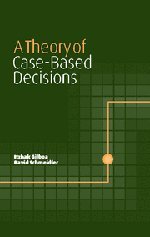
Gilboa and Schmeidler provide a new paradigm for modeling decision making under uncertainty. Case-based decision theory suggests that people make decisions by analogies to past cases: they tend to choose acts that performed well in the past in similar situations, and to avoid acts that performed poorly. The authors describe the general theory and its relationship to planning, repeated choice problems, inductive inference, and learning. They highlight its mathematical and philosophical foundations and compare it to expected utility theory as well as to rule-based systems.
User’s Reviews
Editorial Reviews: Review “This text is an excellent introduction to optimization theory.” Richard A. Chechile, Journal of Mathematical Psychology Book Description Gilboa and Schmeidler provide paradigm for modelling decision making under uncertainty. About the Author ITZHAK GILBOA Read more
Reviews from Amazon users which were colected at the time this book was published on the website:
⭐Gilboa and Schmeidler(GS)put forth what they claim is a new approach to decision making under uncertainty(Keynesian Uncertainty and/or Ellsbergian Ambiguity).The Case-Based Decision(CBD) approach is based on the use of analogy,similarity and induction.Decision maker’s choices are based on the degree of analogy(positive and negative) with past cases stored in their memory.Actions are implemented that worked well in the past.Actions that were judged not to have been successful in the past are avoided.CBD is thus self correcting over time since decision makers can learn from experience based on the recollection of past events stored in their memories.GS’s basic model is composed of two parts-memory and similarity.These two parts could be described as the basis of all analogical reasoning,which is pattern recognition.The decision maker has stored in his memory a set of what GS call triplets.Each triplet is composed of a decision problem,an action,and an outcome.Each new problem the decision maker faces is dealt with by the use of an index ranking each feasible action from low to high.The index is a weighted sum of the outcomes that have occurred in the past whenever a particular action was chosen.The weight is determined by a similarity function that measures the similarity between the new problem(case) and all the other relevant past problems(cases).A number of different possible similarity functions are put forth.Every one of these functions is additive with respect to the content of the decision makers memory of all past cases.An entire chapter is devoted to presenting an axiomatic foundation for similarity functions. The major criticism of this book is their omission of the work done in this area by John Maynard Keynes in 1921 in chapter III and Part III of the A Treatise on Probability(1921;TP).GS confine their consideration of Keynes’s earlier work in this area to the following one liner.”It should be mentioned that similar ideas were also expressed in the economic literature by Keynes(1921),Selten( 1978),and Cross(1983).”(2001,p.33). Keynes didn’t just express”similar ideas”in the TP,which is not part of the economic literature,although much of Keynes’s analysis and modeling in the TP can be applied in economics.Starting in chapter XIX of the TP,Keynes constructs a formal technical analysis of analogy in terms of propositional functions .There are two basic parts to this analysis,past experience(GS’s memory)and degree of resemblance(GS’s similarity).Based on an analysis using his concept of ‘generalization’,Keynes arrives at conclusions and results that parallel most of the conclusions arrived at by GS.One severe point of disagreement that Keynes would express would be the GS concern that the similarity functions must be additive .Additivity for Keynes would be a special case that could be attained only in the limit.In general,similarity functions will be sub additive and/or qualitative. My recommendation is that this is an excellent book for those readers who have never read the TP.However,those readers who have already digested chapters III,XVIII-XXIII of the TP will gain little additional understanding of inductive reasoning using analogy, construed as pattern recognition based on degrees of similarity,from reading GS.
Keywords
Free Download A Theory of Case-Based Decisions in PDF format
A Theory of Case-Based Decisions PDF Free Download
Download A Theory of Case-Based Decisions 2001 PDF Free
A Theory of Case-Based Decisions 2001 PDF Free Download
Download A Theory of Case-Based Decisions PDF
Free Download Ebook A Theory of Case-Based Decisions