

Ebook Info
- Published: 2010
- Number of pages: 160 pages
- Format: PDF
- File Size: 11.07 MB
- Authors: Ann Kerns
Description
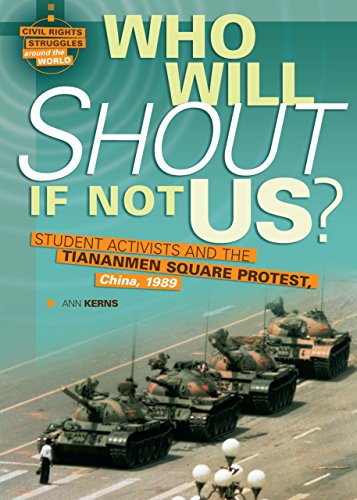
In this gripping story of a historic clash between repressive government forces and individuals seeking freedom, we’ll explore the reasons that led students in China to defy authority. We’ll learn the details of their demands and of the shattering events that followed when they took to the streets to press for their civil rights. “In the blink of an eye, the tank was approaching the sidewalk and closing in on me. It seemed as if the barrel of its gun was inches from my face. I could not dodge it in time.”―Fang Zheng, a student demonstrator at Tiananmen Square In the spring of 1989, university students in Beijing grabbed world headlines with a courageous stand against decades of Communist authoritarian rule in China. Thousands and then millions of students and workers from all over China gathered on the city’s Tiananmen Square to support demands for democracy, clean government, and increased personal freedoms. China’s premier, Li Peng, and his supporters wanted to crush the demonstration, and the government declared martial law on May 12. The world watched as army tanks and troops reached the city center on June 2. Soldiers fired their guns as students struggled to flee. A single demonstrator captured international attention as viewers around the globe watched him face off against encroaching military tanks. The army was in control of Beijing, and thousands of demonstrators were killed, wounded, or arrested.
User’s Reviews
Editorial Reviews: From Booklist Like the other entries in the Civil Rights Struggles around the World series, this book chronicles events that will be ancient history to its readership but closes with a brief analysis of the enduring effects of the infamous Tiananmen Square conflict in 1989. After laying out a general look at China in the twentieth century, Kerns presents a detailed, dispassionate account of the events of 1989, known in China as the “June 4th Protests,” to distinguish them from the many other demonstrations (peaceful and otherwise) that have occurred in Tiananmen Square. Forced to rely largely on foreign and refugee reports—because of the Chinese government’s disinterest in transparency—she paints a picture of an initially nonviolent series of student protests that escalated in large part because of the government’s clumsy attempts to ignore, belittle, or at least put an unfavorable spin on the protesters and their issues before taking an uncompromising hard line. Well stocked with small color photos, side boxes (including one on the still-anonymous “Tank Man”), and supportive back matter, this makes a serviceable assignment title on the topic. Grades 6-9. –John Peters Review “It is a challenging job to try to set a civil rights struggle in a cultural and historical context; however, the various authors of the books in the series Civil Rights Struggles Around the World strive to do so. In Who Will Shout If Not Us?, Kerns provides a brief description of China’s early history before delving into the 20th century narrative that sets the stage for student revolts. Key characters and movements are detailed, along with sidebars that highlight their importance and provide easy reference for unfamiliar names or key concepts. Other titles in the series display the same careful research and well-organized information. Plenty of photographs and the sidebars with relevant information create visual variety, though occasionally sidebars cover two facing pages and awkwardly disrupt the flow of the main text. The commendable back matter, which includes a useful time line of events and a decent glossary, also contains a ‘who’s who’ that reiterates the prominent people and provides a solid paragraph of biographical information. Though these titles are notable for the level of care in both their content and production, they remain resources that only a limited audience will be likely to turn to, and then only when needed for research.” –VOYA, Journal”Presenting an in-depth view of groundbreaking events and movements in world history, these volumes are loaded with archival quality photos, quotes from key players, and eyewitness accounts. details historical background information is provided so that students understand the context of each topic and its implications on future events as well. For example, in We Stand as One, Edge discusses not only the garment workers strike, but the women’s suffrage movement’s influence upon it and vice versa. All volumes include extensive source notes, timelines, biographical entries, useful glossaries, selected bibliographies, and suggestions for further reading, both in print and online. High school students would benefit from using this series for research. Recommended.” –Library Media Connection, Journal”Like the other entries in the Civil Rights Struggles around the World series, this book chronicles events that will be ancient history to its readership but closes with a brief analysis of the enduring effects of the infamous Tiananmen Square conflict in 1989. After laying out a general look at China in the twentieth century, Kerns presents a detailed, dispassionate account of the events of 1989, known in China as the ‘June 4th Protests,’ to distinguish them from the many other demonstrations (peaceful and otherwise) that have occurred in Tiananmen Square. Forced to rely largely on foreign and refugee reports―because of the Chinese government’s disinterest in transparency―she paints a picture of an initially nonviolent series of student protests that escalated in large part because of the government’s clumsy attempts to ignore, belittle, or at least put an unfavorable spin on the protesters and their issues before taking an uncompromising hard line. Well stocked with small color photos, side boxes (including one on the still-anonymous ‘Tank Man’), and supportive back matter, this makes a serviceable assignment title on the topic.” –Booklist, Journal”These series entries address three struggles in the worldwide history of civil rights. Strong texts provide readers with essential background information on such topics as the ILGWU, apartheid, and Chinese government oppression; the activist movements’ beginnings, confrontations, results, and significance within their nations’ histories are then discussed. Many dynamic photographs illustrate the information-rich (if dense) volumes.” –The Horn Book Guide, Journal”These volumes are a treasure trove of information about the fight for civil rights across time and the globe. From the uprising of 20,000 American garment workers to Gandhi’s 241-mile Salt March, the suppressed demonstrate again and again their will to defeat their suppressors with dignity. The books are an effective combination of facts, fine photographs, and interesting quotes and excerpts from relevant documents. Perhaps most important in inspiring a young audience, the texts contain a poignant personal element that takes these historic milestones to an intimate, emotional level. The cruelty with which humans can treat one another is unflinchingly presented but the extraordinary grace exhibited in the face of it rises to the top.” –School Library Journal, Series Made Simple, Journal About the Author Ann Kerns has edited and written many nonfiction books for young readers. She also enjoys reading, travel, cooking, and music. Born in Illinois, Ann currently lives in Minneapolis. Read more
Reviews from Amazon users which were colected at the time this book was published on the website:
⭐Evidence of human settlement in China dates from 5,000 B.C. China, an ancient and much revered culture, “is one of the oldest continuous civilizations in the world.” The country was ruled by emperors whose primary base was centered in Beijing until the early part of the twentieth century when the Kuomintang (National Party, or KMT) put an end to the monarchy in 1912. In 1921 the Chinese Communist Party CCP formed declaring that “social and economic classes are abolished and all people are regarded as equals.” These two political factions joined forces during WWII, but at its end they soon were at odds with one another again. In 1949, on the wake of political unrest, the CCP defeated the KMT, who fled to Taiwan. Mao Zedong established the People’s Republic of China (PRC). The single party system of Communism had begun.Zhou Enlai was the first premier of the People’s Republic of China. Mao, who would soon begin the first of many reform campaigns, “believed that Communism could defeat the foreign interference and internal corruption that had plagued China.” Many of his initial reforms met with criticism or disaster and in the mid-1960s his Cultural Revolution had begun, a revolution that “had all but destroyed the Communist Party.” In an effort to assert control over the Party and country, thousands perished as did many of China’s valuable cultural artifacts. Within two years of Mao’s death in 1976, Deng Xiaoping became the leader of the CCP, however “Most Chinese people remained committed to Socialism and Communism. But they wondered when Deng’s reforms would start to show real, long-lasting effects.”Change throughout the 1980s was slow and there was an “air of discontent” on campuses as “students began to object to Communist control tactics.” They, like everyone else were concerned about their freedom and their future and “wanted more control of their own lives.” Upon the death of Hu Yaobang, youth sympathizer and general secretary of the CCP, the students of Beijing mobilized to pay their respects and present a list of demands to the government. It was April, 1989 and student protests began in earnest. Mikail Gorbechev was coming to China on an official government visit. What would happen if he saw a dissident movement in Tiananmen Square? Would this further damage relations with the country? How would they stop the student uprising? Could they?This is an impressive overview of the infamous civil rights protests at Tiananmen Square. The condensation of political and cultural Chinese history was quite well done, a task that is quite daunting. The entire effect of this overview funnels directly into the protests at Tiananmen leaving the reader with a good idea of why this conflict erupted and an understanding of the stance both sides took on the matter. There has been much debate on the casualties resulting from the conflict, but this book treads lightly on the matter citing Chinese figures mentioned on 6/4. In the back matter, the source notes thoroughly document the material, a fact that students and teachers will appreciate if reports are to be undertaken. Numerous photographs and sidebar materials add a great deal to the text. For example, one two-page sidebar focuses on the life of Mao Zedong with a brief biographical sketch. In the back of the book is an index, a glossary, a timeline, biographical sketches of important Tiananmen student protesters, and additional recommended book and website resources.
Keywords
Free Download Who Will Shout If Not Us?: Student Activists and the Tiananmen Square Protest, China, 1989 (Civil Rights Struggles around the World) in PDF format
Who Will Shout If Not Us?: Student Activists and the Tiananmen Square Protest, China, 1989 (Civil Rights Struggles around the World) PDF Free Download
Download Who Will Shout If Not Us?: Student Activists and the Tiananmen Square Protest, China, 1989 (Civil Rights Struggles around the World) 2010 PDF Free
Who Will Shout If Not Us?: Student Activists and the Tiananmen Square Protest, China, 1989 (Civil Rights Struggles around the World) 2010 PDF Free Download
Download Who Will Shout If Not Us?: Student Activists and the Tiananmen Square Protest, China, 1989 (Civil Rights Struggles around the World) PDF
Free Download Ebook Who Will Shout If Not Us?: Student Activists and the Tiananmen Square Protest, China, 1989 (Civil Rights Struggles around the World)