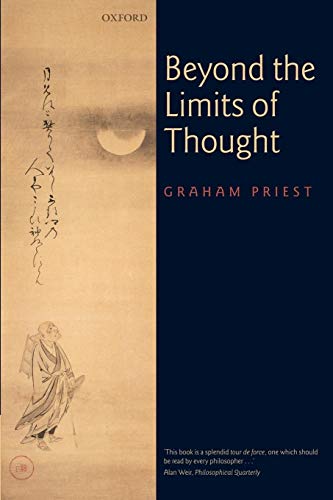
Ebook Info
- Published: 2003
- Number of pages: 336 pages
- Format: PDF
- File Size: 2.81 MB
- Authors: Graham Priest
Description
This second and extended edition of Priest’s classic includes new chapters on Heidegger and Nagarjuna, as well as reflections on reactions to the first edition. Praise for previous edition: “a splendid tour de force, one which should be read by every philosopher…”–Philosophical Quarterly “[H]ighly entertaining and provocative…an engaging and instructive tour through some of the most perplexing features of our own conceptual finitude…”–TLS
User’s Reviews
Editorial Reviews: Review `Review from previous edition This book is a splendid tour de force, one which should be read by every philosopher…’ Alan Weir, Philosophical Quarterly`clever, resourceful, undogmatic, unpretentious, often sensible and usually clear over a wide range of issues’ Timothy Williamson, British Journal for the Philosophy of Science`highly entertaining and provocative… an engaging and instructive tour through some of the most perplexing features of our own conceptual finitude…’ A. W. Moore, Times Literary Supplement`Graham Priest combines a deep philosophical appreciation of fundamental logical issues with a marvelously informed reading of both the history of philosophy and contemporary texts. His work is ambitious and insightful… The book is an ambitious attempt to do important philosophical work across major borders – borders of the formal and philosophical, the historical and the contemporary, the Analytical and the Continental traditions. In [this] regard it is a resounding success.’ Patrick Grim, Philosophy and Phenomenological Research About the Author Graham Priest is Boyce Gibson Professor of Philosophy at the University of Melbourne, and also Arche Professorial Fellow at the University of St Andrews. He is the author of In Contradiction (1987), Introduction to Non-Classical Logic (2001), and the editor of several collections on logic and related subjects. He is also the author of a successful book on Logic in the Very Short Introduction series.
Reviews from Amazon users which were colected at the time this book was published on the website:
⭐Australian philosopher Graham Priest is the primary champion of dialetheism, a philosophical position that allows some contradictions to be true and is based on extensions of classical logic in ways similar to how Einstein extended Newtonian conceptions of physical truths. Priest argues that the classical Law of Non-Contradiction has too long held the western mind hostage and kept it from exploring other types of truth and developing other forms of logic such as paraconsistent logics. It is at the boundaries of human thought that these kinds of dialetheias or true contradictions arise most prominently.In this volume Priest examines the boundaries of thought in four areas, 1) the limits of expression, 2) the limits of conception, 3) the limits of cognition (what can/can’t be known), and 4) the limits of iteration (what can/can’t be calculated, operated, i.e., the mathematical infinite). The book proceeds mostly historically, examining examples of the limits of thought in pre-Kantian philosophy such as Cratylus, Aristotle, Cusanus, Sextus, Aquinas, Leibniz, Berkeley, then explores the limits of thought in Kant’s noumena, categories, and antimonies, and then Hegel’s conceptions of infinity. Later Priest explores modern forms of mathematics and logic starting with Cantor, Russell, Ramsey, Zermelo, Von Neumann, then on into the limits of language with Frege, Wittgenstein, Quine, Davidson, and Derrida. Most of the chapters are readable by those with little or no experience with logical notation but some of the chapters (8-11) are rather technical. This second edition ends with three new chapters, one on Heidegger, one on Nagarjuna (co-written with Jay Garfield), and one on further reflections on dialetheism.Priest sees these recurring contradictions at the limits of thought expressing a similar form and has developed what he calls the *Inclosure Schema* to describe their common structure. Priest concludes that throughout history human attempts to say the unsayable, to bring heaven down to earth (so to speak) have resulted in paradox and contradiction and, despite the many attempts to avoid, ignore, or get around them, they reappear later in new forms. The wise conclusion is to admit that some form of dialetheism is necessary for certain kinds of thought to proceed towards greater types of truth.I’m not sure why Priest’s work hasn’t been discovered by more nondualist philosophers, those of us who are thoroughly comfortable with a worldview where human thought and reason are understood to be inherently bound by contradiction and paradox. If you are a Buddhist, Advaita, or Taoist philosopher, you are probably already very familiar with this territory and should be happy that western philosophers are slowly coming to understand what the philosophy of India has known for centuries: that the human mind is coextensive with conventional reality and truth in which all attempts to characterize ultimate-final truth [paramartha-satya], can only come up with paradox, contradiction, dualisms, oppositions, inconsistencies, incompleteness, and the like. Buddhist philosophy consistently employs paradox and contradiction in order to point out the limitations of the mind and conventional truth and point the practitioner’s awareness to the ultimate truth that lies waiting free of all forms of mental grasping.If there is one problem with Priest’s project it is that there’s little or no support for the kinds of methodologies that could confirm and support his dialetheist philosophy, namely the methodology of meditation. Philosophers of India have employed dialectical reasoning and argument together with meditation for centuries and have therefore developed a deeper and more complete understanding of the nature of the mind and consciousness. In meditation the limits of thought are revealed and confirmed in ways that conventional methods of argumentation, discourse, language, and conceptualization are unable to. Unfortunately however meditation is a long way from becoming a standard practice among western philosophers but it is catching on in the culture at large for other reasons.Whatever your background, if you are a philosopher and are interested in the larger metaphysical questions of philosophy–God, infinity, the absolute, fundamental ontology, limits and boundaries, etc., Priest’s book will delight you. I can also recommend Priest’s other books
⭐,
⭐, and
⭐.
⭐This book is a great companion for any general survey about the history of philosophy, and I’m now convinced that the great antagonist of philosophy is and has been the Inclosure Schema. The Moriarty to our Sherlock, the Joker to our Batman, the Gary to our Ash. In the end, our nemesis becomes our greatest coach, our enemies become part of our identity, and our rivals become our friends,. These contradictions which we find in literature are given formal proof and argument in Beyond the Limits of Thought in an extremely convincing way.The book is a tour de force. Its structure and approach gain momentum, and it follows a historical arc, starting with Aristotle and ends with Heidegger.I think that anyone with a basic grounding in Philosophical Logic and its notation can make their way through the book. You will be left with a strong intuition of the Inclosure Schema.The author alludes to there being true contradictions, but doesn’t reason directly with true contradictions in the book, except perhaps in the penultimate chapter covering Nagarjuna. He only gets you to the point where you will see these true contradictions. What to do with them, after they are identified, is not to be found in the text. It has created a new itch which I can’t scratch, and I will likely read another of his books to satisfy myself.
⭐He has a writing style that can be a little difficult to follow. He doesn’t go into detail where a less knowledgeable reader might need it. I had to turn to google and do some background research on some of the areas before I could fully understand what he was saying.
⭐Found hard to read but very interesting
⭐I do not understand why Deleuze doesn’t figure in this book. Heidegger is mentioned but Deleuze is in many ways a greater philosopher and a philosopher of paradox. To quote from Difference and Repetition, “paradox is the passion of philosophy”. If you tie neo-platonism, christian mysticism, the hermetic tradition, and the history of western metaphysics, what results is a view of nature that is thoroughly paradoxical. For Deleuze, expression goes beyond language and sense is not limited to language. Paradoxes are not inexpressible but are the force of expression itself.
⭐I should not be reviewing this book, as a lot of it is simply beyond me. It is however extremely interesting and written in a lively style. I could not trace any typos in what is a beautiful paperback edition. The last chapter (added to this second edition) is a dust-up where the author takes on his critics from the first. I cannot see who comes out the winner, neither can I determine whether something can be and can not be. Perhaps it is better to merely acknowledge that language is unable to resolve certain paradoxes.Apparently Bill loves Monica – now I am not sure about that.
Keywords
Free Download Beyond the Limits of Thought 2nd Edition in PDF format
Beyond the Limits of Thought 2nd Edition PDF Free Download
Download Beyond the Limits of Thought 2nd Edition 2003 PDF Free
Beyond the Limits of Thought 2nd Edition 2003 PDF Free Download
Download Beyond the Limits of Thought 2nd Edition PDF
Free Download Ebook Beyond the Limits of Thought 2nd Edition