Ebook Info
- Published: 1987
- Number of pages: 327 pages
- Format: PDF
- File Size: 4.06 MB
- Authors: Graham Priest
Description
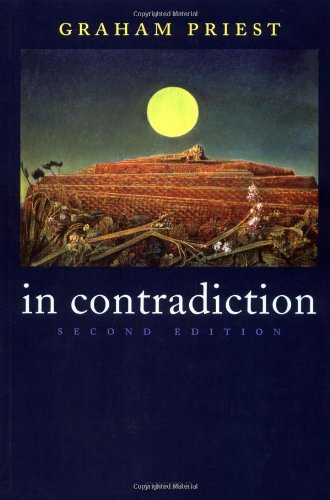
In Contradiction advocates and defends the view that there are true contradictions (dialetheism), a view that flies in the face of orthodoxy in Western philosophy since Aristotle. The book has been at the center of the controversies surrounding dialetheism ever since its first publication in 1987. This second edition of the book substantially expands upon the original in various ways, and also contains the author’s reflections on developments over the last two decades. Further aspects of dialetheism are discussed in the companion volume, Doubt Truth to be a Liar, also published by Oxford University Press in 2006.
User’s Reviews
Reviews from Amazon users which were colected at the time this book was published on the website:
⭐This book is absolutely superb. It is a powerful and hard to refute defense of dialetheism, the view there are true contradictions. This is an affront to the western world’s sensibilities, and it is a welcome one. As Priest points out, consistency has enjoyed a free pass since Aristotle. It turns out, the arguments provided for it are weak. Either our views of consistency truly need to be whipped into shape, or there is much more to logic and rationality than is dreamt of in our philosophy.Whether you approach this book as wrong from the beginning, or as right, it is well worth your time. If you are against the views, then digest what Priest has to say and figure out what is wrong. Don’t hand wave it. Defend your position. If you are for the views, then digest what Priest has to say, and prepare to defend yourself. This is not something that shall enter philosophical circles lightly. It is a conversation that needs to happen, and deserves to happen. This book is the beginning of that conversation.You may be thinking to yourself, “Oh these are just some silly philosophers talking about silly things.” To those of you out there who approach this with an incredulous stare, take heed of the power of non-trivial inconsistent systems. Semantic closure becomes a real possibility. I only need to point at the expressive power of English to tantalize your imagination. (The semantic inconsistency of English gives it its power. Truly, it is really hard to come up with a well-formed sentence in English that is absolutely deductively senseless.) Further, paraconsistent mathematics is a delight. Priest treats paraconsistent set theory and arithmetic in chapters 17 and 18. As an undergraduate mathematician, the beauty and elegance of the systems was shocking and intriguing.Priest’s excellent writing, professionalism, and scholarly commitment makes this a joy to read. He is not afraid to admit when he has been wrong. (Indeed the second edition includes autocommentary on the first edition, marking where has erred in the past.) This is the mark of a truly great thinker, who wishes to find the truth, not just defend his version of it. When Priest is marked down in the annals of great philosophers, this book will be by his name. It will challenge you to think, and to quote Kant, it will “awake you from your dogmatic slumber.”
⭐It’s very well written. I only regret opting for the kindle version (which is almost the same price as the physical book), as I have found the inability to quickly go back and forth that you get with a physical book really missing. This material is too deep for most humans for reading linearly on a 6 inch kindle device, and paging back and forth on a 6 inch device without any proper usability helpers for jumping around in the Kindle software is utterly derailing. I guess unless you’re a lifelong researcher in this area, do yourself a favor and buy the physical book if you really intend to get through it.I wish I could return and buy the full price physical copy to complete reading it.
⭐Well, this is something. Dialetheism is the view that there are true contradictions; some sentences are both true and false (not neither; Priest importantly defends bivalence). Part I argues – quite convincingly – for the existence of true contradictions, mostly based on the semantic paradoxes and the lack of any forthright solution to these.The second part develops a logic based on Kleene’s connectives (but with both true and false as the third truth-value). In order to save modus ponens, he invokes an intensional conditional (this is actually one of my main worries – if dialetheism needs these kinds of steps, not the least to solve Curry’s paradox, how much value does the limitation of expressivity against the Tarskian solutions really have?). The third part discusses various application of dialetheism to formalizing naïve set theory (why not if we have to countenance contradictions anyway), solve problems pertaining to the metaphysics of change and of time and inconsistent obligations in legal systems. These are, of course, not sufficiently developed here for a full evaluation to be possible. The last two chapters include a commentary on the edition and a replies to critics section.In general, one main problem (which most critics in the end seems to worried by) is the problem of expressing the claim that some statement is not a dialetheia, which seems to lead to problems of expressivity (Priest’s appeal to pragmatic considerations are not very convincing); since this is the main line of argument against Tarskian solutions to the paradoxes, one might thus wonder what the gains of adopting dialetheism are (and the costs are … well, intuitively pretty high to begin with).There are also some outstanding questions regarding the actual formulation of LP, and surely others as well – thing is, dialetheism is not going to be very widespread anytime soon and I am surely not very tempted myself (most obviously in the Gödel discussion; sacrificing consistency of arithmetic for completeness is a non-starter); but however that may be, Priest has at least shown us that (unless Lewis is right) the view cannot be dismissed without further ado. This is a wide-ranging, lucid, well-written and always provocative book which should be consulted by anyone dabbling with or dealing with philosophical logic or related subjects. If there is one major criticism, it might be that some of the applications seem a little too quick or not worked out in sufficient detail (so do some of the replies to critics). A dialetheist is one who recognizes the existence of true contradictions, not (according to Priest himself) one who tries to multiply them beyond reason to plug gaps in all kinds of current theories. Yet it seems, from Priest’s discussions, that the true contradictions are very likely to spread somewhat beyond control.
Keywords
Free Download In Contradiction: A Study of the Transconsistent 2nd Edition in PDF format
In Contradiction: A Study of the Transconsistent 2nd Edition PDF Free Download
Download In Contradiction: A Study of the Transconsistent 2nd Edition 1987 PDF Free
In Contradiction: A Study of the Transconsistent 2nd Edition 1987 PDF Free Download
Download In Contradiction: A Study of the Transconsistent 2nd Edition PDF
Free Download Ebook In Contradiction: A Study of the Transconsistent 2nd Edition