Ebook Info
- Published: 1993
- Number of pages: 366 pages
- Format: PDF
- File Size: 2.60 MB
- Authors: Michael Dummett
Description
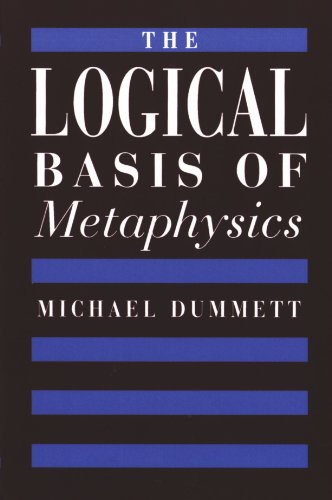
Michael Dummett’s new book is the greatly expanded and recently revised version of his distinguished William James Lectures, delivered in 1976. Dummett regards the construction of a satisfactory theory of meaning as the most pressing task of contemporary analytical philosophy. He believes that the successful completion of this difficult assignment will lead to a resolution of problems before which philosophy has been stalled, in some instances for centuries. These problems turn on the correctness or incorrectness of a realistic view of one or another realm―the physical world, the mind, the past, mathematical reality, and so forth. Rejection of realism amounts to adoption of a variant semantics, and often of a variant logic, for the statements in a certain sector of our language. Dummett does not assume the correctness of any one logical system but shows how the choice between different logics arises at the level of the theory of meaning and depends upon the choice of one or another general form of meaning-theory. In order to determine the correct shape for a meaning-theory, we must attain a clear conception of what a meaning-theory can be expected to do. Such a conception, says Dummett, will form “a base camp for an assault on the metaphysical peaks: I have no greater ambition in this book than to set up a base camp.”
User’s Reviews
Editorial Reviews: Review “Fundamental issues of human understanding are pursued with moral passion and enormous energy by a real philosopher. The questions Dummett presses reach at least as far as the very limits of thought.”―Barry Stroud, Times Literary Supplement“Michael Dummett’s The Logical Basis of Metaphysics was very much worth waiting for: the book is important, daring, controversial, and very deep… The overall thesis of the book is that the way to solve metaphysical problems is through philosophy of language, and the large metaphysical ‘pay-off’ the book offers is nothing less than a revision of classical logic! In a nutshell, this means that the principle of Bivalence (the Law of the Excluded Middle) is wrong and Brouwer’s Intuitionist Logic is right! Although the conclusions are dramatic, they are reached by slow and sober steps… Even though I have not been ‘completely converted,’ I have myself learned an enormous amount from this book, and I believe that it marks one of the true high-water marks of twentieth-century philosophy.”―Hilary Putnam, Harvard University“It will be difficult to exaggerate the philosophical interest of the general conclusion that Dummett recommends in this book. If he is right, a large number of issues which have been wrangled over inconclusively, in some cases for centuries, acquire a new sharpness and tractability, with a serious prospect (or worse) that the verdict will go against what has passed for common sense. If he is wrong, as I in fact believe, he is profoundly and importantly wrong, and it is a difficult and pressing task for philosophy to see why… [He has been urging] the general conception in articles and, in passing, in books not primarily devoted to it, for some thirty years. What is new here is the depth, generality, and detail with which he spells out the views about what the theory of meaning must do which have stood largely in the background of his previous writings about realism… This is an extraordinarily important book.”―John McDowell, University of Pittsburgh About the Author Michael Dummett was Wykeham Professor of Logic, Emeritus, at the University of Oxford.
Reviews from Amazon users which were colected at the time this book was published on the website:
⭐The two reviews previous to mine are beautifully erudite, insightful and on target. Mine is entirely subjective. I finished reading this book minutes ago. Roughly the last half of the last chapter was an out-and-out page-turner for me. I am stunned by Dummett’s grace, passion and perspicuity! My lack of education meant I could not follow (in detail) much of many of the chapters, but even so, along the lines noted by the previous reviewers, it is clear to me this book is a stunning intellectual achievement. In my very truly humble opinion, Dummett blows Davidson out of the water. (I’ve always thought Convention T was overblown.) If, as said by a previous reviewer, contemporary philosophy has gone in other directions, so much the worse for contemporary philosophy. In my mind, this work lifts Dummett into the same league as Wittgenstein and Quine — perhaps not as revolutionary, but perhaps deeper. (Similarly, Bach did not invent counterpoint, but he took it to the greatest heights.) This is not intended to be a helpful review per se: I just wanted to express how thrilled I am by having read this amazing book — this is what philosophy was meant to be.
⭐Michael Dummett’s *The Logical Basis of Metaphysics* is a summing-up of his influential and controversial views on the philosophy of language. Based on the 1976 William James lectures at Harvard (a series which also included John Austin’s *How to Do Things with Words*) but substantially revised at the end of the 1980s, this book offers a more technical and more comprehensive presentation of Dummett’s views on the dispute between realism and anti-realism. Dummett’s basic suggestion that the dispute between these two parties hinges on the acceptance or denial of the principle of bivalence — a statement’s being either determinately true or false — for an area of our discourse is well-known: but he covers much more than this in examining what form a theory of meaning for a language expressing one or the other position might take.At the time of the lectures, and even at the time of the book’s publication, Donald Davidson’s adaptation of Tarski’s truth-definition for the purposes of natural language semantics was one of the most popular programs in the philosophy of language; a great deal of Dummett’s discussion is oriented towards demonstrating the unacceptable limitations of such an approach. The problems with the famous “Convention T” and the relation between the logic obeyed in the object language and that obeyed in the meta-language receive extensive treatment. Although Tarskian model theory was intended (and is generally accepted) as a semantics for quantificational logic of the type invented by Frege, Dummett’s critique could be characterized as “Frege against Tarski”: the principles of semantic analysis devised by Frege (laid out in Dummett’s *Frege: Philosophy of Language*) are generalized to principles a coherently conceived “meaning-theory” for *any* kind of logic must implement. As such, they offer a vantage point for criticizing “modest” semantics, which takes a classical, Tarskian “homophonic” semantic theory’s lack of structure as itself a reason to doubt the necessity or possibility of any more systematic theory.Following the general discussion of semantics for classical and non-classical logics, chapters eight through thirteen have a separate thematic unity (deriving from a later series of lectures): their theme is the justification of logical laws by examining their obeying certain proof-theoretical strictures. The logical method Dummett bases his discussion on is “normalization”, discovered by Dag Prawitz in the 1960s. Normalization is an analogue of cut-elimination in sequent calculi, which demonstrates the theoretical superfluity of a “roundabout” approach to the proof of a theorem, for natural deduction: and the way it is worked, systematically converting steps in a deduction into a canonical form, is explicitly cited by Dummett as evidence of the value in proof-theoretical demonstrations of the meaning of logical constants.But Dummett’s discussion contains both more and less than the results of the literature on normalization: more, because he introduces additional concepts intended to show the superiority of intuitionistic logic as “self-justifying”, and less, as he ignores many properties of normalization which have interested proof theorists as not germane to his purposes. At any rate, a passing familiarity with the concept — which can now be acquired on the cheap, thanks to Dover’s reprinting of Prawitz’s
⭐– is necessary for understanding what Dummett is up to in this section. Following this, the last two chapters of the book contain some more general critique of realism and truth-conditional theories of meaning, including arguments defending the tenability of anti-realism for the theist.This book was surely intended as a summation of Dummett’s work; but although that work has had a great deal of influence upon analytic philosophy, it would be slightly misguided to think that this book has a great bearing upon issues in contemporary philosophy. To a certain extent, it represents paths not taken by semantics, metaphysics, and philosophy of logic as they have developed in recent decades: but this in itself, coupled with the book’s amazing technical sophistication, might be reason enough to read and ponder what is and what might not be the right way to avoid going at philosophy “bald-headed”.
⭐Hilary Putnam describes this as “one of the true high-water marks of twentieth century philosophy”, John McDowell said “this is an extraordinarily important book”, and, when I was a graduate student, a philosopher described it to a class of graduate students as being perhaps the most profound work on truth-conditional theory of meaning in the twentieth century; since Wittgenstein’s Tractatus Logico-Philosophicus also deals with truth-conditional theories of meaning (so I would argue, at least), that is quite a claim.If these names – Wittgenstein, McDowell and Putnam – mean anything to you, Dummett’s name should be just as familiar, and this book should need no further recommendation. If you have not heard of these people, you are probably not acquainted with analytical philosophy, one of the most influential forms of philosophy in the twentieth century. Analytical philosophers tend to approach philosophical problems by means of philosophy of language: typically, they ask about meaning. In this book, Dummett attempts to explain what a theory of meaning is, why a theory of meaning has metaphysical implications, and how theories of meaning can be evaluated. His claim is that metaphysical problems are, fundamentally, problems about what logic to adopt, and that a theory of meaning can be used to justify a logic. This work raises issues that are deep, but also highly technical, and certainly not for a novice. Don’t even try to read this book unless you’ve spent some time studying analytical philosophy, and have decided that it interests you. But if you are seriously interested in analytical philosophy, this is a book that you really should try to read.If you want to begin reading Dummett, this is not the best place. Its the definitive statement of his position, aimed primarily at other experts in the field. His ideas can be found in a less comprehensive but slightly more digestible form in two anthologies of his, Truth and Other Enigmas and The Seas of Language. The latter is probably slightly easier for beginners.
Keywords
Free Download The Logical Basis of Metaphysics (The William James Lectures) in PDF format
The Logical Basis of Metaphysics (The William James Lectures) PDF Free Download
Download The Logical Basis of Metaphysics (The William James Lectures) 1993 PDF Free
The Logical Basis of Metaphysics (The William James Lectures) 1993 PDF Free Download
Download The Logical Basis of Metaphysics (The William James Lectures) PDF
Free Download Ebook The Logical Basis of Metaphysics (The William James Lectures)