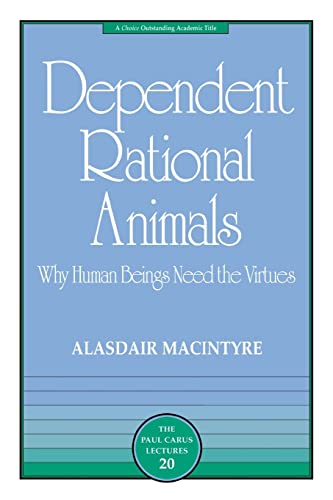
Ebook Info
- Published: 2001
- Number of pages: 180 pages
- Format: PDF
- File Size: 10.66 MB
- Authors: Alasdair MacIntyre
Description
To flourish, humans need to develop virtues of independent thought and acknowledged social dependence. In this book, a leading moral philosopher presents a comparison of humans to other animals and explores the impact of these virtues.
User’s Reviews
Editorial Reviews: Review This book represents a “revised and expanded version” of the 20th installment of the prestigious Paul Carus Lectures. — International Studies in Philosophy, 2005
Reviews from Amazon users which were colected at the time this book was published on the website:
⭐Many virtue theorists seem to think it enough to say that “qua humans” we should flourish, and that figuring out how to flourish “just is” what practical reasoning is, and hence that virtue is intrinsic to being human in about the same way that having roots is intrinsic to being a tree, and that those of us who fail to “see” that are somehow irrational in wanting some further argument. They skip blithely over the obvious fact that much reasoning that seems quite practical and wildly successful seems rather less than virtuous. MacIntyre indulges in no such self-satisfied question-begging. Whatever else is to be said for MacIntyre’s “Dependent Rational Animals,” he displays the virtue of engaging directly and forthrightly the hard questions that unsympathetic or unconvinced souls would pose for his position.The way he argues that we need the virtues is quite startling in originality. Generally, ethicists take as their standard the autonomous, self-sufficient reasoner–where “reason” means something like “able to give a logically defensible verbal justification,” usually in terms of some sort of universal rule. MacIntyre sees this as a mistake. The question, he thinks, is how any of us ever come to be independent practical reasoners and what it means to be such. We must, he thinks, understand that “reasons to act” have little to do with our linguistic ability or capacity to display verbally a syllogism that concludes with the action in question. Rather, “reasons to act” are more concrete, pragmatic, and instrumental.Thus, we can say that intelligent animals act with reasons, despite having no language, if their actions are clearly aimed at ends, especially if it is clear that they choose their instrumental acts on the basis of perceptions of the current environment.*Human practical resoning* begins in this aspect of our animal nature–our ability to learn in practice what we need to do in order to accomplish the things we need to accomplish if we are to flourish. Note that the issue here is learning in practice, and identifying correctly through our practice what we find to be needful for our flourishing. Reason, then, is grounded in the practice of flourishing.And rather than look at “autonomous” adults, MacIntyre points out the obvious fact, usually overlooked by ethical theorists, that we are actually always dependent on each other in myriad ways. Our mutual dependency dictates that we need communities of giving and receiving various things–including education, formal and otherwise–not only to flourish but to be able to know, and reason, about flourishing. Without the virtues, the conditions for practical reasoning *at all* cannot exist.The argument, then, is that our animality and dependency dictate what constitutes both flourishing and practical reason about flourishing, and that we can demonstrate that the virtues are necessary for being independent practical reasoners who flourish.Rather, that’s the strategy of the argument. The argument itself is, of course, much more involved. In its entirety, does it work? I’m not sure. I don”t know that everyone would agree with his axiomatic/unargued starting point, that to flourish requires us to be independent rational thinkers, even in the sense of “rational” he’s spelled out here. We of democratic mien see thing that way, of course–but so far as I know, MacIntyre doesn’t provide an argument for the overriding necessity of independence.A couple of things are troubling–his apparent reliance on D.W. Winnicott’s psychoanalytic account of child development, for instance. I’m not sure whether it really matters–so long as one accepts the notion that persons cannot develop into independent rational thinkers without the support of others, MacIntyre’s affinity for Winnicott can be seen as a personal quirk, I think.But that does lead to one perplexity: a lot of what MacIntyre says about the necessities of human life–matters of our dependence–is empirical, in a fairly straightforward sense, more than philosophical. Does this matter? It seems so to me. At least some of his argument turns on empirical claims about conditions for human flourishing for which he provides no argument or evidence.Finally, MacIntyre sees current society as more or less beyond the pale ethically–according to him, neither our families nor our nation states promote virtue or independent practical rationality of the sort he has spelled out. One could conclude, of course, that we live in vicious ands heathen times, so to speak–and perhaps we do. Or one could wonder whether MacIntyre’s empirical claims, and the philosophical argument he bases upon them, may not have more to do with his tastes than with the conditions of human flourishing. Is it really so obvious that in our culture we fail to flourish? Taken from the perspective of human history, our developed nation states have a few things going for them that resemble flourishing: the highest levels of material welfare, more equitably spread (in spite of the great distance we have to go in achieving equality); the most widespread education and highest rates of literacy; the lowest rates of infant mortality; the longest life spans; the greatest emphasis on human rights, including for women and minoeriites; the easiest access by non-elites to the arts; the cheapest books (relative to per capita income); the most efficient (if not yet ideal) institutions for international consultation and cooperation, and . . .I like MacIntyre”s version of how life ought to be. I recommend reading the book. But I suggest that one not fail to note that his empirical claims are less than obviously true, while some empirical facts about our flourishing seem to have escaped his notice–or at least been given less weight than many folks would give them.One other thing: This book is badly written. Never mind the needlessly poor sentence structure in which he so often indulges (and he obviously knows better, since he often writes clearly). But the structure of the argument and its exposition is generally less than transparent. (The reviewer who thought first that MacIntyre had gone soft reflects this fact.) For instance, on page 107, he tells us there are two ways that a certain thing is important, then spends twelve pages discussing the first–without ever getting around to identifying the second, so far as I can discern. That sort of sloppiness is not unusual in the book. Do you think maybe one of the minor virtues, one of the small obligations owed by people who write books for which they ask our money, is that they not be lazy about how they express themselves?
⭐A very cool fusion of moral philosophy and animal behavioral psychology.Some of the arguments are slightly discredited by recent exploration of non-mamalian intelligence, particularly octopi, but not so much that it isn’t still worth the read.
⭐Appreciated the insights MacIntyre brings to understanding human nature and our search for meaning through virtue with or without religion.
⭐Anyone who likes good philosophical writing will enjoy “Dependent Rational Animals.” In it, Alasdair MacIntyre argues for a concept of human flourishing that acknowledges the virtues of acknowledged social dependence as well as those of independent practical reasoning (the normal focus of virtue theory). Parts of the book are underargued — particularly the section on politics — but the writing is lucid, and the philosophy is wise and compassionate. Best of all, the book opens our eyes to the obvious but often overlooked truth that any account of human good is seriously partial and deficient if it neglects the reality of dependence — a state occupied by everyone at some point in his or her life, and by some persons for their entire lives. Mind opening. Highly recommended.
⭐Excellent logical treatise built on a foundation of Aristotle, Aquinas, Hegel, and Nietzsche (in repudiation) supporting the utility of good within community in the post- modern sense. Challenging and rewarding read, to be given focus on multiple occasions!
⭐Read “After Virtue” first. I have a classical liberal background but with tension with a more communal Thomistic approach which MacIntyre provides. What I particularly like about “Dependent Rational Animals” is how he incorporates an innovative analysis of children and disability as a justification for this communal approach, inspired by what we know from studying “intelligent” animals.
⭐Dependent Rational Animals is a must for any student considering Mind Science as a profession. Easy reading and comprehension is the hall mark of this work.
⭐This is the clearest exposition of his thinking on what is required to live a good life.
⭐An excellent book
Keywords
Free Download Dependent Rational Animals: Why Human Beings Need the Virtues (The Paul Carus Lectures) in PDF format
Dependent Rational Animals: Why Human Beings Need the Virtues (The Paul Carus Lectures) PDF Free Download
Download Dependent Rational Animals: Why Human Beings Need the Virtues (The Paul Carus Lectures) 2001 PDF Free
Dependent Rational Animals: Why Human Beings Need the Virtues (The Paul Carus Lectures) 2001 PDF Free Download
Download Dependent Rational Animals: Why Human Beings Need the Virtues (The Paul Carus Lectures) PDF
Free Download Ebook Dependent Rational Animals: Why Human Beings Need the Virtues (The Paul Carus Lectures)