Ebook Info
- Published: 1998
- Number of pages: 304 pages
- Format: PDF
- File Size: 15.38 MB
- Authors: Alasdair MacIntyre
Description
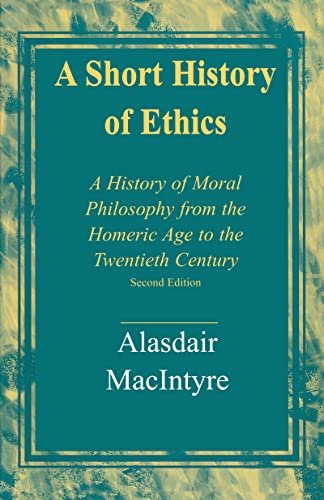
A Short History of Ethics is a significant contribution written by one of the most important living philosophers. For the second edition Alasdair MacIntyre has included a new preface in which he examines his book “thirty years on” and considers its impact. It remains an important work, ideal for all students interested in ethics and morality.
User’s Reviews
Editorial Reviews: Review “The second edition of this classic will be more widely read than the first, one expects, if only because in the intervening three decades the author has become perhaps the most important moral philosopher in the English-speaking world.” ―First Things“MacIntyre’s highly respected Short History has been translated into six languages. Out of print in English for several years, its reappearance in this second edition is a welcome event. MacIntyre is always provocative, and this book will continue to excite engagement with fundamental moral issues.” ―Choice”This brilliant and provocative book is not so much a history of ethics as it is an essay about the history of ethics, with numerous examples. For that reason it is interesting and philosophically important in a way that most short histories of some branch of philosophy ‘from Homer to today’ are not. . . . It is important, not as one more pedantic history, but for its demonstration that the history of ethics can be more than a chronologically ordered set of summaries with occasional connective remarks about influences and refutations. MacIntyre presents an extended argument about human nature and society, morality, and the historical development of Western civilization, leading to the conclusion that to understand and to do moral philosophy properly it is necessary to study history―the history of morality as well as the history of ethics. One may wish to quarrel with some of his supporting arguments, with certain interpretations of particular authors, or with aspects of his outline of the history of morality. But by combining a rich socio-historical apparatus with a high degree of critical acumen [MacIntyre] has presented us with a detailed example of a kind of history of ethics which is far superior in depth and philosophical relevance to any of the existing varieties.” ―Philosophical Review From the Back Cover The author writes…’This history of moral philosophy which runs from the Greeks to contemporary Anglo-Saxon discussion is necessarily compressed and selective, but is intended to enable the general reader and the student to place particular texts in moral philosophy in an historical perspective. The function of this perspective is to clarify three kinds of historical and philosophical connection whose importance is often underrated. The first is a matter of the debts which moral philosophers owe to their predecessors; the second concerns the question of the nature of the moral concepts which furnish any moral philosopher with the objects of his enquiry upon moral concepts themselves and the extent to which the philosophical analysis of a concept may play a part in transforming or even discrediting it. A consequence of these preoccupations is that the book contains a higher proportion of purely philosophical enquiry than might be expected in an historical work.’ About the Author Alasdair MacIntyre is research professor of philosophy at the University of Notre Dame. He is the author of numerous books, including After Virtue: A Study in Moral Theory, Third Edition (Notre Dame Press, 2007) and Three Rival Versions of Moral Enquiry: Encyclopaedia, Genealogy, and Tradition (Notre Dame Press, 1990). Read more
Reviews from Amazon users which were colected at the time this book was published on the website:
⭐Edit: I first read this book seven years ago. I now change some of my original observations. His section on Greek ethics is simply too good to warrant anything lower than a five star rating. I do think the writing is clunky at times and the last half of the book is very uneven, but it is still a fine survey.The title of the book is misleading. It gives one the impression that AM will gives us a survey of the history of ethical positions. While he does do this to a degree, that is not the point of the book. AM’s argument is that key terms in ethics change meaning with the change in language and/or social custom (269). Secondly, key moves in philosophy and social theory change ethical foundations.AM begins with Greek ethics and gives a thorough review of it. Interestingly, AM wrote this book before he endorsed Aristotelian ethics as the way out of the modern morass. He is more critical of Aristotle here than he is in After Virtue.The next key move is Christianity. This section is weak for a number of reasons. AM had not yet converted to Christianity and as a result he depended on much out-of-date and long-refuted German scholarship on Christianity. Secondly, ten pages on Christianity? He tried to summarize Augustine and Aquinas in two paragraphs! That being said, his summary, while too brief, was accurate. Augustine and Aquinas reinterpreted key sections of Plato and Aristotle, respectively, into explicitly Christian categories.But something changed in the history of Christianity. Luther arose. Luther introduced a character that had been absent in ethical discussions: the individual. Luther also introduced new rules for social ethics. Luther bifurcated morality by positing absolute and unconditional ethical commands on the one hand (God says so) with the self-justifying rules of market and state on the other (124). This paved the way for autonomy and secularism.The rest of Western ethics can be seen as a footnote or an outworking to this. With the idea of contract introduced, social ethics now revolved around the tenuous idea of “natural rights.” Western thinkers could not (still can’t!) reconcile an authoritarian state with limits to the state’s power. Locke tried and came very close to doing this.Evaluation:The Good: the reader has a good understanding after reading AM. This book’s argument is much tighter than that of After Virtue. Also, AM does a superb job in showing (hinting, rather) the inevitability of interpreting ethical norms from within a community. He perfects this move in After Virtue.The Bad: The writing style could be improved. It is like watching an elephant run. I forgot how man times the author used the word “just” (and not in the sense of justice). Secondly, as he notes in his preface, his section on Christianity is weak. Thirdly, he spends too much time on analysis and too little on exposition. This is okay if the reader already understands the thinker in question. It is annoying if he doesn’t.My title might have given the impression of a negative review of the book. Far from it. Alasdair MacIntyre is the most important ethicist I have read, and I heartily commend all of his works.
⭐This is a fine discussion of (western) moral theory and its history up to the early twentieth century. It may not be the best short introduction to the history of ethics, but it is perceptive and serviceable.One reviewer on Amazon comments that MacIntyre’s writing is not clear. I found his diction at times quite lucid; however, his style is learned in the early to mid twentieth-century British (Scottish) way. This book is not always an easy read, but it is an informative one. It is good for someone who is interested in the subject, who is looking for an historical introduction, and who is willing to pay careful attention.Part of the reason why it is not an always easy read is related to MacIntyre’s rebuttal to A. J. Ayer. MacIntyre, contra Ayer, believes that right understanding of the history of moral theory is not just descriptive rehearsal of what various people thought but involves the participant in the philosophical enterprise itself. Therefore, MacIntyre’s history contains philosophical argumentation. It not only reproduces the reasoning process of historical persons but also demonstrates MacIntyre’s own evaluation of moral theories.I initially read the first edition, which is essentially identical to the second edition except that the latter contains an updated preface. Otherwise the two editions are the same. The preface in the second edition is essential reading and not to be skipped over. In it MacIntyre addresses weaknesses in four chapters: on Christianity, on the British Eighteenth-Century, on Kant, and on modern moral philosophy.Perhaps most lamentable in the book is that MacIntyre did not correct more thoroughly in his second edition these acknowledged errata (especially that involving Christian ethics) or omissions (such as lack of Jewish and Islamic ethics and more basically ethics of the medieval period). The faulty readings and lacunae appear in both editions. It would have been more helpful to readers if he had made in the text the emendations that he notes in the preface to the second edition.Particularly noteworthy in the book’s historical narrative is the keen sensitivity that MacIntyre shows to the bearing of social and community life on ethics. This first appears in his discussion of Greek ethics but extends to his final reflections. Throughout the history of moral theory has been a tension between the embeddedness of ethics within a particular way of life and the tendency to individual choice. This may be viewed as the distinction between our living with, and adopting, a moral vocabulary and framework of ends, rules, virtues, and commitments given to us by the social fabric that we inhabit, on the one hand, and, on the other hand, our choosing “both with whom we wish to be morally bound and by what ends, rules, and virtues we wish to be guided” (p. 268). The former is focused on the community; the latter, on the individual.MacIntyre does not discuss in depth in this book that the one approach to ethics tends less toward social fragmentation than the other. That is left for his later works.
⭐I wonder if the other reviewers who panned this book stuff their own shirts or send them out. I suspect that rather than disliking the book they dislike the message. MacIntyre uses this book to drop the bread crumbs to lead moderns back to the foundation of Western Civilization, which curiously enough takes us back to the beginning. “You shall not cease from exploration; and the end of your exploring will be to arrive where you started and to know the place for the first time.” MacIntyre is one of those philosophers who holds that there is a real world, that there are right and wrong choices for human beings, that we have screwed up our language and philosophical discourse to the point where they mean nothing and the only answer is to rectify our basic understanding, to recalibrate our thought to reality. I find the author to be difficult because his thought is so loaded with content and one must follow him carefully. DON’T BUY THE KINDLE EDITION YET. THE GREEK TERMS ARE DISTORED BY POOR SCANNING AND THERE ARE NUMBEROUS TYPOS (LIKE LEAVING OUT THE WORD “NOT” IN A SENTENCE).
⭐Loved It . I recommend this product
⭐Anyone who cares to ‘reflect on their guiding assumptions’, whether early or late, should revel in a chapter a day.
Keywords
Free Download A Short History of Ethics: A History of Moral Philosophy from the Homeric Age to the Twentieth Century, Second Edition in PDF format
A Short History of Ethics: A History of Moral Philosophy from the Homeric Age to the Twentieth Century, Second Edition PDF Free Download
Download A Short History of Ethics: A History of Moral Philosophy from the Homeric Age to the Twentieth Century, Second Edition 1998 PDF Free
A Short History of Ethics: A History of Moral Philosophy from the Homeric Age to the Twentieth Century, Second Edition 1998 PDF Free Download
Download A Short History of Ethics: A History of Moral Philosophy from the Homeric Age to the Twentieth Century, Second Edition PDF
Free Download Ebook A Short History of Ethics: A History of Moral Philosophy from the Homeric Age to the Twentieth Century, Second Edition