Ebook Info
- Published: 2011
- Number of pages: 200 pages
- Format: PDF
- File Size: 0.00 MB
- Authors: Alasdair MacIntyre
Description
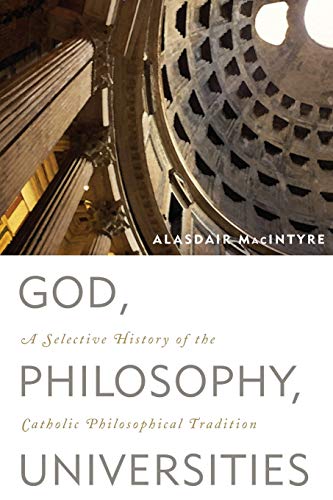
What does it mean to be a human being?’ Given this perennial question, Alasdair MacIntyre, one of America’s preeminent philosophers, presents a compelling argument on the necessity and importance of philosophy. Because of a need to better understand Catholic philosophical thought, especially in the context of its historical development and realizing that philosophers interact within particular social and cultural situations, MacIntyre offers this brief history of Catholic philosophy. Tracing the idea of God through different philosophers’ engagement of God and how this engagement has played out in universities, MacIntyre provides a valuable, lively, and insightful study of the disintegration of academic disciplines with knowledge. MacIntyre then demonstrates the dangerous implications of this happening and how universities can and ought to renew a shared understanding of knowledge in their mission. This engaging work will be a benefit and a delight to all readers.
User’s Reviews
Editorial Reviews: Review MacIntyre is the master craftsman of the guild of the Catholic philosophical tradition; we are his apprentices, and studying his masterful narration of this tradition’s history…is our first task. ― Modern Age Published On: 2011-09-01There is a prophetic quality to much of the work of Alasdair MacIntyre, a quality present in his new book, God, Philosophy, Universities. . . . MacIntyre has offered a framework for moral discourse that tries to reconcile the claims of historicism with the need for objectivity. . . . MacIntyre brought us along on an extraordinary intellectual journey. ― Commonweal Magazine Published On: 2010-03-01Fascinating. ― Logos: Journal Of Eastern Christian StudiesWhile not a work of academic philosophy―MacIntyre intends it for undergraduate seniors and first-year graduate students―this book can profitably be read by any reader of First Things. In fact, it should be so read, as either an introduction or a refresher to the great tradition, and then passed on to a friend. ― First Things Published On: 2010-07-01Without ostentation he displays his great learning, pointing out, almost in passing, that what many an undergraduate thinks is the height of modern philosophy was actually knocked out by Augustine more than a millennium beforehand. ― Comment Magazine: Cardus Published On: 2011-06-24MacIntyre incorporates . . . his view that modern university education has become fragmented and absent of any inquiry into the relationship between the disciplines, leaving little place for theology or philosophy. ― Publishers Weekly Published On: 2009-04-01One could not wish for a better statement of either the nature and promise of Catholic philosophy or its perilous position in the contemporary university. ― TheologyThis compact book will be very useful to undergraduates, graduate students, and scholars of the philosophy of religions, and for clergy. Highly recommended. ― Choice Published On: 2009-11-08MacIntyre has offered a book that serves its intended non-specialist audience well…. He explains the Catholic philosophical tradition in a way that will be accessible to intelligent readers and shows how the tradition truly is philosophical…. MacIntyre’s contributions are welcome and go some distance to showing how theism is ultimately more satisfying from a strictly philosophical standpoint…. A useful starting point for those many students and lay people who have been denied the very sort of education that MacIntyre here espouses, including and especially within our Catholic universities. ― American Catholic Philosophical QuarterlyMacIntyre indicts the university for its lack of integration, the disconnections among the disciplines, and the intellectual disregard of one discipline for another. ― The Chronicle ReviewAlasdair MacIntyre, one of the world’s leading moral philosophers and author of the classic volume After Virtue: A Study in Moral Theory, would give academic theology a central role. In his most recent book, God, Philosophy, Universities, he appeals to John Henry Newman’s The Idea of a University (1854) to argue that philosophy, and its close ally, theology, make a university what it should be – a ‘universe’ of knowledge. Universities today, MacIntyre complains, keep their disciplines separate. Hence students are being trained up for specialised job opportunities rather than for life, while research programmes fail to make connections across the broad span of neighbouring subjects. He advocates that theology should listen to, and be in constant conversation with, every other academic discipline if universities are to fulfil their function as places where students and teachers explore what it means to be human. ― Financial Times Published On: 2010-04-01MacIntyre thinks that lay Catholics, especially those engaged in current controversies that make philosophical claims, should know something about the history and tradition of Catholic philosophy. His account pivots on St. Thomas Aquinas, of course. Before him are Augustine, Boethius, Anselm, Islamic and Jewish influences, and other topics. ― Research Book News Published On: 2010-08-01Beautifully and crisply written, and historically based, this book makes an insightful case for a certain slant on Catholic philosophy. Worth the price of admission, even by itself, is the first-chapter paragraph that ends ‘… the deepest desire of every such being, whether they acknowledge it or not, is to be at one with God.’ — Harry J. Gensler, John Carroll UniversityA fascinating narrative of the development of Christian and especially of Catholic philosophy, conveying a powerful argument for the necessity of Catholic philosophy and a forceful statement of the challenges facing Catholic philosophers―and the universities that they inhabit―today. — Arthur Madigan, Boston CollegeThis is MacIntyre at his best: relating intellectual and cultural history while engaging philosophically with core ideas and arguments. Here the focus is on the interweaving of religious ideas and philosophical enquiry through the development of Catholic Christianity, leading to a challenge to Catholic thinkers to enter more fully into philosophy, and to universities to reacquaint themselves with their ancient vocation. MacIntyre has set a new foundation for discussion and further study. — John Haldane, University of St. Andrews and the Pontifical Council for CultureThis book clearly explains the fundamental problems and the historical background for the philosophical inquiry about God and how human beings are related to God. This book is essential reading both for seasoned philosophers (teachers) and for relative beginners in the field of philosophy (students). It enables the reader to step back from his or her specialized work, and see how the study of philosophy is first and foremost what its etymology says, a pursuit of wisdom. — Patrick Lee, Franciscan University of SteubenvilleGod, philosophy, universities is both a tour de monde and a tour de force. Alasdair MacIntyre provides a swift, personal but not at all tendentious history of where philosophy has come from, where it has been, and what it has become, with special reference to its role in the university. — Ralph McInerny, University of Notre DameIn his accessible new book, the influential philosopher Alasdair MacIntyre shows how a distinctively Catholic understanding of the university might restore even to the secular university, a sense of purpose, of the nature of academic inquiry as ordered to a unified conception of truth, a conception that gives due credit both to the diversity of the parts of the curriculum and to the ways in which those parts complement one another. — Thomas Hibbs, Baylor University About the Author Alasdair MacIntyre is professor emeritus of philosophy at the University of Notre Dame. He has written 16 books, including After Virtue, Three Rival Versions of Moral Enquiry, A Short History of Ethics, and, more recently, Edith Stein: A Philosophical Prologue, 1913-1922.
Reviews from Amazon users which were colected at the time this book was published on the website:
⭐Alasdair MacIntyer’s book titled GOD, PHILOSOPHY,UNIVERSITIES has a copywrite date of 2009. The book makes an attempt to demonstrate that Catholic Philosophy and Theology have a long and productive history which needs more attention. Readers will learn useful history and attain an appreciation for the achievements of devout Catholic scholars.MacIntyre’s opening sections dealt with a difficult question of the early Christians. Many of the early Christian/Catholic scholars pondered over the fact that God made men to think. Yet, such thinking could interfere with the demands of obedience to God. In other words, what was truth and where did it lie. Historians of the Catholic Church know that Church councils, Catholic debates, etc. continued this argument which is still unresolved. Yet, much original work resulted from these differences of opinion.The section on St. Augustine (354-430)placed him in the middle of different views of Christ, the Church, etc. St. Augustine was well aware the Council of Nicea (325 AD)and the question of the Holy Trinity. St. Athanasius (c 293-373) argued for the concept of God as Three in One (The Holy Trinity). St. Augustine, who was a Manichean, converted to the Catholic Faith under the auspices of St. Ambrose (347-397). St. Augustine could be a stern moralist, but he also enshrined such virtues such as charity, bona fide love (perhaps Divine Love), etc. MacIntyre related that St. Augustines basic thesis was the men love the wrong things such as greed, lust, power, etc. which separated men from THE CITY OF GOD. St. Augustine saw state power and authority as a necessary evil to control crime and theft.MacIntyre’s section re Boethius (c 480-525), the Pseudo-Dionysius (c. 500 AD), and St. Anselm (1033-1109)confronted the problem of reason and the Faith. Boethius was more of a mystic similar to St. Augustine, but Boethius included Aristotle’s (384-322 BC)works on reason and logic. The status of the Psudo-Dionysius was interesting. Some Catholic Churchman confused him with one of St. Paul’s associates. When the Psudo-Dionysius’ identity was discovered, many Catholic monks and scholars dimissed his work. However, St. Thomas Aquinas (1225-1274)accepted it in spite of the questionable status of the author.Macintyre gave explanations of St. Anselm’s (1033-1109)ontological reasons for God’s existence. St. Anselm was devoutly religious and an ardent believer in the Catholic Faith. Yet, he is considered by some as the Father of Scholastcism. St. Anselm insisted that there had to be SOME reason to support the Faith or else the Catholic Faith could be called unreasonable.MacIntyre included the contributions of Jewish and Moslem scholars to Medieval teaching and learning. His inclusion of Averroes (1126-1198) and Maimonides (1135-1209)helped to explain the inclusion of Greek thought and especially Aristotle’s corpus into Medieval Catholic universities. Obviously,such thought was challenged in Europe,but Aristotle’s work gained acceptance when Church authorities saw it in the service of the Catholic Church and God.What was of historical interest was the little contribution of the Greek Byzantines. Due to the fact that the Byzantines accepted the concept of Caesaropapism, the Byzantine rulers limited scholarship due to possible potentially dangerous questions about the Byzantine ruler being the head of the Byzantine Church. In Western Europe, the Catholic Church authorities were often at odds with the secular rulers. The Catholic authorities needed thoughtful men to make claims about the rights of the Church vs. secular rulers. The Catholic Scholastics thought that Theology, the Queen of the Sciences, included all learning including history and science. One of the problems that was often debated was the status of the Cosmos. Aristotle and some of the Moslem scholars argued that the Cosmos was eternal. On the other hand,the Catholic Scholastics argued that the Cosmos was created Ex Nihilio or out of nothing. However, as St. Thomas Aquinas stated the goal was truth and knowledge and that truth was where ever it was found even among the Greeks, Jews, and Moslems.Obviously the crown jewel of Medieval Philosophy/Theology was St. Thomas Aquinas. He attended the University of Naples where he learned of Aristotle’s METAPHYSICS and PHYSICS at a time when such studies were banned at the University of Paris (1244). There was an adage that the closer one was to Italy and Rome, the more comprehensive teaching and learning were. St. Thomas Aquinas tried to unite philosophy and learning with what he thought was the truth of the Catholic Faith and reality of God. Aquinas rejected the concept of a universal soul and the duality of the body/soul that was often debated. Aquinas did not see the physical world as evil but as an example of God’s creation. Medieval Catholic Schoolmen saw the university as institutions to discover truth and how to think.The Scholastics who followed St. Thomas Aquinas included John Duns Scotus (1266-1308)and William Ockham (1283-1347)who thought Aquinas tried to prove too much. Scotus and Ockham may be considered as Nominalists because of their overriding concern of the use of concepts and names. This led to the trivalizing Scholasticism and led to parody and ridicule. The teaching of Scholastic thought was reduced to repetition and sterility. As a result, the Scholastics contributed little during the age scientific discovery during Early Modern European History.MacIntyre argued that men like Descartes (1596-1650) and Pascal (1623-1662), while devout Cathlics, used too much guess work and mysticism to prove reality. Decartes’s work was quickly challneged when Newton (1642-1727)corrected some of Decartes’ errors in physics. Pascal’s “bet” fell on deaf years. MacIntyre stated that between c 1700-1850 that Catholic thought was negligible. The few men who tried to unite philsophy and science were largely ignored. These men included Nicolus de Molegrauche (1638-1715), Father Jospi Bassovitch (1711-1783), and Father Rosini-Serbbate (1797-1850) who did important work but got little attention. Father Gregor Mendal (1822-1884)did pioneer work in genetics only to be neglected until the 20th. century.This neglect ended during the papacy of Pope Leo XIII and Cardinal Newman (1801-1890). Pope Leo XIII demanded that Scholastic Philosophy/Theology be an integral part of Catholic seminaries and colleges/universities. Cardinal Newman insisted that college/university teaching and learning develop unity across academic disciplines. Newman argued that college/university teaching should include virtue and a bona fide search for truth. This is not the same as good taste as some would have it.MacIntyre’s last chapter is NOT encouraging at all. MacIntyre clearly states that knowledge and learning have disintegrated into petty disiplines and complete disconnection of knowledge and honest scholarship. However, we can hope for more than what we expect.MacIntyre could have strengthened this book by including Catholic scholars who contributed so much to science while remaining devout Catholics. For example, Father Jaki (1924-2009)did exceptional work in advanced physics. Father Lemaitre (1894-1966)did exceptional work by developing a mathematical model of an expanding universe which was conformed by Hubble (1889-1951). Mention could have also mentioned two books edited by Cardinal Schonborn titled CHANCE OR PURPOSE and CREATION AND EVOLUTION. However, the omission of these books should not deflect from the usefullness of MacIntyre’s book.
⭐This is a wonderful book, it makes you wonder, almost a spiritual, religious experience. It is notable for its clarity, brevity, and fairness to those philosophers with whom MacIntyre disagrees (in that, he is like Aquinas.)The book presents itself as the summary of a “History of Catholic Philosophy’ course given at Notre Dame, and those who took that course were blessed. Although it would serve as a fine introduction to Catholic philosophy, it is also a good, compact reminder for those who have already studied that material. I found myself not only enjoying the thread of Catholic philosophy, compared with secular philosophy and Catholic theology, but I obtained new insights on several individual thinkers.For instance, I was not aware (or forgot) the extent to which Descartes had borrowed the ‘cogito ergo sum’ from Augustine. I never knew how much John Henry Newman depended on Joseph Butler. MacIntyre underscores the sad fact that just as the Enlightenment philosophers flourished, Catholics philosophy became moribund, which explains why we are still trying to ‘catch up’ with critiquing the modern philosophy which underscored the Enlightenment and modernity.In conclusion, MacIntyre focuses on (St.) Edith Stein and Karol Wojtyla (Pope John Paul II), especially his encyclical letter “Fides et Ratio,” Faith and Reason. For true, and even orthodox, Catholic thinking, one must not choose between a rationalistic philosophy, or a fideistic, fundamentalistic faith, but it must be a both/and.And in the contemporary era, Catholic universities have tried too hard to ‘keep up the with the [secular university] Jones,’ while not trying to integrate the wisdom gleaned from the various physical, economic and psychological sciences, contrary to the Catholic-founded universities of the middle ages, and the thinking of Cardinal Newman. If and when they do not, they are not helpful toward their original mission, of evangelization through scholarship. Highly recommended.
⭐I have read 4 of Mr. MacIntyre’s books and found them clear and insightful. They were a pleasure to read. He avoids the jargon of professional philosophers. I admire his dedication to truth. His search has lead him far afield from current modern thinking, yet he is deeply respected for his useful contributions to the study of wisdom.This book is no exception. For believers it clarifies the problems of God and Faith while showing why God and Faith are rejected by so many. The reflection of our society in the university systems of the west, beginning with Descartes to today squares with my experience. I was instructed in a midieval system. On day one of High School I knew in order what subjects I would take and my date of graduation. Same for college. Everything was connected. When I went to a modern university I found that connections between disciplines were few and even the philosophy department was pretty disjointed and chaotic.This book ends with a powerfully compelling challenge. “Catholic Philosophy will only return to its rightful place as a mainstream contenter in modern philosphy when it engagages, incorporates, and transcends all philosopical views. Catholic Philosophy is called, in his mind, to present a compelling and dynamic picture of Truth.
⭐A nice textbook
⭐Very good overview and for the academic library
Keywords
Free Download God, Philosophy, Universities: A Selective History of the Catholic Philosophical Tradition in PDF format
God, Philosophy, Universities: A Selective History of the Catholic Philosophical Tradition PDF Free Download
Download God, Philosophy, Universities: A Selective History of the Catholic Philosophical Tradition 2011 PDF Free
God, Philosophy, Universities: A Selective History of the Catholic Philosophical Tradition 2011 PDF Free Download
Download God, Philosophy, Universities: A Selective History of the Catholic Philosophical Tradition PDF
Free Download Ebook God, Philosophy, Universities: A Selective History of the Catholic Philosophical Tradition