Ebook Info
- Published: 2004
- Number of pages: 255 pages
- Format: EPUB
- File Size: 0.38 MB
- Authors: Isaac Asimov
Description
The first novel in Isaac Asimov’s classic science-fiction masterpiece, the Foundation seriesTHE EPIC SAGA THAT INSPIRED THE APPLE TV+ SERIES FOUNDATION • Nominated as one of America’s best-loved novels by PBS’s The Great American Read For twelve thousand years the Galactic Empire has ruled supreme. Now it is dying. But only Hari Seldon, creator of the revolutionary science of psychohistory, can see into the future—to a dark age of ignorance, barbarism, and warfare that will last thirty thousand years. To preserve knowledge and save humankind, Seldon gathers the best minds in the Empire—both scientists and scholars—and brings them to a bleak planet at the edge of the galaxy to serve as a beacon of hope for future generations. He calls his sanctuary the Foundation. The Foundation novels of Isaac Asimov are among the most influential in the history of science fiction, celebrated for their unique blend of breathtaking action, daring ideas, and extensive worldbuilding. In Foundation, Asimov has written a timely and timeless novel of the best—and worst—that lies in humanity, and the power of even a few courageous souls to shine a light in a universe of darkness.
User’s Reviews
Reviews from Amazon users which were colected at the time this book was published on the website:
⭐I read this as kid and remembered being interesting. It is still interesting because instead of action adventure it is great people doing great things and the tale then moving on. But it is dated as only men are the main characters.
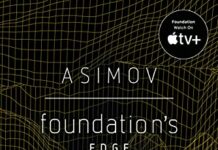
⭐I really dislike this novern cover. Readers shouldn’t expect the streaming series with the book. Two different things.While I liked this book, I’d rather have read “Prelude to Foundation” and “Forward The Foundation” before this one. Those two deal with the Hari Seldon story, and I think should be read before Foundation instead of later.I thought the characters introduced were interesting, as was the idea. Nice read.
⭐Asimov’s world building is fantastic. I’ve read the Foundation and Robot series multiple times and I expect to do it many more times.
⭐Breathes there a teenager of the md-20th century with a love of science fiction who was not weaned on the Foundation series? All that sweeping drama, testosterone-laden but basically non-violent (all the violence is simply swept into summarizing references to ships destroyed and cities ransacked) marching through decades without concentrating on anything really boring, like character development, emotional entanglements or the trappings of society. Not a single reference to such trash as classical music, or stage shows, or pop music, or romance, just sweeping views of a distant future (or could it have been the distant past?) with the means of traveling between stars in the galaxy in the flash of a gnat’s eyelash.And yet . . . revisiting the beloved Foundation, reading through the filter of a lifetime of experience, cracks appear in the plaster, and beneath them one finds that the lath is too widely spaced, the bricks behind that lath are often without mortar, and one can see the trees where bricks are missing. We live already in an age where technology has bypassed this particular Universe. Computers have become infinitely more pervasive than Asimov might have dreamed in his wildest fantasy, for at the time of the writing they were mere collators of stacks of punched cards, the transistor had yet to be introduced or shrunk to the size of a grain of sand, much less a sub-microscopic speck imprinted by the millions on a tiny wafer of silicon.Asimov had enormous faith in the future of Humanity, but he had no idea of how rapidly that future would approach – or how slowly humans would react and adapt to the challenges posed. No Empire can be established when information is instantaneously available to three-quarters of the population. Will an army composed of humans indefinitely repress an entire population composed of their friends, family, relatives? We see the answer in Libya, in Egypt, in Syria, in Africa – where the mobile phone has allowed guerrilla tactics to be employed by any group, whether terrorist or freedom-fighter or mall-invasion gangs or “mothers against the death camps of dog pounds.”Human society has been transformed by 24/7 information availability – but the universe of the Foundation proposes a populace of ciphers acting in ignorance of facts that would already be generally available in the 21st century. “Just Google it” or “look it up in Wikipedia” is nowhere to be found. There is a project of the First Foundation to write a “Galactic Encyclopedia” – yet it already exists in 2012.And yet that universe is immensely attractive, reduced to comic book simplicity, perfect for any adolescent (whether 14 or 74) to immerse himself – or very infrequently herself, as this universe is truly misogynist: the strongest female is just a papier maché accoutrement.The psychobabble of “psychohistory” which is the very premise of the Foundations is wholly implausible, of course. The introduction by Asimov of “The Mule” is his admission of the absurdity of such a concept, which he probably didn’t consider when the first book was written. Man has mutated more rapidly in the past 10,000 years than Asimov’s populace has in 50,000 – a highly unlikely probability in the event that man actually progresses to interstellar colonization.All that said – I downloaded the trilogy on Kindle whilst in America, read it through lovingly, and was again transported to that clean, technologically impossible universe, forgetting all the travails of real life at present, putting the horrors of terrorism, the Hunger Games, the beheadings of “infidels” and the lies of politicians to one side for too brief a span. It isn’t great literature, not even great Science Fiction – yet it is riveting to any adolescent male who enjoys reading as opposed to or in parallel with the escapism of cinematic action films like the “Matix” or “Terminator” trilogies.For some reason, Europeans aren’t allowed to download the books. No doubt the vagaries of copyright laws, tax authorities and those £%^&* politicians – as well as the accursed lawyers (who are blissfully absent from the trilogy, undoubtedly bred out of existence due to their total lack of humanity).Asimov was the supreme techie of his time – and it shows in his use of language – sparse, precise, technically impeccable, but occasionally impenetrable without a modicum of concentration.I heartily recommend it to you !
⭐First, some rebuttals. The books do have a badge about The Foundation being a Apple TV+ miniseries. It is not an ad for the series. Recall that books used to be displayed on shelves in places they called “bookstores.” They would put tie-ins like this on books to get you to buy the book if you were watching, or looking forward to watching the movie or TV series based on the book. The purpose was to get you to buy the book, not advertise the media you were going to watch.In fact, this is why I bought the trilogy. The last time I read these books was before cell phones and personal computers. I was, among other things, wondering how well it would hold up. Because we are talking about interplanetary travel, I can’t really imagine that an update of this story would involve cell phones and, there is no part of the story which may have been changed, knowing about personal computers. I don’t find it outdated at all. Now, we do now know that missions are planned and replanned and rehearsed before people get into their spacecraft. But that is an issue that, for the most part, we don’t see in SciFi. From Star Wars to Moonfall, our favorite science fiction characters get up there and do their stuff by the seat of their pants. As for the updates that were inserted in the Apple TV+ mini-series, there isn’t one change that seemed to help the story out and being more faithful to the original would certainly done a better job. And I am talking about plot elements. I am not talking about the race and gender of the characters. You want to fool with that, be my guest. But leave the plot as much as possible as it is in this wonderful series of books.
⭐I first read this series in my youth. Entranced at the time, I devoured the initial trilogy. Now, after long years I appreciate the smooth transitions, colorful characters and mathematic precision of this work.Bravo Isaac Asimov!
⭐“Violence is the last refuge of the incompetent.”Anyone who knows Science Fiction knows that Foundation is a seminal work, one of the great works, an era defining masterpiece of the genre. But what does that mean for the reader now? Does a book written in 1951 still stand up?Foundation is the story of the collapse of an intergalactic empire and the efforts of a scientific community to preserve and rebuild. It is exactly that ambitious in scope and in never flinches from that. It is creative, engaging, visionary, leaps smoothly from generation to generation and adventure to adventure in a fashion that would make a Marvel movie feel comfortable and is, above all, a bloody good read. It is also jammed packed with some of Asimov’s most quotable lines (the above about violence being my favourite).There are problems for a modern audience. The endless reference to “atomic” weapons feels quaint rather than threatening. The idea that you might mathematically model future social development based upon predicated behaviour of the masses provided there is no significant influence from individuals feels rather silly now, especially for those of us who have worked in the modelling of crowds: you kind of have to swallow the principles of “psychohistory” as psychobabble and roll with it. Finally, there aren’t any women to be seen. After all, why would women want to have anything to do with this nasty Science nonsense (cough, Bletchly park, cough.) Oh, wait, there’s a wife. She nags a lot.Still, it was 1951, and if you can look past the stuff that doesn’t make any sense any more this is still a brilliant book and a brilliant read. Most of all, if you want to indulge yourself in the old days when we used to think the smartest and the bravest would win out against the stupidest and most loud, this is a warm balm against the nasty burns you get from watching the news.I will add that I haven’t read any of the sequels, so there may be a feminist uprising in second foundation that includes a complete revision of psychohistory to embrace the modelling of chaos. But, to be honest, as long as it has more spaceships and smart people I’ll keep reading.
⭐I read this as a thirteen year old, over forty years ago, remember being captivated by it and decided to re-read it.Oh dear, I guess some books don’t age well and the eyes of adulthood see them very differently.It’s a classic, but now seems quite dull and dated. The technology of the planets on the edge of the crumbling empire seems laughable. Does Asimov really expect us to believe atomic power is revered as a religion to planetary systems that no longer understand it? The prose is clunky and the politics rather contrived. The book is really quite dull; whatever did I see in it? My fault for revisiting what I recall as a childhood favourite.
⭐Just like with I, Robot, Asimov’s Foundation is really a collection of short stories – five in this instance. It’s a format that’s pretty common for the time it was written: science fiction stories were largely published not as single complete works but as serials in magazines, and so they needed to be on the shorter, snappier side of things. It’s only later that these stories were collected into a single bound edition and sold as novels. Each of the five stories details a significant era in the history of the Foundation as it faces crises mathematically and psychologically calculated to lead it inexorably to the formation of a new Empire after the old has fallen. These involve stories of how the Foundation establishes itself on the planet Terminus first as a scientific outpost, and then going through several metamorphoses to prevent it from being overtaken by its “barbaric” (hmm.) neighbours.Wait… are they mathematicians or psychologists? The book seems to start off with Seldon as a mathematician and then goes onto refer to him as a psychologist throughout all the other stories. Weird.The fall of the Galactic Empire as explored by Asimov is based around the history and fall of the Roman Empire. It’s a great concept, as with all of Asimov’s work – very high in concept indeed, for its time – but as a thoroughly modern reader, I couldn’t help but feel it was all rather… simplistic.What do I mean by “simplistic”? The reason we’re given for the fall of the Galactic Empire is stagnation of thought: the entire galaxy has basically forgotten how the 50,000 year old technology of “atomic power” operates – a crucial technology for their very survival – and instead of training more people to reclaim that knowledge, they ignore it and restrict the use of the technology to the core worlds (and have maintenance people constantly doing minor repairs on power plants that are falling apart because they only know how to use it empirically). The consequence is that entire star systems essentially regress to an early 20th Century level. And the reason for all of this is because the nobles of the Empire have forgotten what the scientific method really is, and nobody is bothered about doing any new scientific research. They only want to catalogue the old.An entire galaxy. Hundreds of thousands of planets. Quadrillions of people. And everyone’s simply forgotten how to do science? Come on.Countless works have elaborated on the foundation (pun intended) Asimov laid here over the years. Galactic empires have been a staple for large-scale epic sci-fi for decades now, and I daresay they’ve refined the concept. We have more believable politics and motives, more complex machinations, and deeper analyses in later works than here right at the start. The politics that led to the rise, and then the resistance that preceded the fall of the Empire in Star Wars, for instance, is far more engaging and believable than the reasons given in Foundation. It is perhaps because Asimov frames the concept of an empire as a largely good thing: sure the current Galactic Empire is rotten to the core due to corruption and stagnation, but we only need to do it right next time around. Whereas in more modern works, a true empire (under a single absolute monarch) is pretty much universally acknowledged as a bad thing: a force for the evils of conquest and indigenous erasure.So, in all, I don’t think the version of the Empire Asimov has in Foundation holds up today. I mean Frank Herbert’s Dune, written only 14 years later, does it a lot better.Also, I know this is endemic of the genre in general (most egregiously in Star Trek), and something we’ve begun to move past now, but we have a failure of worldbuilding in that planets are treated as though they are small nations or settlements. It’s much easier to manage a world when it has only one type of people on it and is administered from one central place, but across an entire planet it’s not very realistic. Terminus, the planet of the Foundation itself, is excused from this, because the Foundation literally is a small settlement on an otherwise barren and inhospitable world lacking in resources. The other planets of the outer reaches – Anacreon, Smyrno, the other two of the Four Kingdoms, and Korell? No. Not excused. It’s possible the problem here is that Asimov was trying to apply the fall of the Roman Empire to a vastly upscaled civilisation, to the point where I think a lot of that stuff falls apart. Controlling lots of planets is a different creature to controlling and administering several countries on one planet. If you can only just barely do the one with a centralised totalitarian regime, there’s no way you can do the other.The Foundation’s growth isn’t particularly believable either. I can buy that it starts as a small settlement focused wholly on creating the Encyclopedia Galactica, and that it needs to leverage its bargaining strength as the only atomic power in the sector to stop itself being invaded by the Kingdom of Anacreon, but later on it turns science into a religion and rules through it and… what? It kind of lost me at that point. I couldn’t suspend my disbelief any more after that.Let’s move on to characters. Asimov is not good at characters. I’ve been told he’s better at it in later books, but these early works really do just treat characters as entirely inconsequential. One of the main reasons Foundation is not engaging to me as a modern reader is because there’s zero attention paid to the people in the story. Couple this with the fact that the five stories are short and they each represent a significant jump forward in time and a brand new set of characters, by the end I didn’t know or care who anyone was, aside from Hari Seldon and Salvor Hardin. Even then, everyone has essentially the same personality – the main characters in each story are shrewd, businesslike, intelligent, logical and project this air of professionalism akin to MPs in the House of Commons pretending to be gentlemanly. They all chomp cigars and outwit their opponents. The differences between them are very minor. By contrast all of their opponents are framed as stupid; angry, lumbering oafs that are easily outwitted by applications of simple logic.The prose lacks in any meaningful description, and the setting of each story is essentially in a meeting room or an office. It involves people: dignitaries, mayors, boards of trustees etc… sitting down in formal meetings and talking – all except the last story, The Merchant Princes, which does have changes of scenery at least. It all makes for very dull reading. There’s snippets of action here and there that hint at the potential of the story, but overall the execution feels like a rough outline. This is the skeleton of a story. With actual character development, engaging imagery and heavy edits, this one book could be expanded into a five-part series of 100,000 word novels (and that’s forgetting the rest of the series).As it is, if you took the characters out and presented Foundation as an essay, it would make more sense.I enjoyed parts of the book for its ideas, and for the inkling of greater things that poked at my imagination – Derelict Imperial Cruisers, threats of war and the fear of retaliation from the Empire. Some of the characters were okay. Salvor Hardin and Hari Seldon were decent, for instance. My favourite story out of the lot was The Mayors – the third – where Mayor Salvor Hardin prevents a war by showing just how much the Foundation has infiltrated the hearts and minds of their entire society. But overall, it doesn’t hold up, and I won’t be prioritising reading further in the series. There’s a niggling curiosity in the back of my mind to see where the Foundation goes after The Merchant Princes, so I may read the next book at some point, but it won’t be for a very long time.Oh, and something that made me laugh, that’s absolutely indicative of its time: The first mention of a woman character is on page 186. We see her all of twice, though she does hold significant political influence – she was quite interesting, actually. But the book is only 231 pages long! There’s also the preponderance on ATOMIC EVERYTHING. I’m sure modern writers will be laughed at in 100 years time for our quaint ideas about far future technology, but it was nonetheless amusing to read the idea that literally everything in Asimov’s future is powered by atomic generators. From spaceships to personal shields, to weapons and dishwashers and even women’s clothing accessories. It’s a good thing Asimov assures us they’ve cured cancer 50,000 years from now.But there’s also the idea that Asimov didn’t think beyond the miniaturisation of atomic power. He has a character state that atomic power is a fifty thousand year-old technology. Surely a Galactic Empire that’s been around for 12,000 years, 50,000 years from now, would be using something other than nuclear fission – which is undoubtedly the type of “atomic power” Asimov is talking about here, given it was a new thing at the time he was writing this. Only seventy years on, and we’re so close to having viable nuclear fusion power. Tens of thousands of years in the future I’d expect us to be a lot further on than that (and we’d need to be, if we’re to travel the stars and become a galactic civilisation).There’s weird errors in the version of the book I’ve got as well. I don’t mean the odd typo that’s slipped through, but a character in the final story called Sutt is routinely and erroneously referred to as “Sun”. I thought at first it was just an expression the characters were using (like “great galloping galaxies!” – that one made me laugh, legitimately) but as I read on, it definitely seemed like they were using Sun as Sutt’s name. Very odd.
⭐Is there anything more distracting from the storyline of the book you’re reading than typos and editorial errors every few pages? Amongst other mistakes, there was a name of one of the characters that kept alternating between two different spellings, and at one point even a big chunk of text that appeared to have been accidentally copy/pasted! Unfortunately this really spoiled my enjoyment of the book. The story itself was quite interesting – not amazing, but it kept me fairly interested to the end. Apparently this is the first in a series of books, but I’m not in a rush to buy any of the others.
⭐Asimov’s Foundation books are rightly so seen as masters of the art of science fiction. The concepts, the ideas and the execution of the books is near flawless and the basic ideas have spread through many other Asimov books.Anyone interested in these books would presumably already have some idea of the central idea of psychohistory being used to model future human events and society. It was a revolutionary concept back in the 1950’s and even today outside of fiction and in the real world of mathematics and human studies is debated.There are some who debunk the idea that humans and society can be modelled effectively to understand future events but there is a large body of research that does indicate it’s at least partially the case that we can understand future patterns based upon historical evidence. And the truth of that is of course the Coronavirus which has various governments basing their strategy upon the predicted actions of society based upon mathematical models using past information. It’s not quite the same but there are certainly parallels that make reading Foundation such an interesting thing.Now, inevitably having been written in the 1950’s the language and some of the social mores are a little quaint compared to modern society. Essentially Asimov reflected the times he lived in and no matter how far thinking – which sci-fi is by it’s very nature – it can only be written on the basis of current understanding. I do note another reviewer who takes to task Asimov for not creating more female protagonists which, I find surprising given that in many of his books the stronger lead characters are often women.Writing style is of course engaging and easy to enjoy which, is something one would expect from a writer of such renown and popularity.Overall, a masterpiece and one that is still relevant today 60 years on.
Keywords
Free Download Foundation in EPUB format
Foundation EPUB Free Download
Download Foundation 2004 EPUB Free
Foundation 2004 EPUB Free Download
Download Foundation EPUB
Free Download Ebook Foundation