Ebook Info
- Published: 2010
- Number of pages: 287 pages
- Format: PDF
- File Size: 23.42 MB
- Authors: Judith V. Grabiner
Description
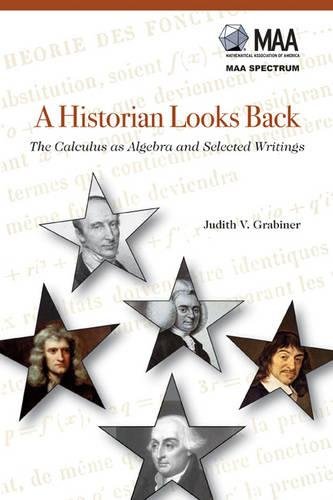
Judith Grabiner, the author of A Historian Looks Back, has long been interested in investigating what mathematicians actually do, and how mathematics actually has developed. She addresses the results of her investigations not principally to other historians, but to mathematicians and teachers of mathematics. This book brings together much of what she has had to say to this audience. The centerpiece of the book is The Calculus as Algebra: J.-L. Lagrange, 1736-1813. The book describes the achievements, setbacks, and influence of Lagrange’s pioneering attempt to reduce the calculus to algebra. Nine additional articles round out the book describing the history of the derivative; the origin of delta-epsilon proofs; Descartes and problem solving; the contrast between the calculus of Newton and Maclaurin, and that of Lagrange; Maclaurin’s way of doing mathematics and science and his surprisingly important influence; some widely held myths about the history of mathematics; Lagrange’s attempt to prove Euclid’s parallel postulate; and the central role that mathematics has played throughout the history of western civilization. The development of mathematics cannot be programmed or predicted. Still, seeing how ideas have been formed over time and what the difficulties were can help teachers find new ways to explain mathematics. Appreciating its cultural background can humanize mathematics for students. And famous mathematicians struggles and successes should interest–and perhaps inspire–researchers. Readers will see not only what the mathematical past was like, but also how important parts of the mathematical present came to be.
User’s Reviews
Editorial Reviews: Book Description In this collection of her work, addressed to mathematicians, Judith Grabiner explores the development of mathematics and the relationship between mathematics and culture. This book is an inspiring resource for those teaching history of mathematics courses. About the Author Judith V. Grabiner received her B.S. in Mathematics from the University of Chicago, M.A. in the History of Science from Radcliffe College, and Ph.D. in the History of Science from Harvard in 1966. She is a member of both Phi Beta Kappa and Sigma Xi.Among the many awards she has received are three Carl Allendoerfer Awards (for the best article in Mathematics Magazine, 1984, 1988, 1996), and four Lester Ford Awards (for the best article in the American Mathematical Monthly, 1984, 1998, 2005, 2009).In 2003, she won the national Deborah and Franklin Tepper Haimo Award for Distinguished College or University Teaching of the Mathematical Association of America. Professor Grabiner has held a Woodrow Wilson Fellowship, an American Council of Learned Societies Fellowship, and two National Science Foundation fellowships.She currently teaches at Pitzer College, one of the Claremont Colleges in Claremont, California, where she is the Flora Sanborn Pitzer Professor of Mathematics.
Reviews from Amazon users which were colected at the time this book was published on the website:
⭐This book is half useful survey of Lagrange’s mathematics and half snappy essays with some delightful one-liners such as these:”Historically speaking, … The derivative was first used; it was then discovered; it was then explored and developed; and it was finally defined.” (p. 147) “This is certainly a complete reversal of the usual order of textbook exposition in mathematics, where one starts with a definition, then explores some results, and only then suggests applications.” (p. 160)”The Declaration of Independence of the United States is one more example of an argument whose authors tried to inspire faith in its certainty by using the Euclidean form. ‘We hold these truths to be self-evident…’ not that all right angles are equal, but ‘that all men are created equal’.” (p. 164)I also wish to record a quibble. “Why Did Lagrange Prove the Parallel Postulate?” is one of several award-winning articles reprinted here for the third time. But despite this the explanation of Lagrange’s proof is rather insufficient and includes an obvious typo (“angle HCK equal to angle ICG”, p. 259) which is also in the 2009 original. It is jarring to find such flaws at the heart of the titular argument of an award-winning paper reprinted several times as a specimen of exemplary writing.
⭐Grabiner is one of the most distinguished historians of mathematics. This book collects several of her best writings, includding several prize-winning essays. An essential book.
⭐
Keywords
Free Download A Historian Looks Back (Spectrum) in PDF format
A Historian Looks Back (Spectrum) PDF Free Download
Download A Historian Looks Back (Spectrum) 2010 PDF Free
A Historian Looks Back (Spectrum) 2010 PDF Free Download
Download A Historian Looks Back (Spectrum) PDF
Free Download Ebook A Historian Looks Back (Spectrum)