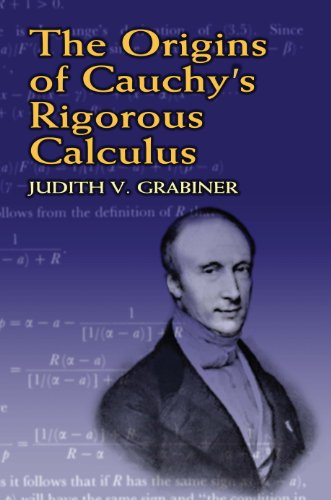
Ebook Info
- Published: 2012
- Number of pages: 274 pages
- Format: PDF
- File Size: 15.06 MB
- Authors: Judith V. Grabiner
Description
This text for upper-level undergraduates and graduate students examines the events that led to a 19th-century intellectual revolution: the reinterpretation of the calculus undertaken by Augustin-Louis Cauchy and his peers. These intellectuals transformed the uses of calculus from problem-solving methods into a collection of well-defined theorems about limits, continuity, series, derivatives, and integrals. Beginning with a survey of the characteristic 19th-century view of analysis, the book proceeds to an examination of the 18th-century concept of calculus and focuses on the innovative methods of Cauchy and his contemporaries in refining existing methods into the basis of rigorous calculus. 1981 edition.
User’s Reviews
Reviews from Amazon users which were colected at the time this book was published on the website:
⭐The Origins of Cauchy’s Rigorous Calculus by Judith V. Grabiner is more technically challenging than many books on the history of mathematics. A year or two of calculus is a prerequisite for full appreciation of Grabiner’s work; a class in real analysis would be helpful. Grabiner’s approach is scholarly, and does require careful, thoughtful attention. At points I found it useful to have an introductory analysis text nearby. Nonetheless, I fully enjoyed this fascinating book. (My university classes included several applied math courses. In recent years I have developed an interest in mathematical logic and analysis.)Augustin-Louis Cauchy’s lectures at the Ecole Polytechnique in Paris in 1820s played the key role in focusing interest on the development of a rigorous basis for calculus; the epsilon and delta notation first appeared in their now standard roles in Cauchy’s lectures in 1823. Based on Cauchy’s work, Abel, Riemann, Weierstrass, Dedekind, Cantor, and others subsequently made major contributions to analysis in the nineteenth century. Grabiner does not discuss this later work in any detail.Augustin-Louis Cauchy’s precise definition of the limit and his fundamental definitions and theorems on continuity, convergence, the derivative, and the integral were quickly accepted. Grabiner observes that Cauchy’s work was so superior to earlier efforts that today it seems to have emerged from a void and to be a unique creation of genius.Grabiner demonstrates, however, that not only does Cauchy’s work owe much to previous efforts by Newton, Maclaurin, Euler, d’Alembert, and especially Lagrange, but that theologian Bernard Bolzano in Prague independently had many of the same ideas as Cauchy. Unfortunately, Bolzano’s work had little immediate impact as it was largely published in either obscure eastern European journals or in personally funded pamphlets.Grabiner’s first chapter concisely establishes the importance and lasting influence of Cauchy’s work. The subsequent five chapters examine how Cauchy himself was influenced by earlier mathematicians and by his contemporaries. Chapter 2, The Status of Foundations in Eighteenth Century Calculus, explores why earlier mathematicians had seemingly little interest in developing a rigorous foundation for calculus.The next chapter, The Algebraic Background of Cauchy’s New Analysis, argues that the tools, especially the algebra of inequalities, that Cauchy required to prove his fundamental theorems were products of the eighteenth century. Key topics include the theory of algebra and the certainty of universal arithmetic, Lagrange’s contributions to approximation techniques, and other eighteenth century efforts to measure the speed of convergence and bounds on errors.Having established a historical framework, Grabiner focuses more closely in Chapters 4, 5, and 6 on Cauchy’s definitions and theorems. Chapter 4 is titled The Origins of the Basic Concepts of Cauchy’s Analysis: Limit, Continuity, Convergence. The final two chapters examine his theory of the derivative and the integral.Some sections are a bit dry (not parched, however), while other chapters flow quite smoothly. I found it awkward flipping back and forth from the text to the end notes, and I eventually began using two book marks to keep track of my locations. There is also an extensive bibliography.Moreover, an appendix contains Grabiner’s translation of several of Cauchy’s key proofs found in his Cours d’analyse and his Calcul infinitesimal. These proofs seem surprisingly modern even though they date from the 1820s.
⭐At least that’s what every math teacher I’ve ever had stated. And that is true, they did invent it. But, the really fascinating thing is: they had no idea why it worked! This was a stunning revelation to me. Often times mathematics education is presented as a laundry list of 400 years of theory and results with little motivation of how things came about or why the theorems are relevant. Maybe exceptional instructors talk about these things, I don’t know. The idea that these demi-gods didn’t understand why Calculus worked casts the subject (and in a way all of mathematics) into a different light. It really has been a journey of discovery.In this book the author explores how the logical foundation of Calculus was discovered over time, mainly in the 19th century long after the subjects inventors had passed on. This book isn’t especially light reading. I think a course in Analysis (Advanced Calculus at some schools) is necessary to understand the more mathematical parts of the book (that is, most of the book). Also, there is very little biographical discussion about the mathematicians mentioned in the book. This is a book that explores the ideas and trends that lead to Cauchy’s work, not about Cauchy himself.Also, the book excludes Bolzano from the title, although he is also a prominent figure in the discoveries. Although excluded from the title he is not excluded from the material.
⭐This light-weight book spends much of its time asserting unsubstantiated clichés and bombastically touting Cauchy’s alleged “revolutionary transformation” (p. 15) of the calculus. So, for example, we are told that “Abel’s reaction to the Cours d’analyse was almost like a religious conversion” (p. 13), for which the only evidence offered is a one-sentence quotation in which Abel calls Cauchy’s book excellent. Needless to say, only a historian blinded by a predetermined agenda could extrapolate a “religious conversion” from such flimsy evidence. Similarly, Grabiner parrots the party line regarding the motivations for rigourisation; which includes, for example, grotesque exaggerations of the impact of Berkeley’s trifling critique. We are told that “Lagrange took Berkeley’s criticisms with the utmost seriousness” (p. 27) and “became so convinced of the validity of Berkeley’s criticisms that he could not remain content with the existing foundations” (p. 37). Not even the flimsiest of evidence is offered in support of these claims; instead we read in the endnotes that “unfortunately, there is no evidence about when, if ever, [Lagrange] read [Berkeley’s critique]” (p. 189). The “unfortune” referred to here is that of not finding one’s predetermined thesis borne out by evidence; an unfortune that hampers the book throughout.
⭐Grabiner details how Cauchy re-purposed and built on the work of his predecessors to help transform the calculus into the rigorous system we know today. While her writing is rather dry, and at times repetitive, The Origins of Cauchy’s Rigorous Calculus provides a glimpse into a fascinating period of math history. Caution: This is a book about math, not a biography. A year of calculus is pretty much a prerequisite for reading this book. For those with less mathematical training, or an interest in the earlier history of the calculus, I’d recommend Eli Maor’s excellent
⭐.
⭐Nicely written…gives a vivid feeling about the period when rigorous calculus was developing …..for any math lovers…..i will recommend this book….
Keywords
Free Download The Origins of Cauchy’s Rigorous Calculus (Dover Books on Mathematics) in PDF format
The Origins of Cauchy’s Rigorous Calculus (Dover Books on Mathematics) PDF Free Download
Download The Origins of Cauchy’s Rigorous Calculus (Dover Books on Mathematics) 2012 PDF Free
The Origins of Cauchy’s Rigorous Calculus (Dover Books on Mathematics) 2012 PDF Free Download
Download The Origins of Cauchy’s Rigorous Calculus (Dover Books on Mathematics) PDF
Free Download Ebook The Origins of Cauchy’s Rigorous Calculus (Dover Books on Mathematics)