Ebook Info
- Published: 2011
- Number of pages: 696 pages
- Format: PDF
- File Size: 6.02 MB
- Authors: Bernard H. Lavenda
Description
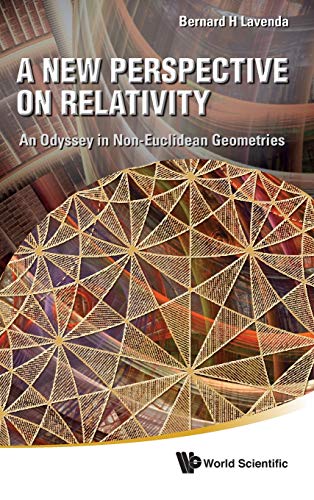
Starting off from noneuclidean geometries, apart from the method of Einstein’s equations, this book derives and describes the phenomena of gravitation and diffraction. A historical account is presented, exposing the missing link in Einstein’s construction of the theory of general relativity: the uniformly rotating disc, together with his failure to realize, that the Beltrami metric of hyperbolic geometry with constant curvature describes exactly the uniform acceleration observed.This book also explores these questions:
User’s Reviews
Editorial Reviews: Review “Lavenda’s book is the most comprehensive and subtle analysis of the relationship between physics and geometry that led to the relativistic description of the mechanics and gravity. And even for their most common misconceptions. A must!” —Electronic Journal of Theoretical PhysicsA New Perspective on Relativity made it to the Best General Relativity Books of All TimeI’m happy to announce that my book, “A New Perspective on Relativity: An Odyssey in Non-Euclidean Geometries”, made it to BookAuthority’s Best General Relativity Books of All Time:bookauthority.org/books/best-general-relativity-books?t=17ntm4&s=award&book=9814340480BookAuthority collects and ranks the best books in the world, and it is a great honor to get this kind of recognition. Thank you for all your support!The book is available for purchase on Amazon. From the Back Cover Starting off from noneuclidean geometries, apart from the method of Einstein’s equations, this book derives and describes the phenomena of gravitation and diffraction. A historical account is presented, exposing the missing link in Einstein’s construction of the theory of general relativity: the uniformly rotating disc, together with his failure to realize, that the Beltrami metric of hyperbolic geometry with constant curvature describes exactly the uniform acceleration observed. This book also explores these questions: * How does time bend? * Why should gravity propagate at the speed of light? * How does the expansion function of the universe relate to the absolute constant of the noneuclidean geometries? * Why was the Sagnac effect ignored? * Can Maxwell’s equations accommodate mass? * Is there an inertia due solely to polarization? * Can objects expand in elliptic geometry like they contract in hyperbolic geometry?
Reviews from Amazon users which were colected at the time this book was published on the website:
⭐At a time when theories have to revert to exoteric scenarios like inflation, or exoteric substances like ‘dark energy’, not to speak about the need of twenty-six dimensions for a toe, this book advocates `back to basics.’ It addresses some awkward issues that were raised by 19th century scientists, but brushed under the carpet by 20th century ones. It uses hyperbolic geometry as a measuring stick upon which to evaluate both special and general relativity theories. It might ruffle some feathers by proposing that physics is determined by the known non-Euclidean geometries, and not inventing geometries to fit what is conceived to be the physics. This book does for relativity and gravitation what Alfred O’Rahilly’s monograph, Electromagnetic Theory, did for electromagnetism by unraveling the historical development of basic concepts and ideas, and showing how they were later distorted and taken out of context. A must read for anyone looking to get a grip on what a relativistic description of mechanics, thermodynamics, and gravity can and ought to do.
⭐The book debunks general relativity, and the paradoxical conclusions of special relativity. All the tests of general relativity are derived in much simpler, and physically intuitive manner, without the need of introducing the heavy machinery of tensors and pseudo tensors. It poses the question of why invent new, non-constant curvature geometries when the constant curvature geometries are more than sufficient in three dimensional space without the added time dimension? The only test of general relativity that depends upon time is the red-shift, which has nothing to do with the space dimensions. So what does a four dimensional metric have to say about gravity? If, nothing else, the book claims that there are no singularities of the inner solution to the Schwarzschild metric since the alleged singularity occurs at the boundary of hyperbolic space of the disc model. A provocative read for anyone interested in relativity and its history.
⭐First with the tongue in cheek remarks of Ohanian’s “Einstein’s Mistakes,” then with the recent appearance of Schlafly’s “How Einstein Ruined Physics,” and now with Lavenda’s quantitative criticisms of Einstein’s science, it does appear that things are changing about the man who invented E=mc^2, or did he? As the author points out, these criticisms and plagiarism charges are not new having been championed all along by the French school. But what makes the latter book stand out is that Lavenda offers a panacea, a new way of looking at relativistic effects that starts with the geometry and not one which ends with it. Although certain sections are technical, Lavenda never loses sight of his physical objectives. Personally, I was surprised to see how many misconceptions have infiltrated into the literature, and more especially into the textbooks. Definitely worth the money.
Keywords
Free Download A New Perspective on Relativity: An Odyssey in Non-Euclidean Geometries 1st Edition in PDF format
A New Perspective on Relativity: An Odyssey in Non-Euclidean Geometries 1st Edition PDF Free Download
Download A New Perspective on Relativity: An Odyssey in Non-Euclidean Geometries 1st Edition 2011 PDF Free
A New Perspective on Relativity: An Odyssey in Non-Euclidean Geometries 1st Edition 2011 PDF Free Download
Download A New Perspective on Relativity: An Odyssey in Non-Euclidean Geometries 1st Edition PDF
Free Download Ebook A New Perspective on Relativity: An Odyssey in Non-Euclidean Geometries 1st Edition