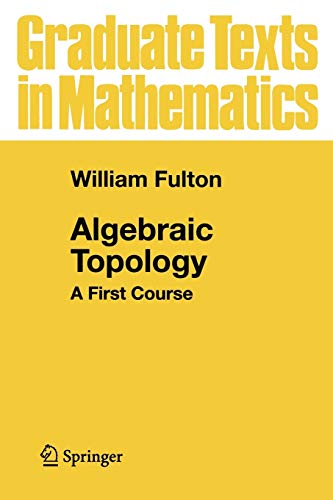
Ebook Info
- Published: 1995
- Number of pages: 448 pages
- Format: PDF
- File Size: 14.14 MB
- Authors: William Fulton
Description
To the Teacher. This book is designed to introduce a student to some of the important ideas of algebraic topology by emphasizing the re lations of these ideas with other areas of mathematics. Rather than choosing one point of view of modem topology (homotopy theory, simplicial complexes, singular theory, axiomatic homology, differ ential topology, etc.), we concentrate our attention on concrete prob lems in low dimensions, introducing only as much algebraic machin ery as necessary for the problems we meet. This makes it possible to see a wider variety of important features of the subject than is usual in a beginning text. The book is designed for students of mathematics or science who are not aiming to become practicing algebraic topol ogists-without, we hope, discouraging budding topologists. We also feel that this approach is in better harmony with the historical devel opment of the subject. What would we like a student to know after a first course in to pology (assuming we reject the answer: half of what one would like the student to know after a second course in topology)? Our answers to this have guided the choice of material, which includes: under standing the relation between homology and integration, first on plane domains, later on Riemann surfaces and in higher dimensions; wind ing numbers and degrees of mappings, fixed-point theorems; appli cations such as the Jordan curve theorem, invariance of domain; in dices of vector fields and Euler characteristics; fundamental groups
User’s Reviews
Editorial Reviews: Review W. Fulton Algebraic Topology A First Course “Fulton has done genuine service for the mathematical community by writing a text on algebraic topology which is genuinely different from the existing texts. Each time a text such as this is published we more truly have a real choice when we pick a book for a course or for self-study. The author, who is an expert in algebraic geometry, has given us his own personal idiosyncratic vision of how the subject should be developed.”a “AMERICAN MATHEMATICAL MONTHLYW. Fulton Algebraic Topology A First Course “Fulton has done genuine service for the mathematical community by writing a text on algebraic topology which is genuinely different from the existing texts. Each time a text such as this is published we more truly have a real choice when we pick a book for a course or for self-study. The author, who is an expert in algebraic geometry, has given us his own personal idiosyncratic vision of how the subject should be developed.”???AMERICAN MATHEMATICAL MONTHLYW. FultonAlgebraic TopologyA First Course”Fulton has done genuine service for the mathematical community by writing a text on algebraic topology which is genuinely different from the existing texts. Each time a text such as this is published we more truly have a real choice when we pick a book for a course or for self-study. The author, who is an expert in algebraic geometry, has given us his own personal idiosyncratic vision of how the subject should be developed.”AMERICAN MATHEMATICAL MONTHLY
Reviews from Amazon users which were colected at the time this book was published on the website:
⭐This is a light introduction to Algebraic Topology – I found Hatcher too be incredibly well written, but a little too dense for what I needed; this gives me a light overview of a lot of things in Algebraic Topology and how it relates to other mathematics that I know and love.
⭐This book is a delight introduction to algebraic topology. It have a fast panoramic view of tha basic part this beautiful theory.
⭐It’s very good.
⭐Useful book
⭐This book is an introduction to algebraic topology that is written by a master expositor. Many books on algebraic topology are written much too formally, and this makes the subject difficult to learn for students or maybe physicists who need insight, and not just functorial constructions, in order to learn or apply the subject. Anyone learning mathematics, and especially algebraic topology, must of course be expected to put careful thought into the task of learning. However, it does help to have diagrams, pictures, and a certain degree of handwaving to more greatly appreciate this subject. As a warm-up in Part 1, the author gives an overview of calculus in the plane, with the intent of eventually defining the local degree of a mapping from an open set in the plane to another. This is done in the second part of the book, where winding numbers are defined, and the important concept of homotopy is introduced. These concepts are shown to give the fundamental theorem of algebra and invariance of dimension for open sets in the plane. The delightful Ham-Sandwich theorem is discussed along with a proof of the Lusternik-Schnirelman-Borsuk theorem. I would like to see a constructive proof of this theorem, but I do not know of one. Part 3 is the tour de force of algebraic topology, for it covers the concepts of cohomology and homology. The author pursues a non-traditional approach to these ideas, since he introduces cohomology first, via the De Rham cohomology groups, and these are used to proved the Jordan curve theorem. Homology is then effectively introduced via chains, which is a much better approach than to hit the reader with a HOM functor. Part 4 discusses vector fields and the discussion reads more like a textbook in differential topology with the emphasis on critical points, Hessians, and vector fields on spheres. This leads naturally to a proof of the Euler characteristic. The Mayer-Vietoris theory follows in Part 5, for homology first and then for cohomology. The fundamental group finally makes its appearance in Part 6 and 7, and related to the first homology group and covering spaces. The author motivates nicely the Van Kampen theorem. A most interesting discussion is in part 8, which introduces Cech cohomology. The author’s treatment is the best I have seen in the literature at this level. This is followed by an elementary overview of orientation using Cech cocycles. All of the constructions done so far in the plane are generalized to surfaces in Part 9. Compact oriented surfaces are classified and the second de Rham cohomology is defined, which allows the proof of the full Mayer-Vietoris theorem. The most important part of the book is Part 10, which deals with Riemann surfaces. The author’s treatment here is more advanced than the rest of the book, but it is still a very readable discussion. Algebraic curves are introduced as well as a short discussion of elliptic and hyperelliptic curves. The level of abstraction increases greatly in the last part of the book, where the results are extended to higher dimensions. Homological algebra and its ubiquitous diagram chasing are finally brought in, but the treatment is still at a very understandable level. For examples of the author’s pedagogical ability, I recommend his book Toric Varieties, and his masterpiece Intersection Theory.
⭐This is a book for people who want to think about topology, not just learn a lot of fancy definitions and then mechanically compute things. Fulton has put the essence of Algebraic Topology into this book, much in the way Mike Artin has done with his “Algebra”. In my opinion, he should win some sort of expository award for it.
⭐Unreadable version of book with shockingly bad formatting of equations. Surprised if the publisher did not know it would be so bad in kindle version.
⭐Good book
⭐Dieses Buch ist eine gelungene Einführung in die algebraische Topologie, welches auch den Namen Einführung zu Recht trägt. Viele Bücher erschlagen den lernenden Leser mit vielen unverbindlichen Formalien. Dieses Buch versucht beim Leser ein lebendiges Verstehen zu erwecken. Fulton beginnt mit bekannten Problemen in der Ebene und geht dann zu der Beschreibung von Windungszahlen über. Danach zeigt er einige Anwendungen des eben gelernten (Fundamentalsatz der Algebra e.t.c.. Fulton stellt anders als üblicherweise zuerst die Kohomologie anhand von De Rham vor, und führt später die Homologie ein. Auch über Riemannsche Flächen und den Riemann Roch Satz wird eingegangen. Die letzten Kapitel setzen sich vom Ret des Buchs etwas ab, da sie etwas mehr vom Leser abverlangen. Sie sind aber das Sahnetüpfelchen.Dies ist ein Buch, welches wirklich gut geschrieben ist und es macht Laune es zu lesen. Hier wird Verständnis aufgebaut.ok
⭐このフルトンの代数的位相幾何(訳のタイトル)をわざわざ訳したものがシュプリンガー・アークフェラー東京で出ているのにもかかわらず、原書を買った理由は訳の日本語がよくわからないからです。そこは任意なのか、それとも存在するのかが日本語でははっきり分からず、また日本語としておかしい文が多数存在し、そういうところを読んでいく度にイライラします。その点原書だと、すっきりと論理的に書かれているため非常に読みやすかったです。
⭐
Keywords
Free Download Algebraic Topology: A First Course (Graduate Texts in Mathematics, 153) 1st Edition in PDF format
Algebraic Topology: A First Course (Graduate Texts in Mathematics, 153) 1st Edition PDF Free Download
Download Algebraic Topology: A First Course (Graduate Texts in Mathematics, 153) 1st Edition 1995 PDF Free
Algebraic Topology: A First Course (Graduate Texts in Mathematics, 153) 1st Edition 1995 PDF Free Download
Download Algebraic Topology: A First Course (Graduate Texts in Mathematics, 153) 1st Edition PDF
Free Download Ebook Algebraic Topology: A First Course (Graduate Texts in Mathematics, 153) 1st Edition