Ebook Info
- Published: 1984
- Number of pages: 83 pages
- Format: PDF
- File Size: 4.65 MB
- Authors: William Fulton
Description
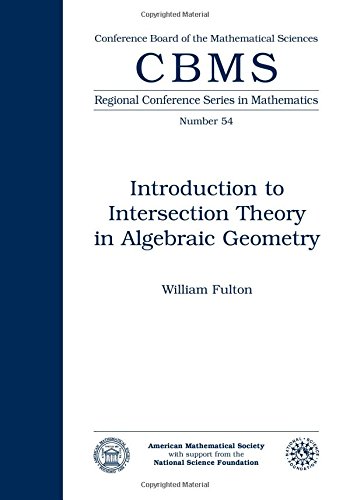
This book introduces some of the main ideas of modern intersection theory, traces their origins in classical geometry and sketches a few typical applications. It requires little technical background: much of the material is accessible to graduate students in mathematics. A broad survey, the book touches on many topics, most importantly introducing a powerful new approach developed by the author and R. MacPherson. It was written from the expository lectures delivered at the NSF-supported CBMS conference at George Mason University, held June 27-July 1, 1983. The author describes the construction and computation of intersection products by means of the geometry of normal cones. In the case of properly intersecting varieties, this yields Samuel’s intersection multiplicity; at the other extreme it gives the self-intersection formula in terms of a Chern class of the normal bundle; in general it produces the excess intersection formula of the author and R. MacPherson. Among the applications presented are formulas for degeneracy loci, residual intersections, and multiple point loci; dynamic interpretations of intersection products; Schubert calculus and solutions to enumerative geometry problems; Riemann-Roch theorems.
User’s Reviews
Reviews from Amazon users which were colected at the time this book was published on the website:
⭐There are a lot of questions that one might ask when contemplating an intersection theory of algebraic varieties or schemes. For example, is there a notion of transversal intersection that is similar to the one from differential topology? Does it make sense to talk about the (homological) boundary of an algebraic variety (scheme)? Can the intersection theory be formulated in terms of a cohomology theory that is (Poincare) dual to a homology theory of algebraic varieties? More generally can one speak of a cobordism between two algebraic varieties? One could think of many more depending on the background with which one approaches the subject of this book, the content of which could be viewed as warm-up to the author’s main book on intersection theory. If one is serious about learning the intersection theory of algebraic varieties, or understanding the specialized topic of enumerative geometry, this book is a good start, although like most books of modern mathematics, intuition and motivation for a particular concept is frequently lacking. Indeed, if the author had given an in-depth explanation and motivation for each topic that he discusses, the book would swell to hundreds of pages. Any potential reader therefore has to expect to do a lot of supplementary reading in order to reach a true understanding of the concepts in this book. With this in mind the following paragraphs summarize briefly the content of each chapter:Chapter 1 (Intersections of Hypersurfaces): This one is the closest to geometric intuition that readers will get in the book. Hypersurfaces are relatively easily to visualize, as are intersections of plane curves. The “principle of continuity”, which has a long history in analytic and algebraic geometry might be harder to grasp (and believe), is explained in terms of the parameterization of hypersurfaces that intersect transversally, with this intersection being a finite set. If readers dig into the outside literature, they will find that the principle of continuity has an interpretation in terms of analytic continuation, the latter of course also motivating beautifully the concept of a sheaf (sheaf theory is very important in modern formulations of algebraic geometry). The author briefly discusses the problem of the five conics as a kind of motivation for discussing the problem of excess intersection in enumerative geometry. This excess intersection problem deals with the case where there is a degenerate intersection, where the “excess” intersection must be compensated for by intersection points lying outside this place of degeneracy. All of these approaches to intersection, as well as the “dynamic” approach that is discussed in this chapter, involve being able to position the hypersurfaces or subvarieties of these hypersurfaces so that their intersection is transversal or the subvarieties have intersection degree equal to the product of the degrees of the hypersurfaces.Chapter 2: Multiplicity and Normal ConesThe language becomes more “modernized” in this chapter as the author assumes knowledge of the theory of schemes when discussing geometric multiplicity. Readers must be comfortable with viewing varieties as prime ideals, but the author does connect the with what was done in chapter 1 by writing down an explicit expression for a cycle of hypersurfaces, and he does motivate the geometric multiplicity using subvarieties of the usual complex n-space. The definition of the geometric multiplicity in terms of the length of an Artinian ring could stand some more explanation however (possibly include some discussion on how Artinian rings are related to Noetherian rings, the latter of which are the predominant ones used in algebraic geometry).The reader will also encounter the notion of a “normal cone” in this chapter for the first time. In motivating it, the author succinctly and expectedly makes use of the notion of a “tangent space” in that it involves taking an ideal modulo its power. That this “tangent space” notion is manifest in the author’s definition can be seen from the case where a regular sequence (regular sequences are defined in this chapter) generates the ideal. One then gets a closed (regular) embedding of the normal cone in a product with complex n-space. This coupled with the fact that the subscheme over which the normal cone is defined sits as a zero section in its normal cone gives the picture of a normal bundle, i.e. a “dual” to the sheaf of sections. The reader will also will encounter the notion of a Cartier divisor in this chapter, discussed in the context of blowing up a variety along a subscheme. That a subvariety can be blown up to a Cartier divisor without using embeddings into projective space and from such an embedding is outlined briefly in this chapter.The author’s discussion of the deformation to the normal cone in this chapter would be very difficult to understand intuitively if he had not described in terms of what is done in differential topology using the notion of a `tubular neighborhood’. He cautions that this analogy is not to be adhered to rigidly, in that a normal cone can be a bundle without being expressed as product with a disk, but he does not give an explicit example. His discussion of why this deformation is important in intersection theory in terms of being able to move or deform the varieties or schemes of interest in the normal cone is also very illuminating, but explicit examples are again omitted. The chapter ends with a “basic idea” of intersection theory, namely that of “intersection of cycles with the zero section”, and a brief but helpful overview of what is ahead in the book.Chapter 3: Divisors and Rational EquivalenceAnalogs of homology and cohomology theory are available in algebraic geometry if one is willing to give the notion of the “boundary” of an algebraic variety (or scheme). These familiar concepts from algebraic topology are accomplished in algebraic geometry by the theory of rational equivalence of cycles. Some lecturers on the subject have called this an analog of the notion of cobordism from differential topology, but in the absence of a proper definition of boundary, this analogy is somewhat weak. The closest thing perhaps to the notion of a cobordism is to think of rational equivalence in terms of a parameterization of cycles by one-dimensional projective space. Although he does not mention cobordism, the author points to this picture of rational equivalence in this chapter.Of course, the notion of a divisor, motivated best by its manifestation in the theory of the poles and zeros of functions in complex function theory, plays the central role in this chapter. The reader will be expected to know how divisors are defined in algebraic geometry, and also what makes the notion of a Cartier divisor so important: they can be represented uniquely as rational functions at least in the intersections of their local data with a subvariety and they determine line bundles, or sections of these line bundles if the defining local equations are regular. Readers may be familiar with them as being related to the Picard group, since two Cartier divisors will determine isomorphic line bundles if they differ by a principal divisor. The divisors modulo the principal divisors is of course the Picard group.The intersection theory of varieties (or schemes) then comes down to studying how (Cartier) divisors intersect with cycles. The author shows how the resulting intersection class gives an intersection product that has features that one would expect from the “cap product” of ordinary algebraic topology. The author wants to call the map from a subvariety to the intersection product (induced by the inclusion of the effective divisor) a “Gysin” homomorphism between algebraic cycles, as an analogy to ordinary cohomology theory, even though the ordinary Gysin homomorphism actually raises the dimension.Chapter 4 Chern Classes and Segre ClassesGiven the discussion of line and normal bundles, and zero sections thereof in the first three chapters, it is not surprising that the theory of characteristic classes has some applicability in the context of algebraic varieties (schemes). The author details how to define Chern and Segre classes in this chapter, using Cartier divisors as expected. He emphasizes that a geometric picture is still lacking, and this is borne out in the ensuing formalism that he outlines. This chapter is about as clear as the usual discussions on the theory of characteristic classes: this subject for some reason is never motivated too well, and those who want to learn it usually have to be satisfied with a formal understanding of the theory. The extension to algebraic geometry of what is done in the theory of vector bundles is fairly clear, particularly the role of the Chern class in intersecting the zero section. The Segre class is viewed as being the better tool for studying the normal cone, and normal cones arise in situations where no normal bundle is available (it is only in cases of a regular embedding). The author gives an explicit expression for the total Segre class in terms of self-intersections of exceptional divisors.Chapter 5 Gysin Maps and Intersection RingsIn this chapter the author elaborates further on the (dimension lowering) Gysin homomorphisms and his approach to defining the intersection ring (the Chow ring) without the use of the moving lemma. The analysis is done for the “clean” case where the embeddings are regular and the varieties are non-singular. He devotes only one paragraph to the case of singular varieties, remarking primarily on the strategy of using rational coefficients to study these objects. If rational homotopy theory is any kind of guide, one might believe that this approach is viable, but the author does not elaborate in any detail.The review of the rest of the book will be omitted, since it was not studied in detail.
Keywords
Free Download Introduction to Intersection Theory in Algebraic Geometry (Cbms Regional Conference Series in Mathematics) in PDF format
Introduction to Intersection Theory in Algebraic Geometry (Cbms Regional Conference Series in Mathematics) PDF Free Download
Download Introduction to Intersection Theory in Algebraic Geometry (Cbms Regional Conference Series in Mathematics) 1984 PDF Free
Introduction to Intersection Theory in Algebraic Geometry (Cbms Regional Conference Series in Mathematics) 1984 PDF Free Download
Download Introduction to Intersection Theory in Algebraic Geometry (Cbms Regional Conference Series in Mathematics) PDF
Free Download Ebook Introduction to Intersection Theory in Algebraic Geometry (Cbms Regional Conference Series in Mathematics)