Ebook Info
- Published: 1996
- Number of pages: 758 pages
- Format: PDF
- File Size: 4.70 MB
- Authors: Bruce Schneier
Description
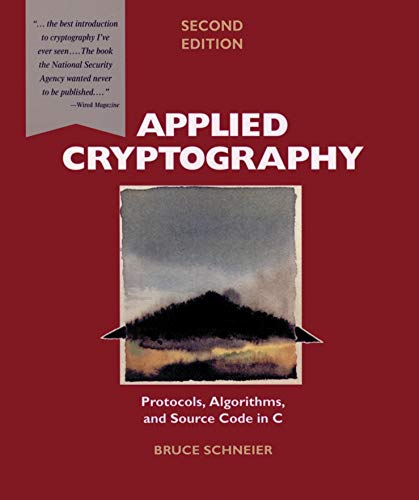
. . .the best introduction to cryptography I’ve ever seen. . . .The book the National Security Agency wanted never to be published. . . . -Wired Magazine “. . .monumental . . . fascinating . . . comprehensive . . . the definitive work on cryptography for computer programmers . . .” -Dr. Dobb’s Journal “. . .easily ranks as one of the most authoritative in its field.” -PC Magazine “. . .the bible of code hackers.” -The Millennium Whole Earth Catalog This new edition of the cryptography classic provides you with a comprehensive survey of modern cryptography. The book details how programmers and electronic communications professionals can use cryptography-the technique of enciphering and deciphering messages-to maintain the privacy of computer data. It describes dozens of cryptography algorithms, gives practical advice on how to implement them into cryptographic software, and shows how they can be used to solve security problems. Covering the latest developments in practical cryptographic techniques, this new edition shows programmers who design computer applications, networks, and storage systems how they can build security into their software and systems. What’s new in the Second Edition? * New information on the Clipper Chip, including ways to defeat the key escrow mechanism * New encryption algorithms, including algorithms from the former Soviet Union and South Africa, and the RC4 stream cipher * The latest protocols for digital signatures, authentication, secure elections, digital cash, and more * More detailed information on key management and cryptographic implementations
User’s Reviews
Editorial Reviews: Amazon.com Review Cryptographic techniques have applications far beyond the obvious uses of encoding and decoding information. For Internet developers who need to know about capabilities, such as digital signatures, that depend on cryptographic techniques, there’s no better overview than Applied Cryptography, the definitive book on the subject. Bruce Schneier covers general classes of cryptographic protocols and then specific techniques, detailing the inner workings of real-world cryptographic algorithms including the Data Encryption Standard and RSA public-key cryptosystems. The book includes source-code listings and extensive advice on the practical aspects of cryptography implementation, such as the importance of generating truly random numbers and of keeping keys secure. Review “the definitive publicly available text on the theory and practice of cryptography” (Computer Shopper, January 2002) From the Inside Flap “. . .the best introduction to cryptography I’ve ever seen. . . .The book the National Security Agency wanted never to be published. . . .” -Wired Magazine “. . .monumental . . . fascinating . . . comprehensive . . . the definitive work on cryptography for computer programmers . . .” -Dr. Dobb’s Journal “. . .easily ranks as one of the most authoritative in its field.” -PC Magazine “. . .the bible of code hackers.” -The Millennium Whole Earth Catalog This new edition of the cryptography classic provides you with a comprehensive survey of modern cryptography. The book details how programmers and electronic communications professionals can use cryptography-the technique of enciphering and deciphering messages-to maintain the privacy of computer data. It describes dozens of cryptography algorithms, gives practical advice on how to implement them into cryptographic software, and shows how they can be used to solve security problems. Covering the latest developments in practical cryptographic techniques, this new edition shows programmers who design computer applications, networks, and storage systems how they can build security into their software and systems. What’s new in the Second Edition? * New information on the Clipper Chip, including ways to defeat the key escrow mechanism * New encryption algorithms, including algorithms from the former Soviet Union and South Africa, and the RC4 stream cipher * The latest protocols for digital signatures, authentication, secure elections, digital cash, and more * More detailed information on key management and cryptographic implementations From the Back Cover “. . .the best introduction to cryptography I’ve ever seen. . . .The book the National Security Agency wanted never to be published. . . .” -Wired Magazine “. . .monumental . . . fascinating . . . comprehensive . . . the definitive work on cryptography for computer programmers . . .” -Dr. Dobb’s Journal “. . .easily ranks as one of the most authoritative in its field.” -PC Magazine “. . .the bible of code hackers.” -The Millennium Whole Earth Catalog This new edition of the cryptography classic provides you with a comprehensive survey of modern cryptography. The book details how programmers and electronic communications professionals can use cryptography-the technique of enciphering and deciphering messages-to maintain the privacy of computer data. It describes dozens of cryptography algorithms, gives practical advice on how to implement them into cryptographic software, and shows how they can be used to solve security problems. Covering the latest developments in practical cryptographic techniques, this new edition shows programmers who design computer applications, networks, and storage systems how they can build security into their software and systems. What’s new in the Second Edition? * New information on the Clipper Chip, including ways to defeat the key escrow mechanism * New encryption algorithms, including algorithms from the former Soviet Union and South Africa, and the RC4 stream cipher * The latest protocols for digital signatures, authentication, secure elections, digital cash, and more * More detailed information on key management and cryptographic implementations About the Author BRUCE SCHNEIER is President of Counter-pane Systems, a consulting firm specializing in cryptography and computer security. He is a contributing editor to Dr. Dobb’s Journal, serves on the board of directors of the International Association of Cryptologic Research, and is a member of the Advisory Board for the Electronic Privacy Information Center. He is the author of E-Mail Security (Wiley) and is a frequent lecturer on cryptography, computer security, and privacy. Read more
Reviews from Amazon users which were colected at the time this book was published on the website:
⭐This book is readable introduction to real cryptography. It covers a wide range of topics (block and stream cyphers and hashing and random number generation algorithms) in enough depth, and with sufficient theoretical foundation, to give the reader an honest overview of the field. The last section contains code for many of the algorithms and electronic versions are available through Schneier’s web site.Throughout the book Schneier manages to include current references to the inevitable political and legal issues. These references are discussed in an engaging manner and without letting them hog the spotlight. On the other hand, in a fast-moving field like cryptography, they are beginning to get a bit long in the tooth. The book was originally published in 1996 and many of the remarks are noticeably dated (though, perhaps, historically interesting).Printings before the fifth are also riddled with errors. Fortunately, good errata are available at Schneier’s website. They are essential: if you find yourself thinking “That can’t be right”, it probably isn’t.Read this book first. Without some college level mathematics you may have to skim some of the chapters; still, you can probably curl up on your couch and read it cover to cover. If, afterwards, you get hooked into following up with Stinson’s “Cryptograpy”, or Menezes “Handbook of Applied Cryptography”, don’t say I didn’t warn you!
⭐Wonderful book. Very approachable yet comprehensive. No need to be afraid of the mathematics or symbolic logic; the protocols section alone is worth the purchase and much of it is written in story form – something like: If Alice wants to prove to Bob that she knows a secret and there’s a cave that splits in two halfway down and Bob yells down which path she should emerge from and they do this ten times…however now that Bob knows that Alice knows the secret, he can’t prove that to anyone and he doesn’t know the secret – a zero knowledge proof. That was just my poor attempt at summarizing a protocol – it’s wonderful and thought provoking to an almost dizzying extent.
⭐I love this book. it teaches basic logic, protocols, etc. While it’s contents are dated regarding the current state of the art, the fundamentals presented in easily digestible pieces. While it is excellent as a reference, it is also readable cover to cover just for the enjoyment of learning.
⭐Much praise has already been heaped on Bruce Schneier and this seminal book. I can add that I bought a copy of this book when it was first published. It became a key reference book over my career and finally just fell apart and was discarded. Technology has changed in ways I never dreamed. The new, imaginative and sophisticated cyber threats of today are more challenging than ever. That being said, the principles of this science are as relevant today as they were then. To have them presented as Mr. Schneier has in this book means that new generations will find it as exciting and fresh as if it were a 21st century marvel. It never occurred to me that I could re-read the book for the pure pleasure of it. How remarkable.
⭐Of course Bruce’s book (even the second edition) is very dated in terms of the specific ciphers and hash functions that are prominently featured. But those will continue to evolve as time passes; no book is going to capture the modern developments for long.The real value of Applied Cryptography is the fundamental understanding (and interest, in my case) it helps to build. Intros to terminology, theory, practical implementations, attack models, and protocol weaknesses are outlined here in great detail. I can honestly say that this book – along with lots of openssl / gnupg tinkering – have put a functional (for my sysadmin purposes) cryptography foundation within my grasp.NB: this book is old enough that it pays to shop around for a used copy in good condition.
⭐When I read this just after it came out, it was arguably the best, most comprehensive book on the subject. It may still be, but I haven’t surveyed the field in the last year. But either way, this book is very easy to read, and makes some fairly complicated stuff easy to understand. This is a subject area that makes it real easy to be dry, boring, and all of that, but this book is none of those things. Applied Cryptography is fun to read, and makes the subject interesting. About 1/2 of the book is stuff anyone interested in the subject, or anyone that needs to implement some form of encryption or digital signatures will find very useful. The other half is the underlying algorithms and mathematics behind it, which to be honest I didn’t read and didn’t need to know to do my job. But this is a great book, and has both sides of the story.
⭐This is an update to a classic. I had used the original version for years and just plain wore the old one out. Highly recommend this for a layman who wishes to understand just what cryptography is really all about. Miss the printed source code for some of the earlier versions of encryption, but time does march on. Looking forward to other works by this author.
⭐Applied Cryptography is a classic book on how and why cryptography works. It is written very clearly and explains in detail how various aspects of cryptography work.Some math-based sections are included, but overall math knowledge is assumed to be minimal. Overall, the book is very consitent in how much it expects the reader to know, few sections are much more advanced than others.While not up-to-date with the latest algorithms and available computing specifications, it focuses as much as possible on the timeless aspects of cryptography. A recommended read to all aspiring cryptographers.
⭐Bruce Schneier is one of the most respected persons in the field of cryptography.His work provides a good in-depth description of crypto protocols, signature systems, hashing & digestsand some of the well-known cipher systems (at the time of publication).His presentation of the material is well balanced between concept & mathematical description.Unfortunately due to both space restrictions & the US embargo on exporting crypto material there is a limit on how muchsource code could be included in the book. I would have liked to see source code forhashing & signatures.Schneier offers discs with much more source but they can only be legally providedto residents of the US & Canada thus I have to reduce my overall rating of this fine work to four stars.Nevertheless as a reference on crypto algorithms & protocols, this remains a fine work.
⭐A great review of a wide range of techniques expressed in easy to follow language with references to further reading.
⭐Well worth the price a wealth of information
⭐Exactly what I was expecting
⭐Eines der wenigen Nicht-Fachbücher welche man verschlingt wie einen guten Roman.Der erste Teil über die möglichen Anwendungen der Kryptographie ließ sich problemlos an einem Stück runter bis man merkt dass schon wieder viel zu viel Zeit vergangen ist. Die beschriebenen Anwendungen sind teilweise sehr abenteuerlich wie zum Beispiel ein Verfahren um dezentral Karten so zu mischeln, dass kein einzelner sie manipulieren oder vor vereinbarter “Aufdeckung” lesen kann.”WTF” Momente sind also definitiv vorprogrammiert ;-)Auch alle weiteren für nicht Mathematiker interessanten Aspekte der Kryptographie werden sehr gut erklärt. Mir hat vor allem die Diskussion über die Brute-Force-Fähigkeit von 192bit Keys gefallen.Der zweite Teil des Buches behandelt verschiedene Verschlüsselungsalgorithmen im Detail. Hier ist dringend eine Überarbeitung nötig, denn viele dieser Algorithmen gelten inzwischen als unsicher und überholt (finde ich nicht so schlimm) dafür fehlen aber andere inzwischen gebräuchliche Verfahren (viel schlimmer).
⭐
Keywords
Free Download Applied Cryptography: Protocols, Algorithms, and Source Code in C 2nd Edition in PDF format
Applied Cryptography: Protocols, Algorithms, and Source Code in C 2nd Edition PDF Free Download
Download Applied Cryptography: Protocols, Algorithms, and Source Code in C 2nd Edition 1996 PDF Free
Applied Cryptography: Protocols, Algorithms, and Source Code in C 2nd Edition 1996 PDF Free Download
Download Applied Cryptography: Protocols, Algorithms, and Source Code in C 2nd Edition PDF
Free Download Ebook Applied Cryptography: Protocols, Algorithms, and Source Code in C 2nd Edition