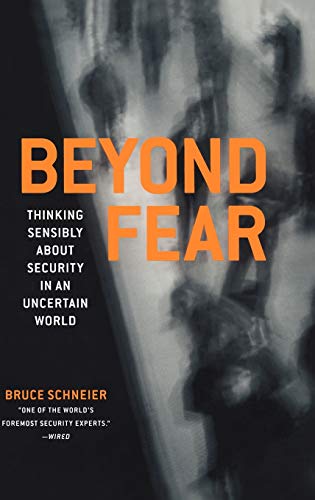
Ebook Info
- Published: 2003
- Number of pages: 304 pages
- Format: PDF
- File Size: 0.90 MB
- Authors: Bruce Schneier
Description
Many of us, especially since 9/11, have become personally concerned about issues of security, and this is no surprise. Security is near the top of government and corporate agendas around the globe. Security-related stories appear on the front page everyday. How well though, do any of us truly understand what achieving real security involves?In Beyond Fear, Bruce Schneier invites us to take a critical look at not just the threats to our security, but the ways in which we’re encouraged to think about security by law enforcement agencies, businesses of all shapes and sizes, and our national governments and militaries. Schneier believes we all can and should be better security consumers, and that the trade-offs we make in the name of security – in terms of cash outlays, taxes, inconvenience, and diminished freedoms – should be part of an ongoing negotiation in our personal, professional, and civic lives, and the subject of an open and informed national discussion.With a well-deserved reputation for original and sometimes iconoclastic thought, Schneier has a lot to say that is provocative, counter-intuitive, and just plain good sense. He explains in detail, for example, why we need to design security systems that don’t just work well, but fail well, and why secrecy on the part of government often undermines security. He also believes, for instance, that national ID cards are an exceptionally bad idea: technically unsound, and even destructive of security. And, contrary to a lot of current nay-sayers, he thinks online shopping is fundamentally safe, and that many of the new airline security measure (though by no means all) are actually quite effective. A skeptic of much that’s promised by highly touted technologies like biometrics, Schneier is also a refreshingly positive, problem-solving force in the often self-dramatizing and fear-mongering world of security pundits.Schneier helps the reader to understand the issues at stake, and how to best come to one’s own conclusions, including the vast infrastructure we already have in place, and the vaster systems–some useful, others useless or worse–that we’re being asked to submit to and pay for.Bruce Schneier is the author of seven books, including Applied Cryptography (which Wired called “the one book the National Security Agency wanted never to be published”) and Secrets and Lies (described in Fortune as “startlingly lively…¦[a] jewel box of little surprises you can actually use.”). He is also Founder and Chief Technology Officer of Counterpane Internet Security, Inc., and publishes Crypto-Gram, one of the most widely read newsletters in the field of online security.
User’s Reviews
Editorial Reviews: Review “Does arming pilots make flying safer? Computer security guru Schneier applies his analytical skills to real-world threats like terrorists, hijackers, and counterfeiters. BEYOND FEAR may come across as the dry, meticulous prose of a scientist, but that’s actually Schneier’s strength. Are you at risk or just afraid? Only by cutting away emotional issues to examine the facts, he says, will we reduce our risks enough to stop being scared.” — Wired”Schneier provides an interesting view of the notion of security, outlining a simple five-step process that can be applied to deliver effective and sensible security decisions. These steps are addressed in detail throughout the book, and applied to various scenarios to show how simple, yet effective they can be….Overall, this book is an entertaining read, written in layman’s terms, with a diverse range of examples and anecdotes that reinforce the notion of security as a process.” –Computing Reviews”Schneier is a rare creature… Although he made his name as an alpha geek in cryptography… [he] can also speak to laypeople about the general security matters that increasingly touch all of our lives.” — Business Week “Once again Schneier proves that he is the one of few people who indeed understands security, and what is more important and more difficult, can explain complex concepts to people not specializing in security. Whatever your trade and whatever your background, go ahead and read it …” — itsecurity.com “In his new book, ‘Beyond Fear’, Bruce Schneier — one of the world’s leading authorities on security trade-offs — completes the metamorphosis from cryptographer to pragmatist that began with Secrets and Lies, published in 2000.” — infoworld.com About the Author Bruce Schneier is the author of seven books, including Applied Cryptography which Wired called “the one book the National Security Agency wanted never to be published” and Secrets and Lies, described in Fortune as a “startlingly lively jewel box of little surprises you can actually use.” He is also founder and Chief Technology Officer of Counterpane Internet Security, Inc., and publishes Crypto-Gram, one of the most widely read newsletters in the field of online security.
Reviews from Amazon users which were colected at the time this book was published on the website:
⭐Bruce Schneier is well-known for his book
⭐, and bringing the concept of cryptography down to be understood by mere mortals. A cryptographer by trade, in the last decade, he has focused on more practical impediments to security. In Beyond Fear, he focuses on practical security measures, largely in the context of air travel in a post-9/11 world. With simple, concrete, and logical examples (and indeed an complete security process), he explains how security tradeoffs are driven by specific agendas, and that increased security in one area usually leads to overlooked or weakened security in another area. He lays out well-considered arguments for the need for what he calls “security theatre” (the APPEARANCE of good security vs. ACTUAL good security), and how we make our own security tradeoffs every day, based on our understanding of risks – which may be completely flawed based on statistics.At its core, though, Beyond Fear explains how a system can never be 100% safe, and our desire to have a system that is impervious to attack is often driven by an emotional need, and not based on logic, fact, and rational analysis – and is often at odds with our desire for personal freedoms, which is often what we’re seeking to secure. It offers hope, however, that by understanding the real risks we face, we’re able to make smart, individual tradeoffs about our personal safety and security – preserving both our liberty and personal safety.It’s a fantastic book, if you have any interest in security or the security-freedom tradeoff. It’s well-written, simple to understand, engaging, and direct. At points, Schneier gets a little preachy about personal freedom, but his agenda will likely resound with most readers. His personal commentary is short-lived, however, and for the vast majority of the book, it’s a well-balanced, rational analysis of our system’s strengths and weaknesses, and our individual roles in it.
⭐Five stars for a book that lays out five steps to think about and analyze any and all security systems, from street mugging to encryption, from home security to national security, in terms of what needs to be protected, how to protect it, who is trying to get at it, what’s it worth, and what trade-offs or externalities the proposed security incurs. Also breaks down the human factor, disentangles identification from authentication from authorization, and breaks down the different prongs of security: defense (prevention), response, deterrence, audit/forensics.The concepts in this book will be familiar to anyone acquainted with threat or risk analysis and the making of ‘attack trees’, which are a subset of ‘who’s trying to get at this’ and ‘how can they be stopped?’Grounded in a thoroughly secular evolutionary worldview, from which innumerable illustrations are drawn, and working from a thoroughly atheistical anthropology which believes in the inherent goodness of human nature, the analysis is hampered from reaching the heights of truth and probing some of the deep things of security, but as a practical layman’s introduction it is not hampered as much as it could be (as if it were, say, a text looking for the underlying cause of security failure, subornability, etc.), and does its job admirably.
⭐I was pretty excited to read Bruce Schneier’s Beyond Fear, I have enjoyed hearning him speak and like his blog. I will say that the book could have said what it says with a lot less pages, possibly even an essay. However, there are lots of great stories and a fantastic word picture called “Security Theater”. His illustration is that after 9/11 no one knew what to do to combat air terrorism, so they gave the appearance of action by doing things like confiscating nail files. Oh do I agree that much of what we see is security theater!Bruce has a five step process he tries to illustrate, especially in the second half of the book: * What assets are you trying to protect? * What are the risks to these assets? ( I think threats is a more correct word than risks ) * How well does the security solution mitigate those risks? * What other risks does the security solution cause? * What trade-offs does the security solution require?This is a nice implementation of threat vector analysis and he tells great stories. I am not sure the book teaches that much, but it might be a valuable awareness tool for executives.
⭐”Beyond Fear” contains the five-step analysis you see in many of the reviews. This framework is valuable, but Schneier adds little wisdom beyond it. When Schneier applies the five steps to actual security decisions, the results do not inspire confidence. Granted, security is often complicated, and no protection is fail-proof. But these observations alone do nothing to take us “Beyond Fear,” in fact they increase fear and paralysis. Overcoming this muddle is the evident challenge in writing about security, a challenge the author runs away from, on every page. Instead, he talks about biology, warfare and dozens of other subjects. These fun facts do nothing to clarify security decisions.Schneier’s rather self-important tone amplifies my disappointment. Example: the book jacket draws us in by asking, “Will arming pilots make flying safer?” and hinting that Schneier proves the negative. He doesn’t even answer the question! He runs past it about three times in the text, and the closest thing to an answer is roughly, “maybe, but we ought to think about it first.” Well Duh!Altogether, this book reminds me of William Gibbs Macadoo’s description of the speeches of President Warren Harding: “An army of pompous phrases marching over the landscape in search of an idea.”I have worked in the information security field for eleven years. I don’t claim authority, just familiarity with the concepts and success in communicating them.
⭐Anyone involved in any kind of security should read this book. While the politicians and the hysterical media scream about face recognition, and other security panaceas, Bruce Schneier explains simply and logically why it doesn’t work and proposes much simpler and more effective measures.Take face recognition as an example. Even a system claiming 99.9% accuracy (which none are) will still fail 1 in 1000 times. How many times would it fail when used on football crowd? Or at an airport? How are the police better off when they have to deal with dozens of false positives from the most perfect system? What is the point of a system which requires every face to be logged in a database when terrorists are so sparse to begin with (and not necessarily in the database)? Obviously it’s ridiculous, but this doesn’t stop people claiming such nonsense will prevent another 9/11 or whatever.Instead he advocates human intelligence – security guards who are trained to recognize signs that people are behaving oddly (or ‘hinky’ as one officer described a terrorist caught smuggling a bomb). This and common sense security based upon risk assessment. As one of the world’s leading experts on security, his is a voice that should be listened to. Unlike his crypto books, there is no an equations to be found here. Instead he highlights his points with real world examples and analogy. This tends to become a little tiresome in places, but the point is well made.It’s too bad that someone as informed as Schneier isn’t in charge of policy. Otherwise we might be in a world where money would be spent on systems which actually protect us, rather than offer faux security and inconvenience.
⭐Having read “Secrets & Lies” by the same author a few years before, I was interested to see what else he had to say. Bruce Schneier is a leading thnker in the world of security and is able to make the topic interesting and relevant to people that otherwise might find it quite dull.In this book, he also looks at many aspects of physical security, and in particular the way that security is being implemented in the modern world. He is highly critical of many security measures and explains in precise detail why they are so ineffective; and why we should still not be that concerned about this, except for the extra cost burden it places on us.I would strongly advise that if you are involved in physical or digital security in any way, that you should have a copy of this book and that you should re-read it from time to time. Even if it is not a primary part of your job, you may well find it of value.
⭐This is an excellent book overall. The author is no hardline libertarian, for sure; he does accept intrusions by the state in the name of security that I might object to, but what is so impressive about the book is the measured, rational way he goes about showing the pros and cons of security measures. It is the sort of book that policymakers here in London would do well to study. A fine antidote to hysteria and complacency in equal measure.
⭐Happy staff when they saw this on the office bookshelf
⭐A good read
Keywords
Free Download Beyond Fear: Thinking Sensibly About Security in an Uncertain World. in PDF format
Beyond Fear: Thinking Sensibly About Security in an Uncertain World. PDF Free Download
Download Beyond Fear: Thinking Sensibly About Security in an Uncertain World. 2003 PDF Free
Beyond Fear: Thinking Sensibly About Security in an Uncertain World. 2003 PDF Free Download
Download Beyond Fear: Thinking Sensibly About Security in an Uncertain World. PDF
Free Download Ebook Beyond Fear: Thinking Sensibly About Security in an Uncertain World.