

Ebook Info
- Published: 2008
- Number of pages: 528 pages
- Format: PDF
- File Size: 6.45 MB
- Authors: Clifford Pickover
Description
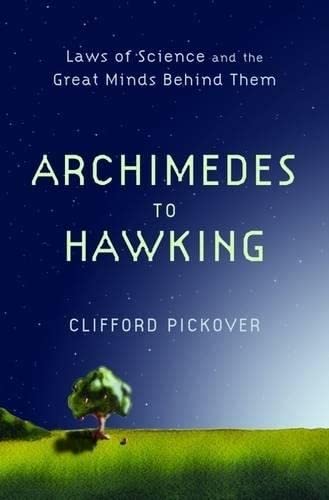
Archimedes to Hawking takes the reader on a journey across the centuries as it explores the eponymous physical laws–from Archimedes’ Law of Buoyancy and Kepler’s Laws of Planetary Motion to Heisenberg’s Uncertainty Principle and Hubble’s Law of Cosmic Expansion–whose ramifications have profoundly altered our everyday lives and our understanding of the universe. Throughout this fascinating book, Clifford Pickover invites us to share in the amazing adventures of brilliant, quirky, and passionate people after whom these laws are named. These lawgivers turn out to be a fascinating, diverse, and sometimes eccentric group of people. Many were extremely versatile polymaths–human dynamos with a seemingly infinite supply of curiosity and energy and who worked in many different areas in science. Others had non-conventional educations and displayed their unusual talents from an early age. Some experienced resistance to their ideas, causing significant personal anguish. Pickover examines more than 40 great laws, providing brief and cogent introductions to the science behind the laws as well as engaging biographies of such scientists as Newton, Faraday, Ohm, Curie, and Planck. Throughout, he includes fascinating, little-known tidbits relating to the law or lawgiver, and he provides cross-references to other laws or equations mentioned in the book.For several entries, he includes simple numerical examples and solved problems so that readers can have a hands-on understanding of the application of the law. A sweeping survey of scientific discovery as well as an intriguing portrait gallery of some of the greatest minds in history, this superb volume will engage everyone interested in science and the physical world or in the dazzling creativity of these brilliant thinkers.
User’s Reviews
Editorial Reviews: Review Listed in Mathematical Reviews”Pickover inspires a new generation of da Vincis to build unknown flying machines and create new Mona Lisas.” — Christian Science Monitor”The ploymathic Clifford Pickover discusses ‘landmark laws of nature that were discovered over several centuries and whose ramifications have profoundly altered our everyday lives and understanding.'” — Kendrick Frazier, Skeptical Inquirer”A perpetual idea machine, Clifford Pickover is one of the most creative, original thinkers in the world today.” — Journal of Recreational Mathematics”The incomparable Clifford Pickover has written another rich science narrative that t once informs and entertains. There is no one writing today with such an encyclopedic knowledge of all things scientific, and Archimedes to Hawking covers the gamut of what is arguably the most important topic in all of science – the laws of nature. Are they discovered or invented? Do they correspond to things out in the world or only to thoughts inside our heads? These and numerous other tantalizing questions are answered as Pickover takes us through a brief history of nearly everything in the universe (and the universe itself).” — Michael Shermer, Skeptic”A ride through the history of world-changing scientific ideas. Pickover pays homage to the great minds who have laid bare the mathematical machinery whirring just beneath the skin of reality. An impressively researched tour de force.” –Marcus Chown, author of The Quantum Zoo”Clifford Pickover has brilliantly succeeded in a monumental task. He has explained, in his usual lucid style, some forty of the greatest laws of physics, and sketched the lives and often eccentric personalities of the geniuses who discovered them. Pickover’s pages reflect his vast knowledge of physics and his firm conviction that mathematics has an awesome external reality.” –Martin Gardner, author of The Colossal Book of Mathematics About the Author Clifford A. Pickover is the author of forty books on such topics as computers and creativity, art, mathematics, black holes, human behavior and intelligence, time travel, alien life, religion, medical mysteries, and science fiction. Pickover is a prolific inventor with over forty patents, is the associate editor for several journals, and puzzle contributor to magazines geared to children and adults. He lives outside New York City.
Reviews from Amazon users which were colected at the time this book was published on the website:
⭐This is Dr. Pickover’s first scientific book since his
⭐and
⭐writings of 2006. After over a year of pursuing science fiction, the author has provided us with a work that was worth waiting for. This is his best yet.Archimedes to Hawking is no dry listing of scientific laws. Yes, it does have the important laws of science and the runners-up which Pickover generously calls the “Great Contenders.” The reason that the book runs to five hundred pages is that Pickover describes the lives and works of the lawgivers. These are not just people who showed up. Their biographies show that they worked at it. “Genius is one percent inspiration, ninety-nine percent perspiration.”Although the illustrations appear to be more for decoration than explanation, some are quite stunning. I particularly liked Bode’s Virgo and Hooke’s Flea, even if they have nothing to do with the laws named for those two. More illustrations like those would have been nice.The author’s approach is interesting. The laws are arranged chronologically. Archimedes is the first, but we have to skip almost two millennia to the Renaissance to find the next. The Industrial Revolution then brings the bulk of the science. There is very little past the turn of the twentieth century. Only three of the scientists named in this collection are still alive. Perhaps we have stopped naming scientific laws after people because we regard the laws of nature more as discovery than personal invention, or maybe it is that we are so expectant of future refinements that we now distrust the concept of the immutable law.The geography of the lawgivers is mostly European. The bulk of the laws are attributed to French, English, and German physicists and chemists. Americans are fourth in number, but only if you include the runner-up category.Although Pickover is not a physicist by training, he shows that he understands the thought process of the physicist. He shows their quest for understanding of the principles of the universe, the search for the beauty and symmetry of nature.Even more, Pickover has learned to think like a physicist. Pickover gives a rational explanation for his inclusion of works in the great laws and the runner-up categories. Many people may be surprised to find that Maxwell’s Equations do not have a chapter of their own but share the Faraday chapter, while relatively obscure works are included, even one of the runners-up that includes my name. Pickover explains that the individual laws that make up Maxwell’s Equations were developed by other people: Ampere, Faraday, Gauss. For a book like this it is necessary to make choices. The author explains his reasoning in a convincing manner. You may argue with his choices, but I think that if he errs, it is mostly on the side of inclusion, not exclusion.I do not think that you have to be a physicist or chemist to appreciate this book, but some formal science training may help you to appreciate the simplicity and beauty of the equations. I see this book becoming a standard reference work for those who study the physical sciences or the history of science. Or you may just like it for the joy of the science and the history.
⭐I did read the book from front to back and was never bored and I will keep it as very useful reference on my shelf. There is so much information in this book in such a compact form and easily accessible that I keep on referring to it every day since the day I have bought it, probably a couple of weeks ago.There is one scientific law listed in the 18th century that I believe should have never be included in the list of “Scientific laws that strongly influenced the world”, and that is Bode’s Law of Planetary Distances; an equation that attempts to demonstrate that there is an “orbital resonance” in the spacing of the planets. I do not agree with this notion at all and consider the Bode equation just an arithmetic fluke. I have communicated my opinion to the author who has promptly responded, has accepted that it is contentious and given his reasons why it was included, while at the same time agreed with me that it probably should not have been included.But I must add that this does not detract anything from the value of this book, in my opinion a very useful reference for anyone with some interest in science.
⭐Cliff Pickover’s newest book is both significant and unique. The blend of factual data and biographically interesting stories of the scientists lends itself to being appealing to a wide variety of readers. No other book that I’m aware of covers both a wide range of scientific laws in addition to covering the back story behind how those laws were developed. Michael Guillen’s Five Equations That Changed the World is similar in both interest and in target audience, but the Pickover book is covers many more laws and people. Jennifer Bothamley’s Dictionary of Theories, in contrast, has a much wider scope (and including non-scientific theories), but the special interest of the back story is absent, again distinguishing the Pickover book as distinctly different.Archimedes to Hawking can be enjoyed by everyone with a curious mind: why DO we name some physical laws after people and some not? how did these geniuses live, and what prompted them to do the work in their fields? how did they stumble upon a brilliant concept, and what struggles did they go through to prove it? All written with Cliff’s unique and entertaining style.In all, it’s a brilliant book that I would recommend to anyone. I plan on recommending that my science teachers have their students buy the book for summer reading for our high school science courses.
⭐interesting book.
⭐”Laws of science and the Great Minds Behind them. Archimedes to Hawkins” by a Clifford A.Pickover. It must be great I thought and with 500 pages. Note the phrases – “laws of science”, “great minds” etc. Much of the laws mentioned can be read in any upper secondary / highschool science book. If you buy this book to understand science better, then you will be disappointed. About one third of the book, is about science and the rest is about the scientists past history, of their families and so on. There are 4 drawings or illustrations in the whole book. They are – the Archimedes screw, frontpage of a book of Daniel Bernoulli’s Hydrodynamica ( publised in 1738), Keplers model of the solar system and a drawing of a flee by Robert Hooke. God help us, why on earth should we have a reproduced drawing of a front page of a book and of a large drawing of a flee which has nothing to do with the substance he talks about? On Archimedes, there are 10 pages, including the drawing that takes quarter of the page. There are anecdotes about how Hooke and Newton disliked each other or another scientist was bullied as a child and stories of their families or family life. Much of the science is devoted to scientists of the early past and not much at all to recent giants like Einstein, Hawkins, although HAWKIN’S name is displayed in the front cover (maybe to attract – and it is misleading). Hawkins and most of the recent great scientists are mentioned in passing or only a half a page is devoted to them. That could well be because this man is not a scientist (it is said that he is a prolific inventor) and has difficulty in understanding more complex scientific ideas, let alone explaining them. He himself says that the “equation based entries were chosen in consultation with scientific colleagues”. Is he implying then that he is a scientist ? If he is a scientist, why not mention that on the book sleeve, instead we are told that he an inventor and has written many books. I as a man, noted, that there is not a single entry on women. What a man-centred man he is. I think they are also called male chauvanists ? Marie Curie is mentioned though and in passing as the wife of Pierre Curie ( 14 pages on him though).This is not a book for people who want to know more about science they already know from upper secondary school or high school, despite the boastful and the lofty title of the book. This is a book for those who fell asleep in science classes or it is a “coffee-table” type of book that you leave there, to impress friends who come to dinner. Don’t buy it if you want to know of science or the ideas that lie in the great minds (as he claims). Don’t be fooled by its pompous and lofty title. I think it is a rip off by a Mr.Ripover.
⭐Incredible source of info on the subject! Recomended!
⭐My husband loved it!
Keywords
Free Download Archimedes to Hawking: Laws of Science and the Great Minds Behind Them in PDF format
Archimedes to Hawking: Laws of Science and the Great Minds Behind Them PDF Free Download
Download Archimedes to Hawking: Laws of Science and the Great Minds Behind Them 2008 PDF Free
Archimedes to Hawking: Laws of Science and the Great Minds Behind Them 2008 PDF Free Download
Download Archimedes to Hawking: Laws of Science and the Great Minds Behind Them PDF
Free Download Ebook Archimedes to Hawking: Laws of Science and the Great Minds Behind Them