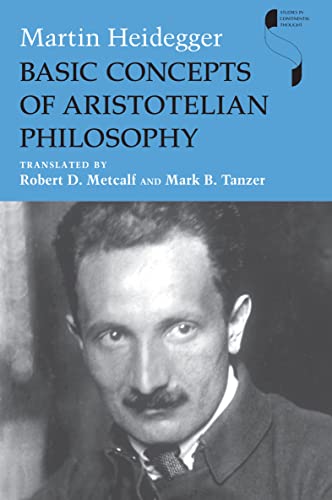
Ebook Info
- Published: 2009
- Number of pages: 456 pages
- Format: PDF
- File Size: 1.84 MB
- Authors: Martin Heidegger
Description
This volume presents Heidegger’s 1924 Marburg lectures which lay the intellectual groundwork for his magnum opus, Being and Time.Here are the seeds of the ideas that would become Heidegger’s unique and highly influential phenomenology. Heidegger interprets Aristotle’s Rhetoric and looks closely at the Greek notion of pathos. These lectures offer special insight into the development of his concepts of care and concern, being-at-hand, being-in-the-world, and attunement, which were later elaborated in Being and Time.Available in English for the first time, these lectures make a significant contribution to ancient philosophy, Aristotle studies, Continental philosophy, and phenomenology.
User’s Reviews
Reviews from Amazon users which were colected at the time this book was published on the website:
⭐THE FUNDAMENTAL DUPLICITY OF LANGUAGE: Part2`Language is duplicitous in several senses.’This book introduces Heidegger’s REAL philosophy as well as, according to Walter A. Brogan, HEIDEGGER AND ARISTOTLE: THE TWO FOLDNESS OF BEING, SUNY, 2005, four and a half stars, the REAL Aristotle, a two-for-one bargain for sure! It is tough going but only in the sense that Heidegger is relating his other tortured concepts, that are even more tortured by other scholars, in his other books, both before and after these 1924 lectures released in 2002 by Victorio Klosterman and translated for Indiana UP in 2010, to very ‘factical’, down to earth, common sense, in the true sense as communal sense, in the Greek sense of shared understanding with other Athenian citizens whether farmers or philosophers.You get a thorough introduction to the NICOMACHEAN ETHICS, the POLITICS, with a startling confrontation in chapter 16, BK V delta, 1021b3-1022a3 to death as man’s ‘rightful’ and ‘proper’ ‘goal’ or rather the simple boundary of human nature. The classical sense of `moral value’ is very different from our own. The `two foldness of being’ speaks of the basic Aristotelian logic of contrasting perception, concepts, etc, that is `this’ is defined by being NOT `that’, synthesis as uniting, versus diairesis as dividing and distinguishing. It is the positive and, neutrally, negative aspects of being, and part of the ontological difference Death, in Aristotle, is simply the limit of human life but is therefore its TELOS. But, emphatically, it is a necessary part of human nature. Aquinas divides the concept of death two fold, yes, but one of his necessary definitions of death is that man naturally dies. This brings up the whole subject of human nature. What is it?It is defined by rather the simple boundaries of human nature, phenominalogically, that is, as it is observed [Sherlock Holmes tells Dr. Watson, `You see but you do not observe.’]. LIVING human being is defined by observation as always acting, even breathing, heart beating in sleep, towards a goal, a TELOS constantly, all the time while alive. Death is defined as a complete stopping. Aquinas describes the afterlife more or less as being frozen in one’s last act. This contradicts all that he says about the specialness of human nature as the reason why God created man in the first place. So it becomes everlastiness, either in heaven or hell, as a lump of ice [John Henry Cardinal Newman’s image mainly of Hell]. For Aristotle, death is just a limit, PERAS, one cannot according to one’s nature go beyond. There is no other `side’, no further boundaries. Afterlife is rendered pointless then by Aquinas, at least as an unstated consequence from his interpreters. PERAS is a fundamental concept in both Aristotle and Heidegger. So everything has a positive AND a negative limit, definition.Heidegger’s thesis goes further, introducing a fantastic explication of Aristotle’s RHETORIC. The two foldness of being is further evolved as the difference between the speaker and the hearer, an always necessary twosome. That it is ontological as such might be crudely explained as the difference between sensation and imagination as in Hume’s TREATISE ABOUT HUMAN NATURE where sensation obviously `tells’ you nothing but does impel you to action of some sort which when noticed you apply your imaginary creation of language. Everybody believes in language but nobody can see it [`Everybody says they believe in God but nobody acts like it.’, Hume] But language creates blueprints which creates skyscrapers. Language creates something NEW for sensation. So, there IS a twofoldness of being.It gets worse than that. Human being is primarily by nature committed to political [`social’] activity which calls out in response [`conscience’] language as spoken to the specific situation of another, literate or illiterate. The overall TELOS is always the whole of people which is the state – or church. Language, spoken or written, ALWAYS has an immediate, at-hand goal, TELOS. Deprive human being of this and he is nothing. [Long term isolation is the worst of tortures and distorts human nature almost as much as death does.] Political activity is always necessarily self-centered [also, to a degree, phenominologically, but NOT as a `subject’ which is actually a complex of things, the most important and most self-centering of which is REASON] as you are the one that sees. You are also motivated that way, `doing something for your country’ so your name will be honored. The word you apply to the object is your appropriation, but with the intent of expressing it to `another’ even if that `other’ is your `listening’ self. Even your relation to a rock has a `political’ dimension. It does have a phenomenological `otherness’ to you as it revels its presence, but not as `communicating’ any concept. You just see `it’ and existentially `know’ its presence.But there is worse. Richard Bodeus, the great Canadian scholar, makes it clear that the audience – you as a human being naturally always act for an audience as `hero’, Abraham Maslow, Colin Wilson, Ayn Rand, or Ted Bundy in a different sense – for the NICOMACHIAN ETHICS is for `always already’ politically experienced mature adults. So, one might say Politics is the most important pursuit [Heidegger says this also] for which the best training is RHETORIC, including logic and philosophy [logic is derived from rhetoric], and ETHICS is an explicit consideration only for experienced people. Bodeus makes an excellent companion for Heidegger [and the understanding of the early Stoics] in that the material universe is obviously determined since everything has a previous cause and effect. BUT!!! Human beings can change [Heidegger takes up this aporia of `deciding’ when to move in his ARISTOTLE’S METAPHYSICS THETA 1-3] by making the effort to learn a new skill, new ways of acting [ look up Hubert L. Dryfus work on learning curves]. And a human being CAN learn to do something and to it differently. It is the intentional power of habituation. You learn habits from your parents, good and evil and bad, and you modify them as you grow into a more and more deliberately and intentional political world.’
⭐The Political Dimensions of Aristotle’s Ethics (S U N Y Series in Ancient Greek Philosophy)Aristotle and the Theology of the Living Immortals (S U N Y Series in Ancient Greek Philosophy)Heidegger And Aristotle: The Twofoldness of Being (Suny Series in Contemporary Continental Philosophy)Aristotle on Life and DeathHeidegger And Rhetoric (Suny Series in Contemporary Continental Philosophy)The Theology of Thomas AquinasAyn Rand’s Normative Ethics: The Virtuous Egoist
⭐This is a remarkable philological analysis of Aristotle’s works. My comprehension of this Greek thinker has increased thanks to Heidegger. Heidegger himself is one of the great philosophers of the 20th century, nominated at one time for a Nobel Prize. I read MH’s book to get a better grasp of Aristotle. For those who want to understand MH’s main work better (Sein und Zeit [Being and Time]), his Basic Concepts of Aristotelian Philosophy would serve as a preliminary work. Just make sure to brush up on your Greek, though, since about a fourth of MH’s text is in that language.
⭐I ordered this for a graduate class I took. What I difficult read! I read all the time and ended up getting an A- in class so I’m pleased, but this is one challenging book. Heidegger put in his will that the Greek couldn’t be translated and it wasn’t. In the end though it was a lot of work, I appreciate the Greek I learned.As far as the book, it was well worth the time. Heidegger has translated Aristotle in a very different way. I very much like his thoughts on pathos and his concepts, or Aristotelian thought, are something I continue to contemplate. I’ll go back in a few months and re-read the book. I’m sure there are things I missed, but experiencing the book with a class was great.
⭐great book, great price.
⭐I am very grateful that this important book has been translated and that it is also available on the Kindle platform. The only thing that would have been more suitable for me is if the original Greek terms which are printed in Greek script were also expressed phonetically as they often are in similar books for the benefit of readers who have not learned to read the original script.
⭐
Keywords
Free Download Basic Concepts of Aristotelian Philosophy (Studies in Continental Thought) in PDF format
Basic Concepts of Aristotelian Philosophy (Studies in Continental Thought) PDF Free Download
Download Basic Concepts of Aristotelian Philosophy (Studies in Continental Thought) 2009 PDF Free
Basic Concepts of Aristotelian Philosophy (Studies in Continental Thought) 2009 PDF Free Download
Download Basic Concepts of Aristotelian Philosophy (Studies in Continental Thought) PDF
Free Download Ebook Basic Concepts of Aristotelian Philosophy (Studies in Continental Thought)