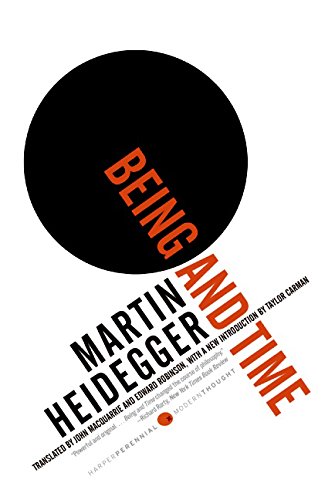
Ebook Info
- Published: 2008
- Number of pages: 608 pages
- Format: PDF
- File Size: 4.34 MB
- Authors: Martin Heidegger
Description
“Being and Time changed the course of philosophy.” —Richard Rorty, New York Times Book Review“Heidegger’s masterwork.” —The Economist”What is the meaning of being?” This is the central question of Martin Heidegger’s profoundly important work, in which the great philosopher seeks to explain the basic problems of existence. This first paperback edition of John Macquarrie and Edward Robinson’s definitive translation also features a foreword by Heidegger scholar Taylor Carman.A central influence on later philosophy, literature, art, and criticism—as well as existentialism and much of postmodern thought—Being and Time forever changed the intellectual map of the modern world. As Richard Rorty wrote in the New York Times Book Review, “You cannot read most of the important thinkers of recent times without taking Heidegger’s thought into account.”
User’s Reviews
Editorial Reviews: Review “Powerful and original . . . Being and Time changed the course of philosophy.” — Richard Rorty, New York Times Book Review“Possibly the greatest Western philosopher since Hegel . . . Heidegger’s greatest work.” — The Guardian“Heidegger’s masterwork” — The Economist From the Back Cover “What is the meaning of being?” This is the central question of Martin Heidegger’s profoundly important work, in which the great philosopher seeks to explain the basic problems of existence. A central influence on later philosophy, literature, art, and criticism—as well as existentialism and much of postmodern thought—Being and Time forever changed the intellectual map of the modern world. As Richard Rorty wrote in the New York Times Book Review, “You cannot read most of the important thinkers of recent times without taking Heidegger’s thought into account.” This first paperback edition of John Macquarrie and Edward Robinson’s definitive translation also features a new foreword by Heidegger scholar Taylor Carman. About the Author Martin Heidegger (1889-1976) was born in Baden-Württemberg, Germany. He studied at the University of Freiburg and became a professor at the University of Marburg in 1932. After publishing his his magnum opus, Being and Time (1927), he returned to Freiburg to assume the chair of philosophy upon Husserl’s retirement. Excerpt. © Reprinted by permission. All rights reserved. Being and TimeBy Martin HeideggerHarperCollins Publishers, Inc.Copyright © 2008 Martin HeideggerAll right reserved.ISBN: 9780061575594Chapter OneExposition of the Task of a Preparatory Analysis of DaseinThe Theme of the Analytic of DaseinWe are ourselves the entities to be analysed. The Being of any such entity is in each case mine. These entities, in their Being, comport themselves towards their Being. As entities with such Being, they are delivered over to their own Being. Being is that which is an issue for every such entity. This way of characterizing Dasein has a double consequence:I. The ‘essence’ [“Wesen”] of this entity lies in its “to be” [Zu-sein]. Its Being-what-it-is [Was-sein] (essentia) must, so far as we can speak of it at all, be conceived in terms of its Being (existentia). But here our ontological task is to show that when we choose to designate the Being of this entity as “existence” [Existenz], this term does not and cannot have the ontological signification of the traditional term “existentia”; ontologically, existentia is tantamount to Being-present-at-hand, a kind of Being which is essentially inappropriate to entities of Dasein’s character. To avoid getting bewildered, we shall always use the Interpretative expression “presence-at-hand” for the term “existentia”, while the term “existence”, as a designation of Being, will be allotted solely to Dasein.The ‘essence’ of Dasein lies in its existence. Accordingly those characteristics which can be exhibited in this entity are not ‘properties’ present-at-hand of some entity which ‘looks’ so and so and is itself present-at-hand; they are in each case possible ways for it to be, and no more than that. All the Being-as-it-is [So-sein] which this entity possesses is primarily Being. So when we designate this entity with the term ‘Dasein’, we are expressing not its “what” (as if it were a table, house or tree) but its Being.2. That Being which is an issue for this entity in its very Being, is in each case mine. Thus Dasein is never to be taken ontologically as an instance or special case of some genus of entities as things that are present-at-hand. To entities such as these, their Being is ‘a matter of indifference’; or more precisely, they ‘are’ such that their Being can be neither a matter of indifference to them, nor the opposite. Because Dasein has in each case mineness [Femeinigkeit], one must always use a personal pronoun when one addresses it: ‘I am’, ‘you are’.Furthermore, in each case Dasein is mine to be in one way or another. Dasein has always made some sort of decision as to the way in which it is in each case mine [je meines]. That entity which in its Being has this very Being as an issue, comports itself towards its Being as its ownmost possibility. In each case Dasein is its possibility, and it ‘has’ this possibility, but not just as a property [eigenschaftlich], as something present-at-hand would. And because Dasein is in each case essentially its own possibility, it can, in its very Being, ‘choose’ itself and win itself; it can also lose itself and never win itself; or only ‘seem’ to do so. But only in so far as it is essentially something which can be authentic — that is, something of its own — can it have lost itself and not yet won itself. As modes of Being, authenticity and inauthenticity (these expressions have been chosen terminologically in a strict sense) are both grounded in the fact that any Dasein whatsoever is characterized by mineness. But the inauthenticity of Dasein does not signify any ‘less’ Being or any ‘lower’ degree of Being. Rather it is the case that even in its fullest concretion Dasein can be characterized by inauthenticity — when busy, when excited, when interested, when ready for enjoyment.The two characteristics of Dasein which we have sketched — the priority of ‘existentia’ over essentia, and the fact that Dasein is in each case mine [die Jemeinigkeit] — have already indicated that in the analytic of this entity we are facing a peculiar phenomenal domain. Dasein does not have the kind of Being which belongs to something merely present-at-hand within the world, nor does it ever have it. So neither is it to be presented thematically as something we come across in the same way as we come across what is present-at-hand. The right way of presenting it is so far from self-evident that to determine what form it shall take is itself an essential part of the ontological analytic of this entity. Only by presenting this entity in the right way can we have any understanding of its Being. No matter how provisional our analysis may be, it always requires the assurance that we have started correctly.In determining itself as an entity, Dasein always does so in the light of a possibility which it is itself and which, in its very Being, it somehow understands. This is the formal meaning of Dasein’s existential constitution. But this tells us that if we are to Interpret this entity ontologically, the problematic of its Being must be developed from the existentiality of its existence. This cannot mean, however, that “Dasein” is to be construed in terms of some concrete possible idea of existence. At the outset of our analysis it is particularly important that Dasein should not be Interpreted with the differentiated character [Differenz] of some definite way of existing, but that it should be uncovered [aufgedeckt] in the undifferentiated character which it has proximally and for the most part. This undifferentiated character of Dasein’s everydayness is not nothing, but a positive phenomenal characteristic of this entity. Out of this kind of Being — and back into it again — is all existing, such as it is. We call this everyday undifferentiated character of Dasein “averageness” [Durchschnittlichkeit].And because this average everydayness makes up what is ontically proximal for this entity, it has again and again been passed over in…Continues…Excerpted from Being and Timeby Martin Heidegger Copyright © 2008 by Martin Heidegger. Excerpted by permission. All rights reserved. No part of this excerpt may be reproduced or reprinted without permission in writing from the publisher.Excerpts are provided by Dial-A-Book Inc. solely for the personal use of visitors to this web site. Read more
Reviews from Amazon users which were colected at the time this book was published on the website:
⭐Ideally, Heidegger’s Being & Time is not one’s first foray into reading Philosophy. Indeed, I would say a ~4th Yr Philosophy Student at University would have a sufficient background to approach the text, BUT! There are no Philosophy Students anymore…so, that doesn’t help…Without trying to name drop a bunch of obscure Philosophers &/or esoteric writings (maybe a few), I’ll name a few basic Philosophers & other Writings/Information one would do well to first become familiar with before approaching Heidegger — the suggestions are not absolute, certainly not necessary; in fact, Heidegger was quite popular with the hippie crowds in the 1960’s US reading Hindu & Buddhist religious texts. So, there’s always that route; however, the route that doesn’t involve illegal psychedelic narcotics & countless STDs would probably include familiarity with:– Socrates (via) Plato, Plato, & Aristotle– The Book of Job, OT, definitely (just as a secular reading, no need to convert to any religion, or do…I don’t care); also, it wouldn’t hurt to be familiar with the 5 Books of Moses, Ezekiel, Daniel, the Gospels, The Book of Revelation, & The Book of Enoch– Jakob Boehme (ok, a bit esoteric; but, he was a German cobbler that had a vision & developed a unique understanding of a knowledge above God that reminded me a lot of Heidegger)– Rene Descartes & Immanuel Kant– Friedrich Nietzsche, Karl Marx, & Sigmund Freud (the 3 Philosophers that delivered the 20th Century)– The Dictionary– The Translation feature on Google Lens (many of Heidegger’s quotes are not translated)– & The Teaching Company has a lecture series recorded by the late Rick Roderick of Duke; if you could locate his lecture on Heidegger, then you will be absolutely set to take down Heidegger. If not, no worries; it’s just calming listening to an Academic with a strong West Texas accent talk about Heidegger prior to reading Heidegger. I’m sure there are plenty of other people from West Texas happy to oblige if you search the internet.Anyhow, that’s what I would recommend becoming familiar with prior to reading Being & Time. Heidegger just uses so many references, offers so much obscurity without a lot of examples, & he creates his own words (they’re German words, but he’s re-appropriating them). It’s all there to trip you up & his work will start slow. If he makes a reference you don’t understand, it’s probably a good idea to pause & look it up the best you can. Once you get used to his writing, your pace will start to pick up…still, don’t expect to read this all at once. Give it time — I was a Senior Philosophy Student in 2008 when I first purchased Being & Time; I didn’t finish the book until my 3rd year in Graduate School (one, I didn’t have a lot of time; but, two, it’s a really difficult book).Once you finally figure out what he’s trying to say, it will be rewarding, it might seem obvious, but it’s not trivial & the profound will be in the undertaking in its own right.I recommend Heidegger’s Being & Time; it’s an important work in Philosophy, & its sheer difficulty offers a sense of accomplishment in its own right once you’ve finished it.
⭐Being and Time is, obviously a ground-breaking work but it is also a work that frustrates many readers. It is not a book that one should try to read without the necessary background (some knowledge of phenomenology) and, ideally, without some guidance (i.e. a class in Heidegger). There are a number of books that attempt to make Being and Time more accessible. Unfortunately a number of them are very problematic. Personally I would recommend
⭐by Magda King. It is not the easiest or most accessible of the commentaries on Being and Time but it is one of the more accurate in my opinion. It also focuses more on the second division which is really the more important division though it is also the more difficult division and for precisely that reason it often gets less attention in the secondary literature.I should say a word about this particular translation. I do not read German but I have read both this translation and the new Stambaugh/Schmidt translation so I have a few comments about their relative virtues. As I said in my review of the Stambaugh/Schmidt translation I really like the Macquarrie/Robinson translation partly because it is the first translation I read so I got used to the terminology and partly because Macquarrie and Robinson give, I think, a better sense of the German by choosing slightly awkward translations (like ready-to-hand and present-at-hand, etc.). The fact is that Heidegger is introducing neologisms so I like the fact that Macquarrie and Robinson invent their own neologisms to translate many of Heidegger’s most important terms. They also have extremely detailed notes throughout the book relating to the translation. Those are two definite virtues of this particular translation. There are two main virtues of the Stambaugh/Schmidt translation in my opinion. First, the translation is smoother and probably a bit more accessible for first time readers. The main advantage, however, is that Schmidt has put in brackets for all the major ‘sein’ words which indicate precisely what German word Heidegger is using. This overcomes to a large degree the need for different translations/capitalizations/hyphens, etc. (Being, be-ing, beings, entities, etc.) for all the different ‘sein’ terminology (it is important to realize that this only applies to the new Stambaugh/Schmidt translation; as far as I know the original Stambaugh translation does not include these bracketed terms). The bottom line is I think anyone who is serious about Being and Time should own and read both translations particularly if you are like me and do not read German.I should probably say a few words about the content of Being and Time. It seems a little ridiculous to write about a book that has achieved such status but my conscience will not let me post a review without saying anything about the contents of a book. Heidegger is, of course, primarily interested in the question of Being as he makes clear in his two introductions. Heidegger believes that Being is something that Dasein understands. We understand what it is for something ‘to be’ but we understand it in a vague way. Heidegger wants to make this vague understanding explicit but to do so he must understand the being that understands, i.e. Dasein. Most of Being and Time is taken up with an analysis of Dasein and its manner of being. The first division lays out what Heidegger calls the existentials of Dasein. They are like the categories that are applied to beings other than Dasein, the existentials are the a priori’s of the being of Dasein. In the second division he grounds all these existentials temporally, specifically, on the three temporal ecstases of the having-been, the present, and the to-come. For Heidegger Dasein is essentially futural meaning the future has precedence. Dasein is its possibilities. This might seem strange but it makes perfect sense. Everything we do has reference to the future and to projects. I read Being and Time because I have projected a future in which I become a philosophy professor, etc. (the father in Cormac McCarthy’s novel
⭐discovers this essential truth when he is looking through a bookcase at the end of the world and realizes that books make no sense when there is no future; their very being as books is predicated on a future. There is no reason to read after the apocalypse when there is no future because there are no human possibilities). McCarthy is being very Heideggerians since one of Heidegger’s basic insights is that it is on the basis of the future, a thrown project, that Dasein is able to exist meaningfully in the world and make sense out of inner-worldly beings.This review is merely the barest skeleton of an outline of a few themes from Being and Time. Ultimately it is impossible to write a summary of such an epoch-making book. It might have been better to simply avoid trying to summarize it at all but I wanted to say at least something about the book. Heidegger has completely altered our understanding of our own being as well as the meaning of Being in general. Heidegger’s influence on Continental philosophy is incalculable. All roads into Continental philosophy lead through Heidegger.There are many who seem to think, due to the difficulty of Heidegger’s text, that it is in fact non-sense, a giant prank, and that Heidegger is not really saying anything (this is an extreme view I know but it is not all that different from the critiques leveled at Heidegger by prominent philosophers like Rudolf Carnap). For now I will simply offer my assurances to the reader: Heidegger’s text is difficult, there is no doubt about that, but if you are truly interested in understanding it and you have the patience to work through it over many years (it will take many years) then I promise you Heidegger’s book does make sense! Whether you will agree with Heidegger’s positions is another question but it is my honest opinion that anyone who truly desires to understand this book can if they are willing to put in the work.
⭐Martin Heidegger’s Being and Time has been one of the most challenging books to read that I have ever come across. Not only was it because this was a translation from the original German into English (albeit excellently done by John Macquarrie and Edward Robinson), but because Heidegger’s own use of German words and his coining of new terms and phrases were difficult for both German- and English-speaking readers. The subtleties of his thought and the nuances in his original German were not just a challenge for our translators, but also a challenge to readers of any excellent translation of his work.Having said that, it is important to emphasise that Heidegger’s book is original and quite brilliant, and it is not at all surprising to discover that his book has had a deep influence on twentieth-century philosophy, and even theology.The book is divided into two Divisions, one on `Being’ and the other on `Time’. Both Divisions form what Heidegger calls Part 1 of a two-part work. Sadly, the second Part was never published (was it even written?). My first reaction to this book (this is the first work by Heidegger that I have read) is that the first Division on `Being’ was the more difficult of the two, in large part because so many new items of specialist Heideggerian terms were introduced here, and hence produced a more demanding read as one tried to accommodate oneself to his way of thinking and expressing himself. The second Division on `Time’ was a (slightly) easier read because one already had most of the `vocabulary’ in hand, even though new terminology and concepts (such as the `temporalising of temporality’) were also introduced. And, of course, the key term – Dasein – figured prominently in both Divisions because Heidegger wanted to use this term for his existential-ontological entity (in ordinary language `human being’) as a means of approaching the fundamental philosophical question `What is Being?’In a sense, Heidegger wants to invert Descartes’s cogito ergo sum (`I think, therefore I am’) into sum ergo cogito (`I am, therefore I think’). For him, human existence in its `thrownness’ into `the world’ and its `fallenness’ and `inauthentic existence’ are primordial constituents of Dasein, `prior’ (or `anterior’) to human conceptualising about its condition. Two concepts which I found particularly striking and important to assess were his views on Dasein as being primordially a `Being-towards-Death’ and of having a sense of Time which includes a past, present and future but which are not based on an everyday use of `clocks’. Heidegger’s view of `authentic’ existence and of `temporality’ challenges the ordinary intuitive understandings of what `real’ living and experience of `time’ mean for the majority of us most of the time. This is because (according to Heidegger) the average everyday existence of Dasein is not controlled by the true Self (the genuine `I’) but by the `They’, i.e. the public norms of what is acceptable thinking and behaving. Heidegger believes that we are `fleeing’ from our true Selves and `authentic’ existence by `falling’ into the `world’ of everyday activity which takes up our time and our lives. A genuine existential coming to terms with the `temporality’ of our `Being-towards-Death’ is possible in `moments of vision’ when the true Self calls to the true Self and releases us from the `They’.Heidegger confronts the ideas of Plato, Aristotle, Descartes, Kant and Hegel when it comes to fundamental ontology and the deepest ontological question about `Being’, although recognising that his `analytic’ of Dasein, despite providing the way and right phenomenological method, has not yet allowed us to answer the fundamental question `What is Being?’ Perhaps this would have received an (i.e. his) answer if the second Part had been written/published, where he would have dealt more extensively with Descartes and Kant. None the less, however ambitious Heidegger’s ontological project was (Being and Time was originally published in German in 1927, with our English translation appearing only in 1962!), there can be no doubt that this major book on ontology provides a penetrating and, at times, intriguing contribution to the big questions about life.Having now read Being and Time in its entirety for the first time and having formed an initial view of the work, I am conscious of the need to read the critical reviews of this book by experts in the field and to discover how Heidegger’s views have influenced other key philosophers in their own thinking and contributions.Is 488-page Being and Time a book for relative beginners in the field of philosophy, much like myself? Hardly, I would say. However, it does repay the hard work done in reading this book carefully, and even `beginners’ who `have a go’ may benefit much.
⭐Not just a unsuitable font but also spacing is very poor, presumably to save a few pages. Sad. Makes reading it an unpleasant experience!
⭐This was a unit which was chosen in the later years of my Philosophy degree. An absolute brilliant read and very trying book indeed. Not to be read without the accompanying Commentary on Heidegger’s “Being and Time”, Division 1 as by the time you get to the end you will be wondering who or what “Dasein ” really is.
⭐This is the best overall paperback edition, in English, of this translation, which is essential for citation, of this great book. The larger size and better quality paper are superior to the U.S. version. It would be good, though, if the publisher were able to obtain the rights to Taylor Carmen’s forward used in the U.S. version, or some such similar piece.A hardcover version would also be great.This is one of the books I read over and over.
⭐Daughter was very pleased with this book.
Keywords
Free Download Being and Time (Harper Perennial Modern Thought) in PDF format
Being and Time (Harper Perennial Modern Thought) PDF Free Download
Download Being and Time (Harper Perennial Modern Thought) 2008 PDF Free
Being and Time (Harper Perennial Modern Thought) 2008 PDF Free Download
Download Being and Time (Harper Perennial Modern Thought) PDF
Free Download Ebook Being and Time (Harper Perennial Modern Thought)