Ebook Info
- Published: 2011
- Number of pages: 326 pages
- Format: PDF
- File Size: 1.27 MB
- Authors: Georges Dicker
Description
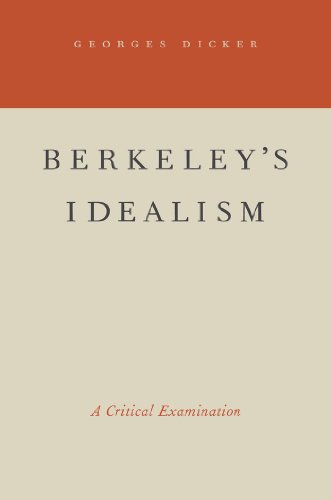
Using the tools of contemporary analytic philosophy, Georges Dicker here examines both the destructive and the constructive sides of Berkeley’s thought, against the background of the mainstream views that he rejected.
User’s Reviews
Reviews from Amazon users which were colected at the time this book was published on the website:
⭐In Preface the author writes: … It [this book] is, rather, a statement to the genius of this then twenty-five-year old prodigy that some three hundred years later, graying professors of philosophy such as myself should find his work so fascinating and rewarding as to want to engage with it, using the method of analytic philosophy to assess the challenging arguments that the good bishop offered for his visionary idealism.Now, from my point of view, there is a big question from the start about “the existence of one objective physical reality.” Who guarantees it?Berkeley assumed that it is the infinite Mind, God, who guarantees it!Modern philosophers, I believe, assume that it is modern physicists!Modern physicists may say that (according to a poll) 58% of them subscribe to the idea of Many-Worlds Interpretation and the rest may do to the Copenhagen Interpretation. However, either interpretation does not guarantee the objectivity of physical reality. Rather, both conclude that a physical reality, being observed by an observer or selected by a life-experiencing personality, is at least very much subjective, and to prove its objectivity is not an easy problem, if not impossible. This situation might suggest an idea “Quantum Idealism,” the term of which I borrowed from a physicist who used this term in a return email to my question concerning this subject (added on 5 Nov. 2013). As a matter of fact, the late physicist John Wheeler posed a yet-to-be-answered question: How come the “one world” out of many observer-participants? (1990) (By the way I believe the answer may be found in the knowledge of psychical research, which Wheeler called as “pathological science,” using the term coined in 1953 by the physicist Langmuir; that is, there is no such thing as the “one world” but “many coherent subjective worlds” through subconscious telepathy.) However, it is true that modern physicists do not like to argue about subjectivity vs. objectivity of physical reality.The author discusses this subjectivity vs. objectivity problem, without referring to the modern physicist’s ideas, in the last chapter 14: Intersubjectivity. Modern philosophers must, I think, correctly take into account the current physicists’ view of physical reality, when they argue about Berkeley’s Idealism today.(Added on 2 August 2011)At least, Ilya Prigogine seems to have successfully (?) eliminated the role of observer in quantum theory; hence, some of the rest physicists may subscribe to Prigogine’s drastically new idea. [Regardless of the idea being considered as an advancement in physics or not, see Ilya Prigogine’s “The End of Certainty (1997)”]
⭐(As posted at amazon.com)In Preface the author writes: … It [this book] is, rather, a statement to the genius of this then twenty-five-year old prodigy that some three hundred years later, graying professors of philosophy such as myself should find his work so fascinating and rewarding as to want to engage with it, using the method of analytic philosophy to assess the challenging arguments that the good bishop offered for his visionary idealism.Now, from my point of view, there is a big question from the start about “the existence of one objective physical reality.” Who guarantees it?Berkeley assumed that it is the infinite Mind, God, who guarantees it!Modern philosophers, I believe, assume that it is modern physicists!Modern physicists may say that (according to a poll) 58% of them subscribe to the idea of Many-Worlds Interpretation and the rest may do to the Copenhagen Interpretation. However, either interpretation does not guarantee the objectivity of physical reality. Rather, both conclude that a physical reality, being observed by an observer or selected by a life-experiencing personality, is at least very much subjective, and to prove its objectivity is not an easy problem, if not impossible. As a matter of fact, the late physicist John Wheeler posed a yet-to-be-answered question: How come the “one world” out of many observer-participants? (1990) (By the way I believe the answer may be found in the knowledge of psychical research, which Wheeler called as “pathological science,” using the term coined in 1953 by the physicist Langmuir; that is, there is no such thing as the “one world” but “many coherent subjective worlds” through subconscious telepathy.) However, it is true that modern physicists do not like to argue about subjectivity vs. objectivity of physical reality.The author discusses this subjectivity vs. objectivity problem, without referring to the modern physicist’s ideas, in the last chapter 14: Intersubjectivity. Modern philosophers must, I think, correctly take into account the current physicists’ view of physical reality, when they argue about Berkeley’s Idealism today(Added on 2 August 2011)At least, Ilya Prigogine seems to have successfully (?) eliminated the role of observer in quantum theory; hence, some of the rest physicists may subscribe to Prigogine’s drastically new idea. [Regardless of the idea being considered as an advancement in physics or not, see Ilya Prigogine’s “The End of Certainty (1997)”].
Keywords
Free Download Berkeley’s Idealism: A Critical Examination 1st Edition in PDF format
Berkeley’s Idealism: A Critical Examination 1st Edition PDF Free Download
Download Berkeley’s Idealism: A Critical Examination 1st Edition 2011 PDF Free
Berkeley’s Idealism: A Critical Examination 1st Edition 2011 PDF Free Download
Download Berkeley’s Idealism: A Critical Examination 1st Edition PDF
Free Download Ebook Berkeley’s Idealism: A Critical Examination 1st Edition