Ebook Info
- Published: 2004
- Number of pages: 280 pages
- Format: PDF
- File Size: 0.85 MB
- Authors: Georges Dicker
Description
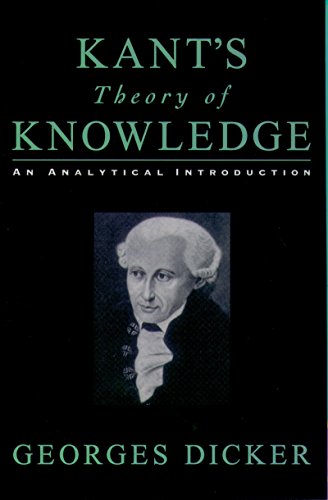
The Critique of Pure Reason is Kant’s acknowledged masterpiece, in which he tackles the question of how we can possibly have knowledge that does not rest on experience (a priori knowledge). The first half of the Critique advances a constructive theory of human cognition and defends the possibility of human knowledge against the skeptical empiricism of Hume. These sections of the Critique are difficult for beginners and for advanced students alike. While there exist many scholarly works discussing the Critique on an advanced level, this book is explicitly designed to be read alongside the text by first-time readers of Kant. Dicker makes Kant’s views and arguments as accessible as possible without oversimplifying them, and synthesizes the views of contemporary scholars. Kant’s Theory of Knowledge will be useful to both undergraduate and graduate students struggling with this notoriously difficult yet deeply influential thinker.
User’s Reviews
Reviews from Amazon users which were colected at the time this book was published on the website:
⭐I am a mathematician who never studied philosophy.I have been trying to learn Kant’s theory of knowledge for over a year now. I listened to many lectures on youtube along with trying to read different books. My efforts started to produce satisfactory results only after I started to read this book.What makes this book stand out among other books in the same subject is its precision and clarity. As a mathematician, I am used to dealing with clear and precise definitions and propositions; and this is why I fell in love with book.I very highly recommend this book to anyone who wishes to study, on his own or in her own, the work of Immanuel Kant.
⭐This is the work of this type that I have read in a very long time. I did have the author as an undergraduate instructor back in the early 1990s and he stood out as that teacher who, though good, is not the ‘easy’ one.My graduate school program in England was Modern European Philosophy which means that German Idealism was a big influence and I found out that I hate Heidegger and that I am not able to understand thinkers like Gadamer very well. I loved Nietzsche for his writing style and ease of understanding – I felt he made sense which is not saying that I agreed all the time because I certainly did not.Now that you know all that you can assess your view of my review with good perspective. I felt that in this book Dicker takes on a couple of main points.Contrasting Humean theory to Kant’s is something that is probably healthy for most people specializing in this field.The question of whether or not there is anything in the objective world showed up. The Idealists said that either there is not or we cannot tell, whereas empiricists and realists say there really is an objective world even though our ability to perceive it is biased by the qualities of our own minds.I did not find it that easy to keep track of the author’s arguments when reading very casually, across days and weeks rather than taking it in one go but I didn’t specialize in logic.The author lays the arguments out clearly, provides accurate descriptions of the main lines of argument – reminiscent of Thomas Aquinas’ written debates in the Summa Theologica and takes reader’s through it without being pointlessly unclear or condescending.Excellent for experts and enthusiasts. For beginners it might seem ‘a bit blarmey’ as he does discuss whether or not space and time and things are real or not with references to obscure theorists and their claims, but it could lead to greater interest. When so, it would be like reading the middle book in a series and instead of just hating how lost one is, reading the rest of the series.
⭐This is a solid introduction to Kant’s epistemology and metaphysics. Dicker lays out the main arguments of the “Transcedental Analytic” with admirable clarity and rigor, borrowing from and modifying earlier interpreters such as Guyer, Strawson, and Wollf. Potential buyers should know that the style of the book–as the subtitle suggests–is heavily analytic. It is advertised as appropriate for “first-time readers of Kant,” but this is true only for those readers who already have quite a bit of analytic philosophy under their belts. Other readers will not have the patience to slog through reconstructions of Kant’s arguments that take the form of long ‘proofs’ with numbered premises and conclusions (plus some elementary symbolic notation). There’s no way around this. The style is unapologetically academic. For readers used to this sort of approach, Dicker is an exceptionally clear and straightforward writer. He pursues Kant’s arguments with remarkable tenacity, and offers very thorough reconstructions of some of the first Critique’s most central lines of thought. Two kinds of reader will probably find this book most helpful: those with background in analytic philosophy who are looking to deepen their understanding of Kant’s work, but lack the patience for the secondary literature and scholarly commentaries; and those looking to get a better grip on, not just Kant, but the way he’s read by commentators such as Guyer and Strawson. Dicker’s reconstruction of the main line of thought about Kant’s conception of objectivity from “The Bounds of Sense,” for example, is great. In general, the patience he displays in going through the main arguments of the Deduction and the Analogies of Experience will make it rewarding even for readers who’ve been through this stuff many times over.Potential buyers should be aware that this is not a comprehensive commentary on either the first Critique or Kant’s work as a whole. Dicker spends very little time on either Kant’s development as a thinker or the historical background of his work. For a more comprehensive commentary, check out Gardner. Readers without the background in analytic philosophy will also find that text much more accessible.
⭐Dicker’s introductions to Kant, Hume, and Descartes are all excellent “advanced” introductions to their subjects. What I mean by “advanced introduction” is that it helps to have a bit of general philosophy background when reading these. For one with a little background, these books are all VERY clearly written — a quality which is too infrequently seen in “introductory” texts. (This is especially the case for introductions to Kant.) That is not to say they are easy reads — but this because the ideas themselves can be difficult. If you put in the effort to read these books carefully, you will get a ton out of them.If one is trying to learn about Kant, I’d highly recommend reading this book in conjunction with Part 1 of Guyer’s “Kant” (in the Routledge Philosophers series). Btw, Dicker’s newest book on Berkeley is very good, too.
⭐Excellent !
Keywords
Free Download Kant’s Theory of Knowledge: An Analytical Introduction in PDF format
Kant’s Theory of Knowledge: An Analytical Introduction PDF Free Download
Download Kant’s Theory of Knowledge: An Analytical Introduction 2004 PDF Free
Kant’s Theory of Knowledge: An Analytical Introduction 2004 PDF Free Download
Download Kant’s Theory of Knowledge: An Analytical Introduction PDF
Free Download Ebook Kant’s Theory of Knowledge: An Analytical Introduction