Ebook Info
- Published: 1989
- Number of pages: 288 pages
- Format: PDF
- File Size: 10.05 MB
- Authors: Friedrich Nietzsche
Description
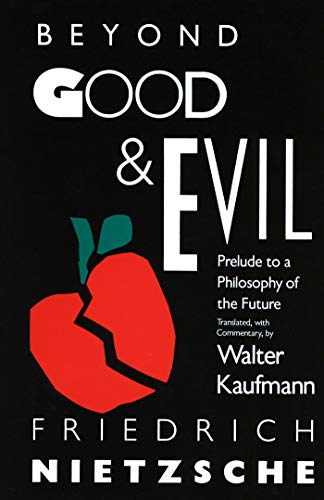
One of the most remarkable and influential books of the nineteenth century—Nietzsche’s attempt to sum up his philosophy. In nine parts the book is designed to give the reader a comprehensive idea of Nietzsche’s thought and style: they span “The Prejudices of Philsophers,” “The Free Spirit,” religion, morals, scholarship, “Our Virtues,” “Peoples and Fatherlands,” and “What Is Noble,” as well as epigrams and a concluding poem. This translation by Walter Kaufmann has become the standard one, for accuracy and fidelity to the eccentricities and grace of the style of the original. The translation is based on the only edition Nietzsche himself published, and all variant reading in later editions. This volume offers an inclusive index of subjects and persons, as well as a running footnote commentary on the text.
User’s Reviews
Editorial Reviews: From the Inside Flap Represents Nietzsche’s attempt to sum up his philosophy. In nine parts the book is designed to give the reader a comprehensive idea of Nietzche’s thought and style. With an inclusive index of subjects and persons. From the Back Cover Represents Nietzsche’s attempt to sum up his philosophy. In nine parts the book is designed to give the reader a comprehensive idea of Nietzche’s thought and style. With an inclusive index of subjects and persons. About the Author FRIEDRICH NIETZSCHE was born in Prussia in 1844. After the death of his father, a Lutheran minister, Nietzsche was raised from the age of five by his mother in a household of women. In 1869 he was appointed Professor of Classical Philology at the University of Basel, where he taught until 1879 when poor health forced him to retire. He never recovered from a nervous breakdown in 1889 and died eleven years later. Known for saying that “god is dead,” Nietzsche propounded his metaphysical construct of the superiority of the disciplined individual (superman) living in the present over traditional values derived from Christianity and its emphasis on heavenly rewards. His ideas were appropriated by the Fascists, who turned his theories into social realities that he had never intended.WALTER KAUFMANN was a philosopher and poet, as well as a renowned translator of Friedrich Nietzsche. His books include Nietzsche: Philosopher, Psychologist, Antichrist, From Shakespeare to Existentialism, and Existentialism: From Dostoevsky to Sartre. Hewas a Professor of Philosophy at Princeton University, where he taught after receiving his Ph.D. from Harvard in 1947 until his death in 1980. He held visiting appointments at many American and foreign universities, including Columbia, Cornell, Heidelberg, Jerusalem, and the Australian National University; and his books have been translated into Dutch, German, Italian, Japanese, and Spanish. Read more
Reviews from Amazon users which were colected at the time this book was published on the website:
⭐This is the third book I’ve read of Nietzsche’s. The first was a collection from various writings, and the second was “The Anti-Christ.” Beyond Good and Evil was Nietzsche’s attempt to summarize his entire philosophy into one book. I don’t know if I’d ever call anything Nietzsche wrote a summary, but this book does lay out his principles in black-and-white, and it did help me put some of the pieces together.Below are a few of my takeaways. It’s not a summary, because I don’t even know if that’s possible. So I just wanted to share a few things I’ve picked up on.On the will to power:If modern (nineteenth century) man is no longer going to believe in God, or at least if they’re going to tone down His influence a bit, the next logical step for them was the concept of free will. In a post-enlightenment world, people were trying to understand if there really is a God pulling our strings like puppets. If they weren’t going to believe that, the next logical step was free will. Nietzsche rejects free will and instead believes in the will to power. Essentially the will to power is his phrase that means people should aim to take power over themselves and create a “superman” or “overman” out of themselves. Nietzsche sees this as an alternative to the concept of free will.On religion -Another thing that I noticed about Nietzsche after reading a fair bit of his work is that, as critical as he is of Christianity, he seems to have a bit of an affinity for Buddhism, or at least the principles of Buddhism. Buddhism’s primary concept is “life is suffering,” right? Nietzsche writes extensively about suffering as well, arguing in part that the cause of all great human advancement is suffering. In the Anti-Christ, he often points out that Buddhism is better than Christianity. To be fair, there was a pretty short list of things that weren’t better than Christianity, according to Nietzsche.I love the short epigrams and how Nietzsche is capable of concentrating so much meaning into such few words-“Blessed be the forgetful: for they forget their stupidities, too.””Whoever reaches his ideal transcends ‘eo ipso.'””‘Where the tree of knowledge stands, there is always Paradise’: thus speak the oldest and the youngest serpents.”*eo ipso = thereby
⭐Aphorism-A Short pointed sentence expressing a truth or precept-Maxim-Adage-Saying. He was full of it/them. He was a product of a long line of Lutheran Ministers. He was granted at 24 years, a full professorship without making a normal written requirement. He lasted about 10 years before becoming a manic, writing his very best work. He had headaches and general ill health that followed him during his incredible profilic productive life. Start with THUS SPAKE THARATHUSTRA and follow with This Tome. Follow with THE ANTICHRIST which was last and best Loathing of Christian Tradition. In original German he used a rather irregular use of phrasing, feeling that words were an unaccepable fixation of thought. GOD IS DEAD meant not what it says. He Voluminously explains in detail. My German is also unusual and duplicitous. His idols whom he later attacked were KANT SCHOP. and WAGNER. HE WAS NOT A HATER OF JEWS, His Sister did his work a sharp turn unserving Push toward Comorade Communisten. Mench vs Ubermench was a leitmotiv thread of his protaginistic firm thrust. He predicted massive Wars to follow from Nationalisic Nihlism. The GOOD EUROPEAN was part of a RETTER MENCH. He was well before his time in invisioning a European Union ie. EEU. After his last work he became Judged Insane as his father had and wrote no more. Now we call it Bipolar Mania. His writing is now judged a classic lead to Extentialism. See Paul Tillich et al. Raison d’etre-Reason to Be-is now seen as his secret success. Love him or hate him, he is an unavoidable Zealot of vision. He is My Guy(ausrufzeichen). His Af’s continue to live. His view of women is skewed. Hope and Despair are opposite sides of the same coin. “That which is done out of love is always Beyond Good and Evil”. So there-Mench of the modern age. It is up to you. Don’t sell him short.
⭐Just received this item, excellent conditions, very legible print. After reading Zarathustra I was perplexed by Nietzsche, his writing skills are nothing short of sublime, the most important thinker of the 20th century for me. By the way, read all the Walter Kaufmann’s translations of Nietzsche’s books, he captured and stayed as close as you can be to the original German writings.
⭐I really liked this book. Now I can’t read it. But its good. I read it thoroughly. Freud thought Nietzsche was a genius more so than he was or something like that. He wasn’t anti Semitic – I think I know what he’s saying but I could be wrong. His father was a preacher and he needed to find a way to negate some of those Christian teachings that can mess some people up so much. Like being too selfless or some such thing. Maybe. He stole one line from Emerson though he did change it just a bit. I think that could be considered plagiarism maybe. He thought Emerson was a cool guy though. I read some Emerson too, but Nietzsche is so much more complex. I also read some of his other books. He gets a bad rap from some people but Louis Lamour liked him. Most of the people who hate Nietzsche don’t know a whole lot of detail about him. And some people get the totally wrong idea like those Nazi types or those idiots that kill people (some have after reading Nietzsche). I sure never got that out of Nietzsche myself. I guess that’s just like those guys like Charlemagne who conquer in the name of Jesus and all though it did work out pretty well for France as it consolidated the territory I suppose.
⭐3 pages in the middle are ripped at the top but the rest of the book is in great condition! Little tape and it’ll be good! (**I did buy this used**)
⭐Beyond Good And Evil is an awesome treatise, Nietzsche’s command of language is so strong, his writing is so beautiful and articulate. By reading Nietzsche you learn many things and some of his writing genius rubs off on us and inspires us greater heights and depths of vocabulary and language. I highly recommend Beyond Good And Evil, but most especially I recommend any of Friedrich Nietzsche’s works, his entire philosophy is profound, provocative and truly amazing!
⭐Good
⭐Okay book, 6/10 read. Very opinionated book, its style is not for everyone. Some topics are interesting, but many topics are boring
⭐Excellent condition of a book that is supposedly ‘used – very good’. Better than expected as it had only one very small fold at top of one page and a large white sticker on first page. Very happy.
⭐Walter Kaufmann editions are the best than any other translation in regard to Friedrich Nietzsche writings..Must read for free spirits
Keywords
Free Download Beyond Good & Evil: Prelude to a Philosophy of the Future in PDF format
Beyond Good & Evil: Prelude to a Philosophy of the Future PDF Free Download
Download Beyond Good & Evil: Prelude to a Philosophy of the Future 1989 PDF Free
Beyond Good & Evil: Prelude to a Philosophy of the Future 1989 PDF Free Download
Download Beyond Good & Evil: Prelude to a Philosophy of the Future PDF
Free Download Ebook Beyond Good & Evil: Prelude to a Philosophy of the Future