Ebook Info
- Published:
- Number of pages:
- Format: PDF
- File Size: 13.24 MB
- Authors: Lawrence E. Cahoone
Description
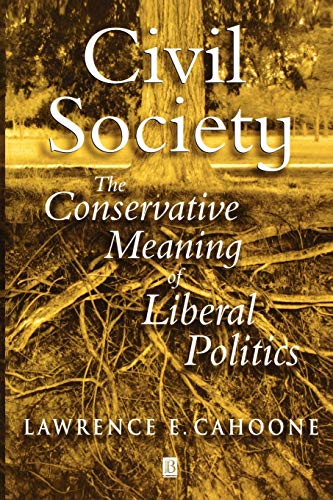
In Civil Society, Lawrence Cahoone stages a critical engagement between the social-political viewpoints of liberalism, communitarianism, and conservatism in order to effect a balanced relation that will bypass or overcome the inadequacies of each position.
User’s Reviews
Reviews from Amazon users which were colected at the time this book was published on the website:
⭐Three books now on conservatism: Roger Scruton, “Meaning of Conservatism,” John Kekes, “Case for Conservatism,” and Lawrence E. Cahoone, “Civil Society: The Conservative Meaning of Liberal Politics.” I can state without reservation that whichever variant of “conservatism” one adopts, the landscape is not attractive. I’ll grant conservatives two critical observations and claims: (1) Ideological Utopianism, i.e., “progressivism,” which insists it can remake society according to some rationalist scheme into an improved model, is surely tenuous at best, and often is accompanied by unintended deleterious consequences. (2) The “problem” of human actions we commonly label “evil” cannot be ignored, reprogrammed, or overcome by improving social structures.While often two-sides of the same coin, the entire notion that some ideological utilitarian calculus will make all our lives better, or that if we “educate, indoctrinate, or inculcate” our citizens, that they’ll achieve perfection, are both empirically nonsense, but based on our biological human natures, not on any conservative conceptual scheme that claims these insights from logic (which is, of course, barred by the first claim).But Cahoone’s work is most valuable not for the conservatism it adopts and extols, but for demonstrating through persuasion the impossibility of the liberal principle of “neutrality.” By virtue of demonstrating the impossibly of this “neutral” principle, conservatives believe they can introduce their conservative “values” as the preferred values of a pluralistic republican society. And, since the vacuum left by abandoning the liberal principle of “neutrality” requires some values to fill its void, arguably many conservative values may be better than other values. But these values have to be shown or demonstrated to be valuable first, and then as values that society should prefer as conservative values over others; mere assertion of conservative principles is insufficient. That is Cahoone’s objective in the second-half of the book.Since the principle of neutrality is widely misunderstood, it is important to understand it before we agree to bury it. As it pertains to liberal governance and to its mechanics in our civil society, neutrality is understood to be the government’s stance toward any particular individual’s choice of morals, modes of life, interests, pursuits, which are, according to this principle, to be left to the individual, not to the state, to adopt in the manner of his/her own choosing. While one may remain sentimentally attached this idea, Cahoone, to his credit, demonstrates this is impossible, and if possible, would be undesirable, to attain. While the capitulation to this realization does force us to adopt non-neutral stances, it does not follow that the conservative stances are the ones to adopt.Cahoone has apparently been tainted, if not absorbed, by the arguments of social constructionists. Their claim is that individuals are socially embedded, and thus individuals are constructed from this embeddedness as the basis of their existence. Whether Cahoone adopts social constructionism as an `empirical’ or an `ontological’ claim is left unaddressed, and for his purposes probably not important. As an empirical claim, social constructionism offers insights as to how society molds individuals, from which they arise, dwell, and interact. As an ontological claim, social constructionism is either tautological or vacuous, but neither is inadequate to any subsequent task. So, we’ll assume Cahoone invokes its empirical claims.As an empirical claim, it is self-evident, if not circular, but it does offer insights in how society molds us individuals according to time, place, and space through the generations. And, yes, we all come to `this’ point embedded in our social histories that are uniquely ours collectively. To cut to the chase, I’ll use a less nuanced example to obtain the same result. As we Americans observed during the Multiculturalist Movement of the 1980s, the central tenet of which is that all cultures (political institutions, religions, artistic tastes, mores, technologies, etc.) are no better/worse than any other (cf., pluralism, which does evaluate the differences). Depending on one’s context and personal perspective, including one’s own cultural and social inheritances, the world’s cultures may be radically different, but in no sense can one claim that one culture/society is superior/inferior to any other. The “great equalizer” of Multiculturalism leveled Modern Western Liberal Democracies along with Medieval Arab Societies along with Aboriginal Societies along with Hebraic Tribal Societies, etc. Even the most egalitarian spirit cannot embrace the “parity” of these divergent societies. This extreme form of relativism was finally slain by our acquaintance with Modern Arab Cultures in the Middle East.A pluralist, in contrast to a multiculturalist, will readily admit that individuals value different aspects of various cultures differently and should be free to do so, and moreover that these diverse cultural and social features may pleasantly co-exist within the same society, as long as the prevailing/dominant “social contract” is understood and subscribed to, which then allows, even revels, in this pluralism of expressions. But that already presupposes a value! Yes, a liberal value, but a value nonetheless. A liberal pluralist may indulge other cultures but would not dare equate a modern pluralistic liberal democracy with that of a medieval feudal theocracy with that of an Australian Aboriginal Hunter-Gatherer Tribe, etc., which all muliculturalists insist we do.Cahoone’s more-nuanced arguments are along similar lines, but both reinforce that `some’ cultural values must preexist as socially embedded and preexistent anterior to any individual, and no matter how indulgent liberals are of others’ values, liberals themselves already demonstrate their tolerance of preexistent values which liberalism insists is supposedly `neutral,’ and which it demonstrates, it is obviously not.So, the `neutrality’ principle of liberalism has been slain! So, what “values” should we liberals adopt as socially normative, since remaining “neutral” is not tenable, defensible, or even desirable? Cahoone offers a very sophisticated alternative that he labels “postmodern conservatism.” In the final analysis, I am not persuaded by any conservatism, not even Cahoone’s conservative principles (which incorporates many liberal principles), which, on the whole are clearly superior to any other “conservative’s.” Alas, that leaves us liberals nowhere, or worse, vulnerable to some others’ values we detest (e.g., neoconservatives, social conservatives, theoconservatives – assuming we/they stay within the `liberal’ tradition at all).To exacerbate the dilemma, we have `progressives’ who once identified themselves as `liberals,’ but now have an aggressive meliorist agenda to `cure’ society of its social ills through grand social engineering (e.g., socialists, Utopians, communitarians, theocrats, etc.), who are the “egalitarians” of the last resort that would flatten everyone and everything to achieve `equality.’ Some may prefer universal poverty and impoverishment as the great “equalizer,” but after the USSR, Mao’s China, Fidel’s Cuba, Chavez’s Venezuela, surely we can do better than equal impoverishment! What is clearer, is that we cannot bury ourselves in a `neutrality’ nostrum any longer.We liberals, however few of us are still left, must find values that we want as normative for our society and culture. That single point makes Cahoone’s book worth its while. We may prefer liberal values, definitely, but liberal `neutrality’ no longer (if it ever) works, as globalization makes increasingly clearer. We must adopt some set of values (even if they are Cahoone’s), lest we evaporate in the vacuum that `neutrality’ bequeaths us only to find some tyrant in its place.Even within our own liberal society, we have those illiberals who would use liberalism’s neutrality for their nefarious purposes to subvert liberalism – from Islam fanatics to Christian fanatics to Hugo Chavez ideologues to neoconservatives – so `neutrality’ is no longer even conceptually defensible. Cahoone, to his estimable analysis, has cast the scales off this liberal’s eyes, and seeing more clearly, we liberals have adopt some values even if `neutrality’ is not one of them. But that requires some moral values be established over others, and as a liberal, I know I must attend, but not very willingly.Postscript: Even if I cannot agree with Cahoone’s conservatism, I certainly understand it far better than his “fellow” conservatives, Kekes, Scruton, Sullivan, included. As always, the conservative is first and foremost a moralist, because that instantiates a particular set of values. Even when a particular religion is excluded as a part of the moral values (Kekes, Cahoone), they have to admit it enters fully through the front door, even if they’d prefer it through side door, even the back doors. But this illustrates their problem. Goldwater (who we all acknowledge was a libertarian, not a conservative), could not keep his conservatism from being overtaken and immersed in Evangelicalism. Once “morals” enters the foray, religion follows, whether or not it is welcomed. As Cahoone demonstrates, some moral values must be accepted as normative, just not the moral values of the religionist moralists. But that remains the central problem for conservatism (in whatever stripe it comes in), once we recognize the need for values (and we all do), I might choose Aristotlean ethics, benevolence ethics, but I do not approve of Kantian morality, much less Judaism, Christian, Catholic, utilitarian calculi (as it is not even “moral”), but where does one draw that line? This explains why liberals shy away from conservatism, because even the best of conservatism gets contaminated by religionists, if not overtaken as well. Behold: The past three decades. Goldwater (and the rest of us) shudder!But, for better or worse, at least Cahoone gets us liberals off our ‘neutrality,’ as if we were ever there to begin with. That is the greatness of this work. Cahoone is not a partisan ideologue (in fact, just the opposite), but he lays out the landscape of the current political climate admirably, honestly, and accurately, and then clears the underbrush and the Overbush to get to some values that we can all accept and trust, except for the fact that the clearings introduced the most toxic “conservatism” in recent memory (a year after this book was published). It only begs the question: How does conservatism get hijacked by such nefarious characters? Therein, is no answer, and therein is the problem.
⭐Cahoon’s book remains very valuable, being perhaps the only book that integrates the wide range of thought informing our understanding of civil society in the modern liberal polity. The book undertakes the important objective of developing a conceptual framework that better illuminates those aspects of American political thought that are widely shared across the political spectrum. Cahoon does this in part by addressing the influence of neutral liberalism, which views government as remaining largely neutral on issues of substantive morality and meaning while it focuses on individualism and material progress. The discussion is of particular value now when the meaning of conservatism in America has been thrown into question. The book situates this discussion within the context of conservative and liberal thought that pertains to the role of civil society. The detailed footnotes are a great resource. It would be nice to see a bibliographic update referencing recent work in this field. Highly recommended.
⭐Lawrence Cahoone is a brilliant philosopher. After listening to 2 of his philosophy courses (Great Courses), I decided to give this book a try. Amazing insights, not dry at all (as described by another reviewer), very fair and even-handed. With an open mind, one may learn a few things……
⭐I am not a Conservative and not a Liberal though I would guess my positions on most things these days are closer to certain Conservative views. I say that as a kind of criticism of this book which aims to put all Conservatives in one basket, and all Liberals in another. In other words something in me opposes this simplistic way of operation, and the presumption that one side is simply all right, and the other side always wrong and stupid.Isn’t it possible that the Liberals are more right on some issues, and the Conservatives more right on others? On the whole as it is biased with a conservitive agenda telling me what and how to think,I would not accept it all blindly . Each person has to think through every issue by themselves. And usually when we do think we do not come into total agreement with others but find areas in which we think and believe differently.
Keywords
Free Download Civil Society: The Conservative Meaning of Liberal Politics 1st Edition in PDF format
Civil Society: The Conservative Meaning of Liberal Politics 1st Edition PDF Free Download
Download Civil Society: The Conservative Meaning of Liberal Politics 1st Edition PDF Free
Civil Society: The Conservative Meaning of Liberal Politics 1st Edition PDF Free Download
Download Civil Society: The Conservative Meaning of Liberal Politics 1st Edition PDF
Free Download Ebook Civil Society: The Conservative Meaning of Liberal Politics 1st Edition