Ebook Info
- Published: 2006
- Number of pages: 240 pages
- Format: PDF
- File Size: 25.76 MB
- Authors: Lawrence E. Cahoone
Description
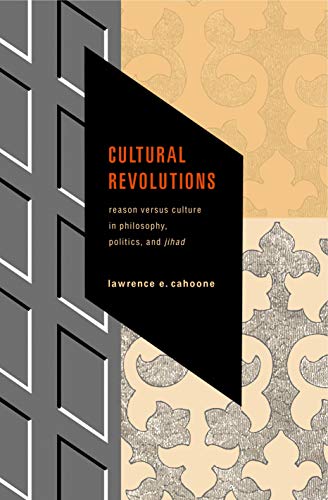
In this probing examination of the meaning and function of culture in contemporary society, Lawrence Cahoone argues that reason itself is cultural, but no less reasonable for it. While recent political and philosophical movements have recognized that cognition, the self, and politics are embedded in culture, most fail to appreciate the deep changes in rationalism and liberal theory this implies, others leap directly into relativism, and nearly all fail to define culture. Cultural Revolutions systematically defines culture, gauges the consequences of the ineradicably cultural nature of cognition and action, yet argues that none of this implies relativism. After showing where other “new culturalists” have gone wrong, Cahoone offers his own definition of culture as teleologically organized practices, artifacts, and narratives and analyzes the notion of cultural membership in relation to race, ethnicity, and “primordialism.” He provides a theory of culture’s role in how we form our sense of reality and argues that the proper conception of culture dissolves “the problem” of cultural relativism. Applying this perspective to Islamic fundamentalism, Cahoone identifies its conflict with the West as representing the break between two of three historically distinctive forms of reason. Rather than being “irrational,” he shows, fundamentalism embodies a rationality only recently devalued―but not entirely abandoned―by the West. The persistence of plural forms of reason suggests that modernization in various world cultures is compatible with continued, even magnified, cultural differences.
User’s Reviews
Editorial Reviews: Review “In this remarkably well-written and closely argued book, Larry Cahoone offers a truly original account of the relation between culture and reason. After providing a reliable and critical analysis of the current literature on the subject, he offers an alternative theoretical perspective of his own that helps us both to understand and criticize religious, especially Islamic, fundamentalism. This important book shows how to construct a culturally sensitive but non-relativist theory of rationality.”―Bhikhu Parekh, University of Westminster and House of Lords“Cahoone rethinks all the basic categories of philosophy of culture in a breathtaking critical analysis of the major contending positions and articulates a clear, though complicated, new theory. It pays off brilliantly in his concluding analysis of Islam in the contentious battle of cultures (and arms). This book should be required reading not only for philosophers of culture but also for social scientists, theologians, historians, journalists, and political leaders.”―Robert Cummings Neville, author of Normative Cultures and Boston Confucianism“In this engagingly written book, Cahoone addresses an eminently timely topic with a clearheadedness that is often lacking in such discussions. With arguments that are unfailingly provocative, he points out that acknowledging the cultural embeddedness of reason by no means requires us to accept a disabling relativism or to abandon our commitments to critical rationality and to intercultural dialogue and understanding. Meaningful forms of rationality can be salvaged in the wake of postmodernism and of the ‘cultural turn,’ he argues. Through a painstaking examination of the seemingly recalcitrant case of genuine or deep cultural difference, Cahoone deftly wends his way between, on the one hand, a liberal culturalism that refuses to take seriously those differences that transgress the compass of liberalism and, on the other, a postmodernism that holds cultures to be bounded, homogenous wholes. He is led to elaborate a conception of culture that allows him to carve out a distinctive and compelling position on the vexed relationship between liberalism and cultural tradition.”―Lorenzo Simpson, SUNY-Stony Brook About the Author Lawrence E. Cahoone is Associate Professor of Philosophy at the College of the Holy Cross.
Reviews from Amazon users which were colected at the time this book was published on the website:
⭐Really good analysis, across a variety of philosophical and topical dimensions, of that culture “is” and how it “means” to its members. A very nuanced view that goes beyond simple functionalist explanations of culture (i.e., evolutionary and/or political-economic) to understand why culture has the power to shape human behavior by determining “meaning” (i.e., what is important to do & not do)..
⭐Culture matters is the basic point of his book, which really focuses on the clash between Islam and the West, which is a clash between postmodern capitalism and liberalism. He argues that this clash represents a historical struggle between “civic-liberal rule” and “primordial and transcendental sources of community” in which the Cold War struggle between communism and capitalism was an aberrant blip, thus the contemporary era is return to this struggle rather than an attempt to find a new Cold War enemy to take the place of SovietsHe tacks on a discussion of jihad, or more specifically Islamic fundamentalism, in the last chapter of the book in which he briefly reviews the standard Islamic intellectuals upon which fundamentalist Islamists have built there conception of the world, from al Wahhabi to Deobandi to Mowdadi, Hanna and Qutb. While he discusses the role of reason in the teachings of each of these thinker’s he primarily focuses on how jihad migrated from an internal, defensive struggle against temptation to an external, offensive battle against the unbelievers and the un-Islamic interpretation of the modern nation-state. He concludes by deciding that Islamist reason is Durkheimian and thus universalistic and totalitarian, whereas modernity and Western reason is Weberian, plural and at a more advanced stage in the historical development of types of reason.Calhoon’s examination of the historical trajectory of the development of reason throughout history is not for the faint of heart – it’s written for an expert. His argument that prior forms of reason do not disappear but are reincorporated or subsumed under the development of new modes of reason but retains some of the other forms in combination, although some cultures/groups have not progressed through the stages and thus more ancient forms of reason predominate.It was helpful to have read Rozanne Euben’s
⭐prior to this, though I have to say I preferred her book.
Keywords
Free Download Cultural Revolutions: Reason Versus Culture in Philosophy, Politics, and Jihad in PDF format
Cultural Revolutions: Reason Versus Culture in Philosophy, Politics, and Jihad PDF Free Download
Download Cultural Revolutions: Reason Versus Culture in Philosophy, Politics, and Jihad 2006 PDF Free
Cultural Revolutions: Reason Versus Culture in Philosophy, Politics, and Jihad 2006 PDF Free Download
Download Cultural Revolutions: Reason Versus Culture in Philosophy, Politics, and Jihad PDF
Free Download Ebook Cultural Revolutions: Reason Versus Culture in Philosophy, Politics, and Jihad