

Ebook Info
- Published: 2002
- Number of pages: 552 pages
- Format: PDF
- File Size: 1.94 MB
- Authors: Mark Burgess
Description
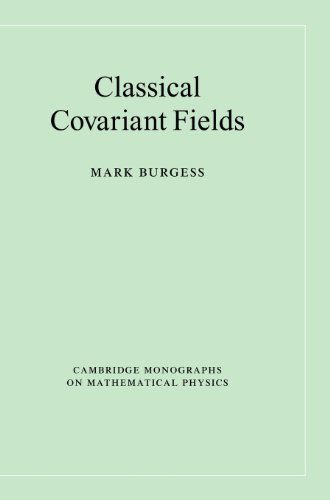
This 2002 book discusses the classical foundations of field theory, using the language of variational methods and covariance. It explores the limits of what can be achieved with purely classical notions, and shows how these have a deep and important connection with the second quantized field theory, which follows on from the Schwinger Action Principle. The book takes a pragmatic view of field theory, focusing on issues which are usually omitted from quantum field theory texts and cataloging results which are often hard to find in the literature. Care is taken to explain how results arise and how to interpret them physically, for graduate students starting out in the field. Many physical examples are provided, making the book an ideal supplementary text for courses on elementary field theory, group theory and dynamical systems. It will also be a valuable reference for researchers already working in these and related areas.
User’s Reviews
Reviews from Amazon users which were colected at the time this book was published on the website:
⭐After buying a number of other books ostensibly about classical field theory that ended up being general classical mechanics texts that happened to include classical fields, I finally stumbled upon Burgess’s Classical Covariant Fields. It’s more expensive than the competition, but when compared to what it would cost to cobble together all of the different topics that it covers piecemeal, it’s really quite a bargain.In the preface, the author states that he intended the book to be a self-contained guide / reference to classical field theory (heavily influenced by Schwinger’s “Source Theory”), and I think it manages to do as good a job as possible…there is a great deal that is assumed of the reader, but enough context is usually provided that if you aren’t familiar with some notation or a technique, you can at least follow along until — and the topics change frequently enough that if you are completely lost, it’s not likely to be for long.However, that very breadth of topics is perhaps the book’s one shortcoming — if you really want to delve in to a specific topic, you’ll need to look elsewhere…but fortunately, there are over a hundred references for the interested reader. My only other complaint is that there do seem to be a higher-than-average number of errors / ambiguities (and I’m sure I missed some due to my overall ignorance of the topic), which while frustrating, can again usually be clarified from their context, or safely ignored without coming back to haunt you later in the book.
⭐Graduate/professional level book which is more valuable than a treasure chest of gold coins. I’ve never seen such a comprehensive, well written and well notated physics book. It’s so good I won’t even try and talk about the details, since my words can’t do it justice in a short space. If you read the product information and it seems to cover even one area you are interested in, then just buy it. Don’t think (till you receive the book) – just buy it now! I bought the Kindle version and the notation seems accurate and looks good. I eventually will buy the hard cover book too, and this will then be the first time I bought both a printed version and Kindle version of the same book. Actually, I never even considered this as a sensible thing to do, – until seeing this book. I don’t expect to ever do it again either.In case you can’t tell … I’m really impressed, and I own most every classic text on field theory, classical physics and action-Hamilton principles. I love them all, but now this one book heads the list as a classic, in my view. If you ever daydreamed about taking the best classics and combining them into one super-classic, forget about it and just buy this book.
⭐Ce livre aurait pu être fantastique si seulement l’auteur avait fait un effort de présentation. En effet le texte est parsemé d’erreurs et d’imprécisions : symboles qui changent d’une ligne à l’autre, problèmes d’indices, grandeurs non définies, allusion à des formules qui ne sont écrites que plus loin, voire presque des erreurs mathématiques (il dit par exemple que exp A exp B = exp(A+B) quand A et B sont des matrices). De nombreux passages sont très flous.Par contre il s’agit d’un des seuls livres de théorie classique des champs, au sens strict du terme (c’est à dire qui étudie l’aspect non quantique des champs, et non juste l’électromagnétisme et la relativité générale). Il expose ainsi une vision très unifiée de la physique, puisqu’il aborde de nombreux sujets qui ne sont d’ordinaire pas exposés sous le point de vue de la théorie des champs.De plus certains commentaires sont particulièrement intéressants et permettent de mieux comprendre les idées fondamentales (par exemple le lien entre des conditions aux bords périodiques et l’invariance de Lorentz, l’hydrodynamique, etc.).Le compendium des différents champs à la fin est très utile.En conclusion ce livre est très bien à condition de connaitre déjà la théorie des champs pour ne pas se laisser dérouter par son aspect cryptique.
⭐
Keywords
Free Download Classical Covariant Fields (Cambridge Monographs on Mathematical Physics) in PDF format
Classical Covariant Fields (Cambridge Monographs on Mathematical Physics) PDF Free Download
Download Classical Covariant Fields (Cambridge Monographs on Mathematical Physics) 2002 PDF Free
Classical Covariant Fields (Cambridge Monographs on Mathematical Physics) 2002 PDF Free Download
Download Classical Covariant Fields (Cambridge Monographs on Mathematical Physics) PDF
Free Download Ebook Classical Covariant Fields (Cambridge Monographs on Mathematical Physics)