Ebook Info
- Published: 1994
- Number of pages: 816 pages
- Format: PDF
- File Size: 11.44 MB
- Authors: Ronald S. Calinger
Description
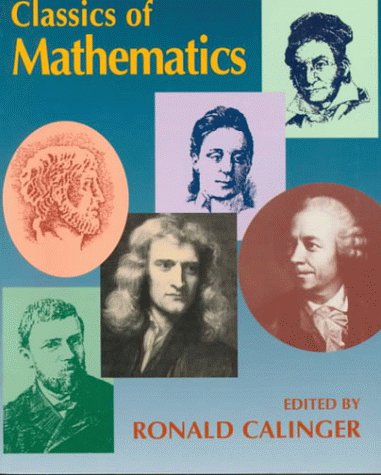
Appropriate for undergraduate and select graduate courses in the history of mathematics, and in the history of science. This edited volume of readings contains more than 130 selections from eminent mathematicians from A `h-mose’ to Hilbert and Noether. The chapter introductions comprise a concise history of mathematics based on critical textual analysis and the latest scholarship. Each reading is preceded by a substantial biography of its author.
User’s Reviews
Editorial Reviews: From the Publisher This edited volume of readings contains more than 130 selections from eminent mathematicians from A `h-mose’ to Hilbert and Noether. The chapter introductions comprise a concise history of mathematics based on critical textual analysis and the latest scholarship. Each reading is preceded by a substantial biography of its author. From the Back Cover This anthology contain selections from writings of leading mathematicians from classical antiquity through the early twentieth century. While the selections are chiefly taken from authors of the Mediterranean and modern Europe, some attention is given to medieval Islam and India, to traditional China, and to the united States.
Reviews from Amazon users which were colected at the time this book was published on the website:
⭐everything is awesome!
⭐Wonderful Treatment of Mathematics through the years. Hard to do, considering that, as a joke, mathematicians have punch lines like, “FOUR!!!” (2+2=?)
⭐This selection of readings in the history of mathematics begins with a quotation from Abel, summarized in my title. The author has selected a wide variety of texts, mostly primary sources, and added brief historical and biographical information necessary for their understanding by the general reader, in particular undergraduates studying the history of mathematics. I believe any course in the history of mathematics should incorporate some such texts. (Unfortunately with standard textbooks running at [price], combining this anthology with the necessary textbook presents practical difficulties.) Reading authentic source material is undoubtedly difficult, and the reader who fails to understand a word of Vieta (even with the good Struik’s help, reprinted by Calinger) will be in good company, but the author’s enthusiasm and his sense of the unleashed power of the variable “x” should still come through.The material covered ranges from ancient Babylonia (as discussed by the incomparable Neugebauer) down to some work from the early twentieth century (including for some reason an extract from Eves and Newsom). (He ought to have provided a compact table of sources in addition to the individual notes strewn through the volume. Perhaps he was dissuaded by the publisher)As one passes beyond the 17th century the selection is wisely confined somewhat near the limits of its intended audience, with major distortions that are probably inevitable. At least the point is clearly made that the development of the calculus was in no sense the end of the history of the mathematics, though perhaps, in Churchill’s words, the end of the beginning.High school students, or other readers looking for a bit more entertainment, should go directly to The World of Mathematics by James R. Newman. (Perhaps also to the deliberately unreliable and entertaining E. T. Bell, and Infeld’s novel inspired by the life of Galois.)Readers looking to learn something substantial about the history of mathematics will find that Calinger’s anthology is useful as a supplement, but not on its own. For independent reading, one might eventually tackle a substantial undergraduate text like Victor Katz’ history of mathematics (whose use of footnotes is excellent, allowing the reader to both check and follow up on points of interest). But it will be more interesting to begin with a more narrowly focussed work by an expert. Neugebauer writes beautifully on the Babylonians, as does Sarton on the Hellenistic age. Marie Boas Hall has a very pleasant book on the Renaissance period, not specifically focussed on mathematics but still quite suitable. Berggren has an excellent text on Arabic mathematics aimed at undergraduates.Graduate students and beyond should start with Felix Klein, Development of Mathematics in the 19th century.And if you read German, the 1st three volumes of Moritz Cantor’s work are wonderful (but heavy). Lüneburg has a beautiful book on Fibonacci, in German, which ought to be translated!For a long time, the history of early mathematics was the history of Greek mathematics. In the last century, the frontiers were pushed both backward and forward significantly, with major discoveries in Babylonian mathematics and substantial elucidation of the history of Arabic mathematics. The study of Indian and Chinese mathematics seems still to be very much waiting in the wings. Whitney wrote in 1889 “All dates given in Indian literary history are pins set up to be bowled down again.” Whether that observation is apposite today I will leave to the experts to debate, but one may hope that the present century will do for both the Indian and Chinese mathematical materials what the last began to do for the Arabic.
Keywords
Free Download Classics of Mathematics 1st Edition in PDF format
Classics of Mathematics 1st Edition PDF Free Download
Download Classics of Mathematics 1st Edition 1994 PDF Free
Classics of Mathematics 1st Edition 1994 PDF Free Download
Download Classics of Mathematics 1st Edition PDF
Free Download Ebook Classics of Mathematics 1st Edition