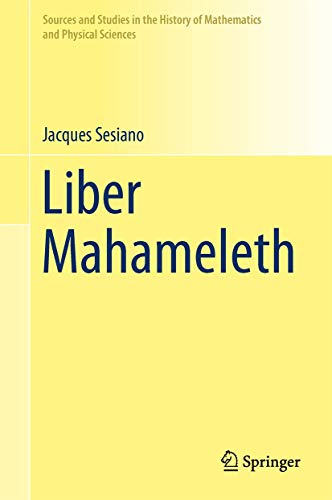
Ebook Info
- Published: 2014
- Number of pages: 1815 pages
- Format: PDF
- File Size: 15.75 MB
- Authors: Jacques Sesiano
Description
The Liber mahameleth is a work in Latin written in the mid-12th century based (mainly) on Arabic sources from Islamic Spain. It is now our principal source on mathematics in Islamic Spain at that time; There are few extant Arabic texts and no one is as complete as the LM. It is also the second largest mathematical work from the Latin Middle Ages (the other is by Fibonacci, some 50 years later).Since the three main manuscripts preserving it are incomplete and there are many scribal errors, a reliable Latin text has been established, which reports (in notes) the various readings of the manuscripts and the errors in them. This is how a so-called critical edition is made. This edition of the Latin text is preceded by General Introduction, describing the various manuscripts, the content of the work and what we know about its author.Part Two of the volume is a translation of the text and ends with a glossary of Latin terms. The glossary will be of great importance for the knowledge of Latin scientific terms from that time, since there is no other mathematical text of this size from the 12th century. Part Three begins with a short introduction and then analyzes all the problems from the text, with a summary of the mathematical methods involved in each chapter. The commentary is a companion to the translation and explains the author’s solving methods.
User’s Reviews
Editorial Reviews: Review “Sesiano’s description of the manuscripts is excellent. Furthermore, his translations are precise and readable, and his mathematical commentary is clear and useful. Overall, the work is a splendid contribution by Sesiano to the field of history of mathematics. The careful, critically edited Latin text will be of interest mainly to specialists, but the English translation and study will be of broader interest.” (Toke Lindegaard Knudsen, Mathematical Reviews, March, 2016)“Sesiano’s book is a milestone in the history of medieval mathematics. It not only makes available one of the most important mathematical treatises in an excellent edition with English translation, but also gives a detailed analysis of the different problems and the methods for solving them and presents a comprehensive glossary which is also useful for non-mathematical texts.” (Menso Folkerts, Historia Mathematica, Vol. 42, 2015)
Reviews from Amazon users which were colected at the time this book was published on the website:
⭐Before about 1100, only definitions and statements of theorems from Euclid’s Elements circulated in Latin, and the only widely read mathematical work was the Arithmetica of Boethius. Sesiano explains in the General Introduction that in the 12th century, the Euclid’s Elements were translated into Latin (both from Arabic and from Greek) and various Arabic mathematical treatises were translated, by authors like al-Khwarizmi. Sesiano tells us that in the 12th century there were two large original Latin works that used Arabic sources. First, the Liber algorismi of John of Seville, and second, the Liber mahameleth (which Sesiano suggests was also written by John of Seville). Leonardo of Pisa’s works are in the 13th century, and Sesiano divides the Arabic influences as Spanish and Eastern Mediterranean, with the Liber mahameleth depending on Spanish sources and Leonardo of Pisa depending on Eastern Mediterranean sources.“Mahameleth” is a transliteration of the Arabic “muamalat”, “dealings”, particularly commercial dealings. The Liber mahameleth cites Abu Kamil, whose Algebra has been translated by Martin Levey. The Liber mahameleth is sprawling and unlike Leonardo of Pisa in his “Liber quadratorum”, the mathematical level seems uniformly elementary. Almost no digestion seems to have been done in the literature of the Liber mahameleth.The OED lists the words denominator and numerator as used in the modern way in Robert Recorde, but at the same time Recorde also writes in “The Whettstone of Witte” about “nombers denominate”, which mean something like a number with units. Different notions of denomination occur in the Liber mahameleth. But while “denominator” can be a Latin word (from the verb denomino, I name, and like how the verb doceo, I teach, becomes doctor, teacher, denomino becomes denominator, namer), it is not used in the Liber mahameleth, which instead speaks about “denominatio”. For example, I would like to make sense of exactly what “denominate” (in Latin, denominare) means in the following:“Similarly if you want to denominate one from fourteen. You know that fourteen results from the multiplication of seven by two; thus seven is its half, and two, its seventh. Since one is a half of two, one is a half of a seventh of fourteen.”
⭐
Keywords
Free Download Liber Mahameleth (Sources and Studies in the History of Mathematics and Physical Sciences) 2014th Edition in PDF format
Liber Mahameleth (Sources and Studies in the History of Mathematics and Physical Sciences) 2014th Edition PDF Free Download
Download Liber Mahameleth (Sources and Studies in the History of Mathematics and Physical Sciences) 2014th Edition 2014 PDF Free
Liber Mahameleth (Sources and Studies in the History of Mathematics and Physical Sciences) 2014th Edition 2014 PDF Free Download
Download Liber Mahameleth (Sources and Studies in the History of Mathematics and Physical Sciences) 2014th Edition PDF
Free Download Ebook Liber Mahameleth (Sources and Studies in the History of Mathematics and Physical Sciences) 2014th Edition