

Ebook Info
- Published: 2004
- Number of pages: 500 pages
- Format: PDF
- File Size: 2.62 MB
- Authors: Tomasz Kaczynski
Description
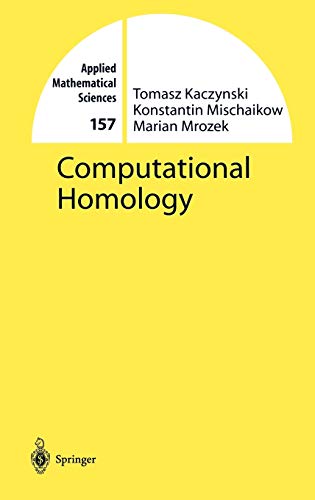
Homology is a powerful tool used by mathematicians to study the properties of spaces and maps that are insensitive to small perturbations. This book uses a computer to develop a combinatorial computational approach to the subject. The core of the book deals with homology theory and its computation. Following this is a section containing extensions to further developments in algebraic topology, applications to computational dynamics, and applications to image processing. Included are exercises and software that can be used to compute homology groups and maps. The book will appeal to researchers and graduate students in mathematics, computer science, engineering, and nonlinear dynamics.
User’s Reviews
Editorial Reviews: Review From the reviews:”…This is an interesting and unusual book written with the intention of serving several purposes. One of them is to demonstrate that methods of algebraic topology, in particular homology theory, that have proved remarkably successful in several areas of pure mathematics can provide powerful, and in some cases indispensable, tools in a number of areas of applied mathematics and science. The second is to provide the necessary theory and “technology” for such applications. This means on the one hand providing all the necessary mathematical foundations of the subject, including definitions and theorems, and on the other hand efficient computational techniques capable of dealing with real life situations. Thus, the book stresses algorithmic and computational approaches; and in fact includes computer code written in a programming language specially designed for this purpose. It is addressed to a varied audience of computer scientists, experimental scientists and engineers while at the same time trying to retain the interest of mathematicians. With this in mind the authors have attempted to produce a modular book, which allows a number of different reading approaches. The basic subdivision of the book is into three parts. The last part contains all the basic pre-requisites from algebra and topology: the most essential facts about Euclidean spaces, point set topology, abelian groups, vector spaces and matrix algebras. This part also contains a description of the programming language used to describe the algorithms found in the book…” –MATHEMATICAL REVIEWS”This is an interesting and unusual book with the intention of serving several purposes. One of them is to demonstrate that methods of algebraic topology, in particular homology theory … . The second is to provide the necessary theory and ‘technology’ for such applications. … the book admirably achieves all its stated purposes. In addition it will provide much needed ammunition for those algebraic topologists who have been feeling besieged by allegations of their subject’s lack of ‘useful’ applications.” (Andrzej Kozlowski, Mathematical Reviews, 2005g)”This book provides the conceptual background for computational homology – a powerful tool used to study the properties of spaces and maps that are insensitive to small perturbations. The material presented here is a unique combination of current research and classical rigor, computation and application.” (Corina Mohorianu, Zentralblatt Mathematik, Vol. 1039 (8), 2004)”In addition to developing a computational homology theory which produces efficient algorithms, the authors demonstrate how these algorithms can be applied to a variety of problems … . I certainly recommend Computational Homology to mathematicians and applied scientists who wish to learn about the potential of algebraic topological methods. … this book is the first comprehensive effort to describe the computational aspects of homology theory … . It is written at a level that is suitable for advanced undergraduate and early graduate courses … .” (Thomas Wanner, SIAM Review, Vol. 48 (1). 2006)”This is the first textbook on what is necessarily a mixture of classical mathematics, computer science, and applications. … it is a unique feature of Computational Homology that every geometric step, however conceptually simple, is broken down into elementary operations. … The book offers a reliable yet practical introduction to (cubical homology), with a strong emphasis on computational aspects. Hands-on experience can be gained through the many problems within the book and also by means of the software packages … .” (Arno Berger, Zeitschrift für Angewandte Mathematik und Mechanik, Vol. 86 (4). 2006) From the Back Cover In recent years, there has been a growing interest in applying homology to problems involving geometric data sets, whether obtained from physical measurements or generated through numerical simulations. This book presents a novel approach to homology that emphasizes the development of efficient algorithms for computation. As well as providing a highly accessible introduction to the mathematical theory, the authors describe a variety of potential applications of homology in fields such as digital image processing and nonlinear dynamics. The material is aimed at a broad audience of engineers, computer scientists, nonlinear scientists, and applied mathematicians.Mathematical prerequisites have been kept to a minimum and there are numerous examples and exercises throughout the text. The book is complemented by a website containing software programs and projects that help to further illustrate the material described within.
Reviews from Amazon users which were colected at the time this book was published on the website:
⭐This is a heavy text but also a great view into the promise of Homology for solving everyday problems. I recommend this for any math mind interested in computer applications or any hacker looking for a new source of inspiration.
⭐This is one of the early books in the field of computational topology. There is a lot of good in this book but I had a few complaints.A thorough presentation of all the mathematics is given including proofs of all theorems. That’s not easy to handle for a novice. In fact, a graduate level course in modern algebra, as well as some point-set topology, seems to be required for the student to follow the proofs. I liked the introduction for a first-time student in the beginning of the book. After that, the book becomes very “dense”. The homology theory is developed for cubical complexes instead of the traditional simplicial complexes as necessary for studying digital images. I liked this approach (but not the notation) so much that I used it later in my own book
⭐. Numerous exercises are provided.The algorithms are fully written, in pseudocode. They are easy to follow as long as you understand the mathematics but some prior experience with algorithms might be necessary. A software package, called CHomP, is available online.
Keywords
Free Download Computational Homology (Applied Mathematical Sciences, 157) 2004th Edition in PDF format
Computational Homology (Applied Mathematical Sciences, 157) 2004th Edition PDF Free Download
Download Computational Homology (Applied Mathematical Sciences, 157) 2004th Edition 2004 PDF Free
Computational Homology (Applied Mathematical Sciences, 157) 2004th Edition 2004 PDF Free Download
Download Computational Homology (Applied Mathematical Sciences, 157) 2004th Edition PDF
Free Download Ebook Computational Homology (Applied Mathematical Sciences, 157) 2004th Edition