Ebook Info
- Published: 2009
- Number of pages: 404 pages
- Format: PDF
- File Size: 11.88 MB
- Authors: F. William Lawvere
Description
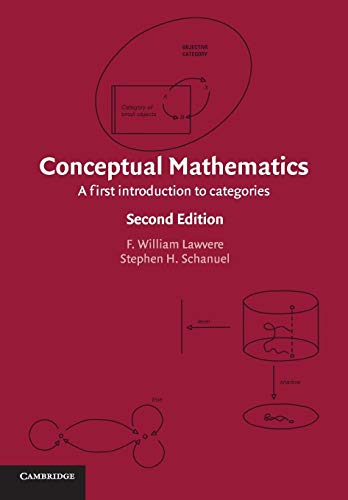
In the last 60 years, the use of the notion of category has led to a remarkable unification and simplification of mathematics. Conceptual Mathematics, Second Edition, introduces the concept of ‘category’ for the learning, development, and use of mathematics, to both beginning students and general readers, and to practicing mathematical scientists. The treatment does not presuppose knowledge of specific fields, but rather develops, from basic definitions, such elementary categories as discrete dynamical systems and directed graphs; the fundamental ideas are then illuminated by examples in these categories.
User’s Reviews
Editorial Reviews: Review “This outstanding book on category theory is in a class by itself. It should be consulted at various stages of one’s mastery of this fundamental body of knowledge.” George Hacken, reviews.com Book Description This truly elementary book on categories introduces retracts, graphs, and adjoints to students and scientists. Book Description Conceptual Mathematics introduces the concept of category to beginning students, general readers, and practicing mathematical scientists based on a leisurely introduction to the important categories of directed graphs and discrete dynamical systems. The expanded second edition approaches more advanced topics via historical sketches and a concise introduction to adjoint functors. About the Author F. William Lawvere is a Professor Emeritus of Mathematics at the State University of New York. He has previously held positions at Reed College, the University of Chicago and the City University of New York, as well as visiting Professorships at other institutions worldwide. At the 1970 International Congress of Mathematicians in Nice, Prof. Lawvere delivered an invited lecture in which he introduced an algebraic version of topos theory which united several previously ‘unrelated’ areas in geometry and in set theory; over a dozen books, several dozen international meetings, and hundreds of research papers have since appeared, continuing to develop the consequences of that unification.Stephen H. Schanuel is a Professor of Mathematics at the State University of New York at Buffalo. He has previously held positions at Johns Hopkins University, Institute for Advanced Study and Cornell University, as well as lecturing at institutions in Denmark, Switzerland, Germany, Italy, Colombia, Canada, Ireland, and Australia. Best known for Schanuel’s Lemma in homological algebra (and related work with Bass on the beginning of algebraic K–theory), and for Schanuel’s Conjecture on algebraic independence and the exponential function, his research thus wanders from algebra to number theory to analysis to geometry and topology. Read more
Reviews from Amazon users which were colected at the time this book was published on the website:
⭐Well, the first half is worth reading. But very much so.There are two major values to this book:(1) it is interesting as a pedagogic experiment. It does not hold as a masterpiece, but it does hold as a spark of genius worthy of iteration.More to talk about than I will. But the general layout is a few (5?) chapters that contain, alone, almost all the content of the book. An advanced reader could read them and be done. However, after each chapter there are several more breaking down the chapter in the form of a Socratic dialogue between teacher and student.People who “read math “ generally know you read it more than once. You read through it — get an idea of the matter then go back through to iron out particulars. This text introduces the student to that by giving an overview chapter followed by breakdowns.It also focuses on developing a few models the students can use to start approaching category theory.(2) The book, the first 1/2, is a great pre-category theory warm up. It’s basically about set composition and properties and playing with them. But it’s something many will find useful and illuminating.The book has flaws. Past the first half it starts to breakdown and it’s casualness gives way to ambiguity that is difficult to follow even if a reader was already familiar with the material. [Section 10 on Brouwer’s Theorem is the first example — largely incomprehensible. And a pity — it’s a beautiful theorem (one likely familiar to those who’ve learned some topology) and by the be guts well in the book. But it’s a disaster. Like a sketch of the chapter got published.The book continues to be strong/helpful for awhile with that section an outlier. But eventually the whole book goes that way. Perhaps useful in a specifically designed classroom setting to balance out the ambiguity of the later chapters.But. An excellent half a book is an excellent book in its own right. And many would do well to read this through.
⭐Possibly a more apt subtitle for this book would be “A First Introduction to Ideas that Underlie Category Theory.” Even after spending quite a bit of time with this book, I didn’t really feel like I’d learned much category theory, per se. (Tom Leinster’s Basic Category Theory seems like an excellent choice if you want to jump right into definitions of categories, functors and natural transformations, then start thinking in terms of adjoints, etc. He also makes that book available on arxiv.) But, early on, Lawvere/Schanuel’s book introduced (quite clearly, I think) category-theoretic ideas like sections and retractions, which I hadn’t even realized that I’d encountered before. (I’d spent some time with Tu’s Intro to Manifolds before this book, and at first I wondered if his definition of a section in the discussion of vector bundles had typos in it or what; after some time with Lawvere/Schanuel, that section from Tu makes a lot more sense.)As others have mentioned, the books seems like it might be quite simple, near the beginning. At first, given my lack of familiarity with category theory, this book made me wonder if category theory was the study of the consequences of associativity of composition laws, as that’s a bit of a recurring theme in this book. And speaking of composition laws, if one wants to come up with a list of prerequisites for this book (or to start reading it, at least), I’d dare say that a familiarity with the composition of functions might be all you really need. That said, I should say this: I recently took a first pass at Rotman’s Intro to Algebraic Topology and, after reading his discussion of Brouwer’s fixed point theorem, I went back to Lawvere/Schanuel to revisit their section of the same topic, but still didn’t feel clear about the Lawvere/Schanuel version after re-reading that section. (Rotman, on the other hand, I found quite easy to understand.) So while one could start this book with minimal prerequisites, I don’t expect to feel like I’d understood it all, any time soon (and I’m well past the minimal prerequisites I just offered). And that’s sort of a drawback — the difficultly level of the book doesn’t exactly scale smoothly, once you’re into the latter half or so of the book. But that’s probably my only criticism, as I find the discussion-driven parts of the book generally quite lucid and insightful.
⭐There are few books worth reading many times. This book is lucid and how it explains things so well is as interesting as what it is explaining. It should be required reading for any writers, and of course any mathematical writers.
⭐Really enjoyed this book. I’d been trying to get a handle on Categories for a while (work related) and this book got me up and running. I still use it regularly as a reference, never leaves my desk.
⭐I am returning to this book over and over. It is very pedagogical and well written. Binding quality is bad. Cambridge should be very ashamed for it.
⭐An excellent introduction to this very important subject.
⭐Category theory is a beautiful abstraction and writing a book about it would have needed a thorough organisation of the concepts on which the theory is founded… Unfortunately, organisation is simply absent :- the authors have mainly treated the “How” and forgot the “Why” : no objective, no roadmap, no synthesis…- In a verbose, confused, disordered style… added to a strange and inefficient use of often unrelated “Articles”, which are supposedly explained by “Sessions”, themselves containing “Sections” which are sometimes even more obscure than the corresponding articles which they are meant to explain !- Even though the reader will face a jungle of sometimes unsubstantiated definitions, notations, unproven theorems, arrows and dots at will, in an imaginary class — and find that amusing through the first 150 pages — the fiesta will soon stop along Part III and part IV, where the price of a loose organisation will have to be paid, inevitably !!- Finally, boredom culminates at Part V, with the disappointing question : what have we achieved ???
Keywords
Free Download Conceptual Mathematics: A First Introduction to Categories 2nd Edition in PDF format
Conceptual Mathematics: A First Introduction to Categories 2nd Edition PDF Free Download
Download Conceptual Mathematics: A First Introduction to Categories 2nd Edition 2009 PDF Free
Conceptual Mathematics: A First Introduction to Categories 2nd Edition 2009 PDF Free Download
Download Conceptual Mathematics: A First Introduction to Categories 2nd Edition PDF
Free Download Ebook Conceptual Mathematics: A First Introduction to Categories 2nd Edition