

Ebook Info
- Published: 2002
- Number of pages: 976 pages
- Format: PDF
- File Size: 14.61 MB
- Authors: Ron Penton
Description
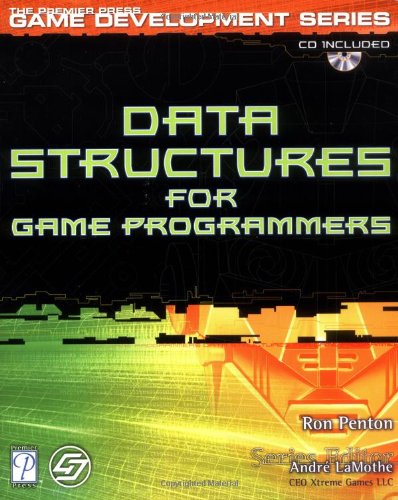
Data Structures for Game Programmers replaces endless pages of boring text with exciting gaming technology and eye-catching graphics. The complex subject of data structures is made easy to understand and fun to learn. Start with an explanation of how the most popular data structures and algorithms work. Then you’re on your way as you create your own! From simple arrays and bit vectors to intense binary tree graphs and hash tables, this book covers it all. It even tackles the algorithms used for sorting, searching, compression, and recursion. Plus, you will actually see each concept put into practice through interactive graphical demonstrations included on the CD!
User’s Reviews
Editorial Reviews: About the Author Ron Penton is an independent programmer with a primary interest in computer games. He began using GW-BASIC in 1989, moved on to Visual Basic 4 in 1995, QBasic in 1996, and learned C++ in 1997. Ron began working on his degree in 1998 at the Rochester Institute of Technology, and is working on completing his Bachelors in Computer Science at the University of Buffalo. Ron contributed a chapter in the book titled Game Programming All in One published by Premier Press.
Reviews from Amazon users which were colected at the time this book was published on the website:
⭐It’s a good intro to data structures, but doesn’t go as deep into each type as I would have preferred.
⭐Publishing a book on data structures and algorithms isn’t an easy task, because there’s no computer science genre that’s got as much of a pedigree. With titles ranging from a dozen good college textbooks to Sedgewick’s five-volume _Algorithms_ series to Knuth’s dense and eternally-unfinished _Art of Computer Programming_ series, any new book on data structures and algorithms is facing some serious competition. When I learned that Ron Penton, a newcomer to the programming book scene, was entering the foray with _Data Structures for Game Programmers_, I was skeptical. Could a book explaining the deep subject of data structures and algorithms written by someone with comparatively little experience in programming hold its own against books written by lifelong academics?Unfortunately, that answer is “not really”. While _Data Structures for Game Programmers_ does a reasonable job of explaining the data structures and algorithms that are necessary for games, the book suffers from serious organization problems and a lack of depth.The book does cover the expected basics and follows the standard format, with a chapter on arrays, a chapter on linked lists, a chapter on binary trees, a chapter on stacks & queues, etc. These are covered reasonably well, showing how the structures are represented, the advantages and disadvantages of each, and how to code them. The book does try to distinguish itself from a standard college data structures textbook in two ways. First, each data structure and algorithm includes an interactive example program on the included CD. These examples are very well done and are an excellent way to see constructs “in action”. Second, the example programs are all game-oriented, mostly involving a Zelda/Ultima style adventure game.Around page 600, the book takes a turn into algorithm territory, and it does take a more game-oriented focus following the obligatory chapter on sorting. Chapters on data compression, random numbers, and path-finding are natural fits for all kinds of games.Following the algorithms are a few short appendices covering the basics of C++ (or as much as can be covered in 30 pages, which isn’t much), a few pages on how PC memory is organized, a quick overview of SDL (the graphics library used to make the example programs), and twenty pages on STL.Unfortunately, the short shrift given to STL is one of the problems with the book. While the value of STL was once debated, it is now blessed by ISO as the C++ standard library and is now as much a part of C++ as the if( ) statement. About half of the data structures covered in the book are already implemented in STL, and the rest can be made out of combinations of STL containers and algorithms. The book, however, ignores STL in favor of building all data structures from the ground up. While I understand the need to show how data structures look and work internally, the chapters should at least mention that the structures are already part of C++ and don’t need to be implemented directly.Early on I mentioned the organizational problems with the book, and a couple of them are significant. The first is how, despite the fact that the book is aimed at C++ beginners, the book opens with a fairly advanced chapter on templates. The templates chapter is followed by a far-simpler chapter on arrays. Despite having not covered arrays yet, the chapter on templates implements an array container assuming that arrays are already understood. Even worse, chapter 9 is a tutorial on how to write classes in C++, even though C++ classes have been in heavy use since chapter two! I honestly don’t know if this is a case of chicken-egg syndrome run amok or if it’s a case of an author and editor not spending enough time organizing the layout of the book, but it does make for a confusing read.My final complaint about the book is about the relative lack of depth given to the subjects. While simple structures like arrays are covered comprehensively, there is too much “this is too advanced a topic for this book” later on. For example, the chapter on binary trees shows how to build and climb a binary tree. The chapter does correctly state that binary trees suffer from a significant flaw, which is that the search efficiency is very dependent on the order of the data inserted. The chapter also states that there are ways around this flaw, namely AVL and red-black trees which re-balance themselves. That’s where the book stops, though. Even though the book could cover balanced trees with a few more pages, the book just recommends you look elsewhere and leaves (no pun intended) binary trees with their flaws. This is later repeated in the chapter on minimax trees, mentioning that tree-searches can have their performance improved significantly, but not detailing those ways because, according to the author, the chapter was getting too big and most folks aren’t interested in minimax trees anyway.In conclusion, _Data Structures for Game Programmers_ tries to achieve a lofty goal, staking a space among books written by the top people in the field. Unfortunately, though, it only partially reached that goal, covering some topics well and gaining big points for the quality of the programs on the included CD, but falling well short of the mark in organization and depth of advanced coverage.
⭐Ron Penton, Data Structures for Game Programmers (Premier, 2003)I don’t normally get all googly-moogly over programming books. In fact, I just took a quick look back at my reading log since 1999, and a select few have gotten four stars, but nothing above that. But I picked up Penton’s nine-hundred-page tome on Thursday and I finished it on Sunday. Nine hundred pages in four days. I’ve only been keeping track of page counts over the past year, but the books I’ve read that have come closest, page-wise, have been Robin Hobb’s lovely novels, three of which I read earlier this year hovered around eight hundred pages. I read the shortest of them in eight days. And I love Robin Hobb.Data Structures for Game Programmers is a wonderful book in no small part because Ron Penton was still an undergrad while writing it. Which is, of course, also the book’s main problem, because someone like me who last saw ivy-covered halls well over a decade ago is likely to be sick with envy that some little greenhorn has already found his way into the world of professional computer-book publishing (and by “professional” here I don’t mean “published by recognizable press,” I mean “the kid’s already published three books in three years, and they’re ALL monstrous tomes, when does he have time to program?”). But let’s face it, you expect something different when you read a book by a young writer, be it the hot new novelist or the new kid on the programming block. And Penton delivers it; Data Structures for Game Programmers is, if you’re a programmer, the most readable computer book you’ve ever come across. Penton seems to have a healthy disrespect for textbooks, which he alludes to a few times in the course of the book, and it shows in his writing; he wants to write something that will teach you more than a textbook by being more accessible. And in this goal, he succeeds. Brilliantly. I learned more about C templates from reading this book than I have in any other three books devoted to nothing but templates, and here they’re just referred to a few times in passing. How is this possible? Because Penton explains things in language far easier to understand than that of most programming books; simply put, he hasn’t yet been so overwhelmed by jargon that he can’t see when he’s written something the layperson might not be able to understand, which is a common ailment among programming authors.Also, there’s been some minor grumbling from some critics about the book’s insistence on reinventing the wheel. Of course it does. That’s how you learn to program– you bang away at it, doing something that’s already been done, until you figure out why it’s done that way. There may be five or six people on the planet who can read it in a textbook and immediately figure out why it’s the case (and, one assumes, they are the same people as those critics), but the rest of us are much happier seeing it this way.If any computer book publishers happen to be reading this, you, especially, should be reading Data Structures for Game Programmers. See what it’s like. Try to get the rest of your authors to emulate it. You’ll have much happier customers that way.This is one of the handful of books I’ve read since getting a library card again (a total, in fact, of four since 2003) that, after returning it to the library, went back on my Amazon wish list, because I want a copy for myself.
⭐I don’t program in c++ yet I bought this after reading a few chapters of an electronic version: they do a fantastic job of explaining stuff a programmer should know in the first years of coding. The highlight for me is the distinction I now have between generics and templates, whereas I’d no idea of the latter before at all.if your doing computer science and need some straight up solid fundamentals with practicality, this book will do it. If you’ve an ambition to use c++ in general for game coding or other work requiring more than stitching together very high level libraries then you want this.The level is aimed at turning a relative novice into a solid intermediate coder, in terms of understanding and application. The concepts travel well, allowing for language and compiler differences.More importantly, it’s NOT a boring book, hence why a non c coder is likely to enjoy referring to it to gain conceptual understanding with a practical bent. Nice job.
⭐This book is very broad ranging and of excellent quality. The potentially dry and tedious world of data structures is given new life by always relating it back to game development.The examples use SDL for the graphical representations and has multi-platform libraries on the CD. This means that non-windows developers can also benefit fully from the examples and the code without extensive editing (and you don’t lose the first 1/4 of the book to windows specific tutorials on Direct X etc).Kudos to the author for making the choice to use SDL. Read the terms of the LGPL license on SDL people, and remember, have fun – this book will certainly give you a great start in the extremely important field of data structures and algorithms.Highly recommended.
⭐The author did a great work. There are a lot of programming books that explain many things but this book has the additional value of showing everything in game demonstrations that perfectly works.
Keywords
Free Download Data Structures for Game Programmers (Premier Press Game Development) with CD-ROM 1st Edition in PDF format
Data Structures for Game Programmers (Premier Press Game Development) with CD-ROM 1st Edition PDF Free Download
Download Data Structures for Game Programmers (Premier Press Game Development) with CD-ROM 1st Edition 2002 PDF Free
Data Structures for Game Programmers (Premier Press Game Development) with CD-ROM 1st Edition 2002 PDF Free Download
Download Data Structures for Game Programmers (Premier Press Game Development) with CD-ROM 1st Edition PDF
Free Download Ebook Data Structures for Game Programmers (Premier Press Game Development) with CD-ROM 1st Edition