

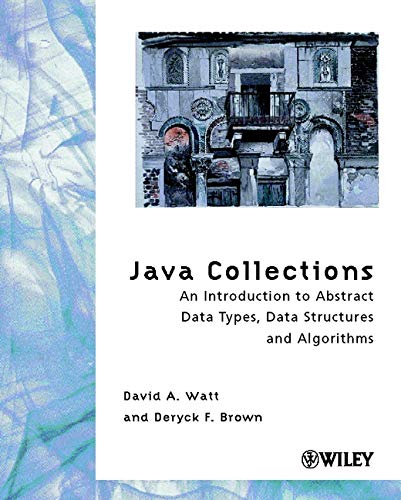
Ebook Info
- Published: 2001
- Number of pages: 566 pages
- Format: PDF
- File Size: 15.45 MB
- Authors: David A. Watt
Description
Paying close attention to the Java 2 collection classes, this book is designed to give programmers the ability to choose the best collection classes for each application. The focus of the book is on abstract data types (ADTs) that turn up again and again in software design. It will use these ADTs to introduce the data structures required to implement them and the algorithms associated with the data structures.Suitable for a first course in algorithms and data structures, or a second course in programming using Java, this text offers a unique angle by concentrating on the in-built collection classes in Java 2, enabling more emphasis on software design, and less on theory.Primarily targetted at students of computer science or information technology, but also of interest to professional programmers and software engineers who are retraining to program in Java.
User’s Reviews
Editorial Reviews: Review “A lovely book…. I will use this book a lot in the next few months on a Java project I’m just starting.” (CVu, December 2001) From the Inside Flap Java Collections is an introductory text on abstract data types, data structures, and algorithms using Java. Written at an appropriate level for a first course in algorithms and data structures, or a second course in programming using Java, this text concentrates on pratical matters like software design and the Jave Collections framework. Only essential supporting theory is included. The text focuses on abstract data types (ADTs) that turn up again and again in software design. It uses these ADTs to introduce and motivate the data structures required to implement them and the algorithms associated with the data structures. This approach helps Java programmers to choose the most suitable collection classes for their applications. Not only undergraduate students but also professional programmers retraining the program in Java will benefit form this even-paced and example-led text. Key features of the text: * emphasizes good object-oriented software design and implementation * presents algorithms both in English and in Java, and shows how to analyze their efficiency (with only light mathematics) * introduces the concept of an abstract data type, shows how to use a “contract” to specify the abstract data type’s contract and its implementation in terms of a suitbale data structure and algorithms * covers a variety of abstract data types (stacks, queues, lists, sets, maps, priority queues, trees, and graphs), compares alternative implementations of these abstract types, and relates them to the Java collection classes * features numerous examples and case studies showing how the abstract data types are used in practical applciaitons * contains numerous graded exercises, offering opportunities to explore alternatives to the designs and implementations presented in the text * includes appendices summarizing the mathematics of algorithm analysis, the relevant features of the Java programming language, and the Java collection classes. From the Back Cover Java Collections is an introductory text on abstract data types, data structures, and algorithms using Java. Written at an appropriate level for a first course in algorithms and data structures, or a second course in programming using Java, this text concentrates on pratical matters like software design and the Jave Collections framework. Only essential supporting theory is included. The text focuses on abstract data types (ADTs) that turn up again and again in software design. It uses these ADTs to introduce and motivate the data structures required to implement them and the algorithms associated with the data structures. This approach helps Java programmers to choose the most suitable collection classes for their applications. Not only undergraduate students but also professional programmers retraining the program in Java will benefit form this even-paced and example-led text. Key features of the text: * emphasizes good object-oriented software design and implementation * presents algorithms both in English and in Java, and shows how to analyze their efficiency (with only light mathematics) * introduces the concept of an abstract data type, shows how to use a “contract” to specify the abstract data type’s contract and its implementation in terms of a suitbale data structure and algorithms * covers a variety of abstract data types (stacks, queues, lists, sets, maps, priority queues, trees, and graphs), compares alternative implementations of these abstract types, and relates them to the Java collection classes * features numerous examples and case studies showing how the abstract data types are used in practical applciaitons * contains numerous graded exercises, offering opportunities to explore alternatives to the designs and implementations presented in the text * includes appendices summarizing the mathematics of algorithm analysis, the relevant features of the Java programming language, and the Java collection classes. About the Author David Watt is a Professor of Computing Science at the University of Glasgow. Deryck Brown is a Senior Lecturer in Computing Science at the Robert Gordon University, Aberdeen. Read more
Reviews from Amazon users which were colected at the time this book was published on the website:
⭐I have no complaint. The book was delivered before estimated arrival date.
⭐I’ve been teaching data structures and algorithms for over 25 years,and the fundamentals–which every computer science student shouldknow–haven’t changed very much. However, it doesn’t follow thateveryone needs to write their own linked lists or hash tables fromscratch, when Java already supplies so much of that. I have looked fora textbook that balances explanation of the basics with exploration ofthe Java Collections Interface, and this is by far the best book to date.(The similarly-named book by Zukowski has too many errors of factin it for my taste.)Another reviewer said that this book does not cover the Java CollectionsAPI. This is incorrect. The authors develop the ideas behind each datastructure as a suitably abstract data type, and then go on with “…andhere’s how the Java Collections API does it.” I think the previousreviewer simply didn’t read far enough to get to those parts.For a tutorial on just the Java Collections API, Sun’s online “Trail” isthe best single source, and has the advantage that it is not intermixedwith implementation details. If that were enough, no data structurestextbook would be necessary. However, in real problems, anypredefined generic data structure is likely to be inadequate and willneed to be extended; this is why a good programmer needs to knowthe Collections API (so as to avoid reinventing the wheel), but inaddition a good computer scientist needs to know how these datastructures are implemented, so that he/she can go beyond them whennecessary.The book is somewhat weak on algorithms and would not serve as areference on this topic; however, there is plenty of meat here for a firstcourse on data structures and algorithms.
⭐I’ve been reading through a copy of this book, and comparing it to another notable book on the same subject, mainly “Data Structures and Algorithm Analysis in Java” (DSAAJ) by Mark Allen Weiss. Something very noticeable is that Java Collections is a much simpler book to tackle, though I feel that this detracts slightly from its use as a textbook. As a PhD student in Computer Science, I prefer the mathematical detail I found in DSAAJ than the lesser amount of math that Watt and Brown provide in Java Collections. Yet, at the same time, the case studies in Java Collections are a tremendous help in understanding what a given ADT is useful for, which DSAAJ doesn’t go into at all. And the detail on what a specific ADT is supposed to do is much better detailed in Java Collections than in DSAAJ. As a TA, I taught a course in Data Structures and Algorithms for Computer Engineering students. The textbook we used for that was Weiss’ DSAA book directed towards C++ instead of Java, but for those who know both versions of the book, the two are very similar. If instead of C++ the course was oriented towards Java, I would have chosen this book as a textbook for that course; these students weren’t needing the math focus, and they (and I) would have preferred the practical programming knowledge in here.For the programmer out of college, or the college student that wants an alternate view on ADTs than what DSAAJ provides, this is an excellent book.Member of the Columbia Java User Group ([…]
⭐Good Book but it is before Generics were introduced so content is dated, I didn’t know this
⭐Data structures and algorithms is a complex subject, but this book doesn’t really help in clearing up the understanding, particularly to students like myself. At the start of our Java module we were told to get this book, which was out of print. I can now see why it was.The language of any subject in the book is dressed up to the eyeballs with formal language which makes even simple statements appear complex and requiring lots of thought.For example. “A string is a sequence of characters. The characters of a string have consecutive indicies.” Now I know what a string it, it simply can be thought of as a sentence, it isn’t difficult. But imagine you are someone who is approaching the subject with no priot knowledge, you would have to think hard about what the book is saying before you get it.With other subjects in the book, like time complexity, a lot of assumptions are made about the readers knowledge, particularly in the mathematical field. If you don’t know what the, “Fastest Growing Term” is, or the, “Constant Factor” you’re stuck! Another example is on power algorithms. The books states, “It is easy to see that b to the power of 20 = b to the power of 10 + b to the power of 10.” But is it easy? I certainly don’t like things like this being assumed. If I think about it, it does make sense, but it isn’t obvious.Basically, as a student, this book wasn’t really suitable for me or my fellow students.
⭐Poorly written.
⭐
Keywords
Free Download Java Collections: An Introduction to Abstract Data Types, Data Structures and Algorithms 1st Edition in PDF format
Java Collections: An Introduction to Abstract Data Types, Data Structures and Algorithms 1st Edition PDF Free Download
Download Java Collections: An Introduction to Abstract Data Types, Data Structures and Algorithms 1st Edition 2001 PDF Free
Java Collections: An Introduction to Abstract Data Types, Data Structures and Algorithms 1st Edition 2001 PDF Free Download
Download Java Collections: An Introduction to Abstract Data Types, Data Structures and Algorithms 1st Edition PDF
Free Download Ebook Java Collections: An Introduction to Abstract Data Types, Data Structures and Algorithms 1st Edition