

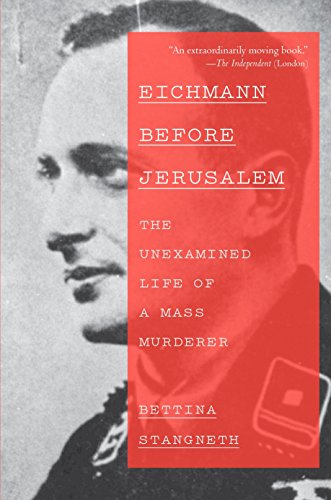
Ebook Info
- Published: 2015
- Number of pages: 608 pages
- Format: PDF
- File Size: 7.16 MB
- Authors: Bettina Stangneth
Description
A New York Times Notable Book A National Jewish Book Award finalist In 1960, Adolf Eichmann took to the defendant’s box in Jerusalem and insisted that he was no “manager of the Holocaust,” as his accusers claimed, just a smalltime bureaucrat following orders. Like countless others, Hannah Arendt—covering the trials for The New Yorker—believed him. Eichmann Before Jerusalem challenges this history for the first time, completely reassessing Eichmann’s story and drawing upon a wealth of newly uncovered materials that reveal his great deception, as well as bringing to light shocking truths about Nazis in the post-war world. Mapping out the astonishing links between innumerable past adherents—from ace Luftwaffe pilots to SS henchmen—both in exile and in Germany, Bettina Stangneth reconstructs in detail the secret life of one of the Holocaust’s principal organizers.
User’s Reviews
Editorial Reviews: Review “[An] extraordinarily moving book.” —The Independent (London)“[Stangneth’s] comprehensive research brings the man and his circumstances firmly back into focus. . . . No future discussion will be able to confront the Eichmann phenomenon and its wider political implications without reference to this book.” —The New York Times Book Review“Meticulously researched, compellingly argued, engagingly written. Bettina Stangneth confronts Hannah Arendt’s notion of the ‘banality of evil’ with important new evidence and nuanced insight, permitting a fresh and informed reassessment of this riven debate.” —Timothy Ryback “Well-written and impressively well-researched. . . . Stangneth, acting more like an investigative journalist than an academic philosopher, does an excellent job in tracing the odyssey of [numerous] archival records, which are scattered across various continents. . . . [She] adds many new, surprising details to our picture of Eichmann before the trial.” —The Wall Street Journal“Remarkable. . . . Eichmann called himself a ‘small cog’ in the Nazi war machine, but Stangneth draws on recently released documents to show that he was anything but.” —The New Yorker “[A] brilliant book, exhaustively researched and convincingly argued. . . . Only now, with the publication of [Eichmann Before Jerusalem] . . . can we see how completely Arendt (and later historians) were hoodwinked by Eichmann.” —The Daily Telegraph (London) “A detailed portrait.” —The New York Times “Important. . . . An extraordinary book. . . . Through unprecedented granular detail, Stangneth unearths exactly what Arendt obscured with her ‘banality’ thesis. . . . The meticulous quality of her research and her distinctive moral outrage make the journey enthralling. . . . Stangneth presents an Eichmann from whom we cannot avert our eyes.” —The Daily Beast “Stangneth’s absorbing account of his years in exile . . . adds considerably to our knowledge of Eichmann. . . . [She includes] a full analysis of Eichmann’s ideas as he expounded them to his friends and former colleagues in exile.” —The Guardian (London) “Stangneth has combined the talents of rigorous academic research with investigative journalism in tracking down and sifting through the mounds of archival data located in diffuse venues. Her efforts at comparing, collating and interpreting the wealth of material in the hall of mirrors and blind alleys that Eichmann erected are nothing less than prodigious. . . . She has freed Eichmann from Arendt’s shadow and restored him to center stage.” —Haaretz “[A] highly intelligent book. . . . Stangneth makes a compelling argument. . . . Her excellent portrayal of the frighteningly active community of Nazi refugees in postwar Argentina is unmatched.” —Irish Times “Stangneth demonstrates, with great forensic skill, that the metaphysical construct, the bedrock of Eichmann’s defence before an Israeli court, was and is rubbish.” —The Herald (Scotland) “[A] well-researched and path-breaking study.” —Jewish Review of Books “It is impossible to overestimate the meticulous care Stengneth has taken. . . . Well worth reading, even more than once.” —The Buffalo News About the Author Bettina Stangneth wrote her dissertation on Immanuel Kant and the concept of radical evil. Ever since then she has been researching a theory of the lie and has written widely on anti-Semitism in eighteenth-century and National Socialist philosophy. In 2000 she was awarded first prize by the Philosophical Political Academy, Cologne, and she received the German NDR nonfiction book award for Eichmann Before Jerusalem in 2011. Bettina Stangneth is an independent philosopher and lives in Hamburg, Germany. Excerpt. © Reprinted by permission. All rights reserved. IntroductionEver since Eichmann in Jerusalem: A Report on the Banality of Evil was published in 1963, every essay on Adolf Eichmann has also been a dialogue with Hannah Arendt. A Jew from Königsberg who had studied philosophy under Karl Jaspers and Martin Heidegger until National Socialism drove her out of Germany, Arendt went to Jerusalem in 1961 for Eichmann’s trial. Like all philosophers, she wanted to understand. But our understanding is always mediated by our context: we bring to the task our own thoughts and experiences and our own images of the past. Hannah Arendt read about Adolf Eichmann in the newspapers for the first time in 1943 at the latest, and eighteen years later she was familiar with all the research on him. What she expected to find in Jerusalem was something she had already described in detail: a diabolical, highly intelligent mass murderer who commanded a kind of horrified fascination, the kind of murderer seen in great works of literature. “He was one of the most intelligent of the lot,” she wrote in 1960. Anyone who dared to understand him would be taking a great leap toward understanding the Nazis’ crimes. “Am very tempted.”Arendt, a philosopher with a gift for acute observation, was not the only person who was puzzled by Eichmann in the flesh. Regardless of where they came from, almost all the trial observers received the same impression: Eichmann-in-Jerusalem was a wretched creature, with none of the scintillating, satanic charisma they had expected. The SS Obersturmbannführer who had spread fear and terror and death for millions exhausted the observers’ attention with his endless sentences, and his talk of acting on orders and taking oaths of allegiance. Shouldn’t the fact that he was so astoundingly good at doing so have aroused suspicions, even in 1961? Voices of doubt were present, but they were very quiet and not at all popular. The crucial difference between these voices and the trial observers was that the doubters all had access to at least part of the Argentina Papers.In 1960 Holocaust research was in its infancy, documentary evidence was scarce, and the desire to extract information from perpetrators who were brought to trial made people incautious. Hannah Arendt chose the method of understanding that she was familiar with: repeatedly reading Eichmann’s words and conducting a detailed analysis of the person speaking and writing, on the assumption that someone speaks and writes only when they want to be understood. She read the transcripts of his hearing and the trial more thoroughly than almost anyone else. And for this very reason, she fell into his trap: Eichmann-in-Jerusalem was little more than a mask. She didn’t recognize it, although she was acutely aware that she had not understood the phenomenon as well as she had hoped.No other book on Adolf Eichmann—and probably on National Socialism as a whole—has occasioned more debate than Eichmann in Jerusalem. The book achieved the primary goal of philosophers since Socrates: controversy for the sake of understanding. However, since at least the end of the 1970s, reference to Hannah Arendt has served to distract us from the matter at hand. One cannot help but feel that the story of the trial has stopped being about Eichmann, and that we would rather talk about the debate and various theories of evil than try to discover more about the man himself than a thinker in 1961 could possibly have known. And yet a major development has given us access to other sources entirely—at least in theory.Since 1979 large parts of the so-called Sassen interviews have become available, and we can now see what Hannah Arendt and all the other trial observers were not allowed to see: Eichmann beforeJerusalem, chatting in his friend’s front room, surrounded by former comrades—Nazis in Argentina, just like him. Historians’ engagement with this wealth of information has, however, remained worryingly brief. They have displayed some reluctance and a notable lack of curiosity regarding this source, even after some of the original tapes surfaced in 1998. A thorough reading of the transcripts alone confirms that more happened in Argentina than just a journalist on the lookout for a story meeting up with a washed‑up Nazi on the lookout for a bottle of whiskey, and reveling in their memories. If anyone was of a mind to actually argue against Hannah Arendt, rather than continue to lament the success of her book, they could have found plenty of ammunition here. Instead, we go on retelling Eichmann’s stories from Israel, referring to the dates he gave, quoting from an insupportable pseudoedition of the transcripts from a tendentious publisher, and leaving unexamined material on Eichmann sitting in archives, wrongly labeled—material that could put even the legendarily reactionary stance of historians to the test. And so there is at least one thing we should learn from Hannah Arendt: when faced with the unknown, we should let ourselves be tempted.My book is, first, an attempt to present all the available material, as well as the challenges that come with it. Even the story of how the Argentina Papers came to be distributed among several archives, like pieces of a monstrous jigsaw puzzle, gives us an unexpected insight into the “Eichmann phenomenon.” And any controversy about this phenomenon is worthwhile. My book presents these sources in detail for the first time, and the route they have taken through history, in the hope that it will enable further research and prompt more questions.Eichmann Before Jerusalem is also a dialogue with Hannah Arendt, and not simply because I first came to this topic many years ago through Eichmann in Jerusalem. Our understanding of history is so dependent on our own time and circumstances that we cannot ignore a perspective like Arendt’s. She had the courage to form a clear judgment, even at the risk of knowing too little in spite of all her meticulous work. And one of the most significant insights to be gained from studying Adolf Eichmann is reflected in Arendt: even someone of average intelligence can induce a highly intelligent person to defeat herself with her own weapon: her desire to see her expectations fulfilled. We will be able to recognize this mechanism only if thinkers deal bravely enough with their expectations and judgments to see their own failure.Having written this book, it remains for me to preface it with a warning, in the same words that Hannah Arendt wrote to a good friend before flying to Jerusalem for the Eichmann trial: “It could be interesting—apart from being horrible.”…Introduction to Chapter 1To this day, we don’t know exactly when Eichmann decided to live in Argentina, but he once explained why he was drawn there: “I knew that in this ‘promised land’ of South America I had a few good friends, to whom I could say openly, freely and proudly that I am Adolf Eichmann, former SS Obersturmbannführer.”Proud to be Adolf Eichmann? What an extraordinary remark! The fact that Eichmann saw this as a realistic possibility was as grotesque then as it seems now. His name had become a byword for the Nazis’ extermination of the Jews, as he was all too aware. Nobody goes to great lengths to live under a false name, among strangers, without good reason. And when Adolf Eichmann was planning his escape, he had an excellent reason: he was simply too well known to remain undiscovered for long.Too many people knew him and knew about his part in the disenfranchisement, expulsion, and mass murder of the Jews. If this fact is not as clear to us today as it was to Eichmann in the late 1940s, it is due to his extraordinary success in presenting himself in Jerusalem. After being kidnapped in 1960, he did his utmost to paint himself as an unimportant head of department, one among many, a “small cog in the machine” of the murderous Third Reich. He was ultimately an anonymous man who had been “made a scapegoat” through error, chance, and the cowardice of others, an unknown SS officer with no influence to speak of. But Eichmann knew very well that this image was a lie. By no means had his name been known only to a very limited circle of people; nor did it become common currency only during the trial. On the contrary, his reputation played a fundamental part in the enormity of the crime for which Eichmann remains notorious to this day.As his name developed into a symbol of the Holocaust, Adolf Eichmann kept a close watch on it; indeed, both he and his superiors specifically encouraged the development. He wanted to be anything but the “man in the shadows” that he sometimes claimed to be. Only before the court in Israel did he try to give the impression that he had been a nameless, faceless, disposable minor official—but then, who wouldn’t want to be invisible when threatened with the death penalty? Still, the Eichmann Before Jerusalem idea that Eichmann had been a man in the shadows seemed plausible to many people. Some even saw his invisibility as the key to his murderous success. Yet obvious clues tell us that by 1938 at the very latest, Eichmann was neither unknown nor interested in operating behind the scenes. As we follow these clues, a far more colorful picture of this shady character will emerge….The Ideal SymbolAdolf Eichmann was not the first person to realize how useful a public image can be. The use of ideals and symbolism was one of the secrets for the Nazi Party’s success. Hitler’s Mein Kampf also provides a warning never to underestimate the effect of a symbolic figure. Speaking in the 1950s in Argentina, Eichmann would say that wartime was when he had finally become famous: “They knew me wherever I went.” He even turned up in a book published by some of his comrades in Vienna, though his name was spread largely through his visibility to his victims: “Through the press, the name Eichmann had emerged as a symbol. . . . In any case, the word Jew . . . was irreversibly linked with the word Eichmann.” And his various official departments with their nondescript and frequently changing names soon just became known as “Eichmann’s office.” These concepts were so powerful that they can be found in witness statements from the Nuremberg trials, along with the term “Eichmann’s special commando” for his representatives abroad. This usage cannot be wholly explained by the fact that Eichmann, unlike many officials in the RSHA, remained in his post throughout the war. He would never have gained this reputation without the public performance that went with it, and without that reputation, “Eichmann’s office” would not have had the position of power that it achieved over the years. A single person’s influence extends only as far as his arm or his commands can reach. His image, however, can have an impact in places he never goes, provided he finds someone to carry it there—even if that someone is his enemy. “Much more power . . . was attributed to me than I actually had,” Eichmann explained. And “this fear” of his presumed power meant that “everyone felt he was being watched.”The Nazi Party’s concept of power was very personalized, and the rapid success of this concept was repeated further down the organization. Eichmann and his colleagues quickly learned how useful a Führer-like figure can be, as a focal point for gathering power. This was one of his fundamental reasons for not hiding in the shadows or shying away from public displays. The Nazis needed a shop-front sign to which the Jewish question could be “irreversibly linked,” and Eichmann was the name to fulfill that symbolic function. Eichmann would later try to make this choice look like pure chance—a view that surfaces occasionally in books and articles on his role. But what other name could even have been considered for the position?Eichmann kept a close watch on his growing reputation, and it could not have escaped him that his exploits were becoming increasingly notorious. The international press reported on them, and the Nazis went over the press of “international Jewry” with a fine-tooth comb. Reviewing the press was a reconnaissance mission in a war that was partly being fought with “intellectual weapons.” Eichmann’s significance, both in his own estimation and for his colleagues, grew in direct proportion to the number of plans and campaigns to which he managed to link his name. By this time, many people were also familiar with Eichmann from his appearances at interministry meetings and planning conferences. With all due caution about viewing history through an individual biography, it is surprising how many of the participant lists for important meetings feature Eichmann’s name. He was involved right from the start, leading experiments—like the Vienna Central Office, Doppl, Nisko, the Szczecin deportations, ghettoization, and even the first attempts at mass extermination—which can now be seen as prototypes for practices that later became standard. At the notorious Wannsee Conference, Heydrich officially enthroned Eichmann as the coordinator of all interministerial efforts toward the “final solution of the Jewish question.” It was the logical next step for his career. A lunatic project like this required someone who had experience in unconventional solutions, someone who wouldn’t get caught up in the usual bureaucratic formalities. Eichmann’s leadership of the Vienna Central Office, and everything that came after, proved he could do just that. He had a talent for organization, and for making possible things that had never been done before. When others were at a loss, he was the man they called on. For example, a professor at Strasbourg University was adamant that he wanted the “skulls of Jewish-Bolshevist Commissars” to add to a collection of skeletons, despite the fact they were still alive. With Eichmann on board, this too could be organized.Eichmann enjoyed his reputation for being the man for tricky assignments. Even when he was neither the initiator nor the driving force of a project, he still managed to convince others he had originated it. The so-called Madagascar Plan is still linked to his name today, although the original idea was verifiably not his, and he never worked on its details. But still he triumphed: in spite of all evidence to the contrary, even today no one can talk about this resettlement plan without mentioning his name. In later years, when circumstances had changed, Eichmann would make an immense effort to divert attention away from himself and play down his role. But that effort only provides further evidence of the position he had really held during the Nazis’ glory years. No one would do that unless they had something to hide, and Eichmann did it surprisingly effectively.It has therefore taken some time for historians to recognize the significance of the gigantic eviction and resettlement plans in which Eichmann played a substantial part. As head of Special Department IV R, he was responsible for “the central processing of Security Police matters during the implementation of the eviction in the East.” The connections were clearer to Eichmann’s contemporaries, as we can see from a report by the Ministry of the Interior, claiming that in September 1941 Eichmann advocated extending the definition of Jews to include half Jews. He was “strongly in favor of the new ruling, though with no real view on the form it should take.” The biographical note on him read: “Eichmann set up the Central Offices in Vienna and Prague, and led the deportation of Jews from Szczecin etc. to the General Government.”The expulsion of the Jews from Szczecin on the night of February 13, 1940, and the deportations from Posen and Schneidemühl that followed, were the overture to the planned reordering of occupied Eastern Europe in its entirety. These events caused worldwide press attention, which was closely monitored by the Reich and made a lot of people nervous. But Eichmann used the attention, just as he had the failure of Nisko, to build up pressure in meetings with Jewish representatives in the months afterward, and to threaten them with a similar “resettlement” program if the emigration quotas were not met. Eichmann’s public persona made the press inflate his role in the resettlement. He liked to give the impression he was behind everything and everyone. Newspaper coverage of the affair created a threatening picture, which only those watching from a distance could afford to underestimate. At this point in time, reports of excessive violence, and even propagandist exaggeration in the international press, served to help Eichmann rather than hurt him. The more reports went around that “this Eichmann did that,” and the more incidents were “attributed [to him] out of pure habit,” the greater his reputation became. Eichmann not only saw through this mechanism; he used it to further his own interests. Read more
Reviews from Amazon users which were colected at the time this book was published on the website:
⭐Most importantly, the book is an incredible contribution to the publicly available information on the activities of Eichmann and many mid- and upper-level Nazi “bureaucrats”, some before the war, and then those who escaped to Argentina after the war. It provides a vast amount of detail on Eichmann and his close associates after the war.The investment of time by the author in finding, investigating, reading, and then organizing the information she retrieved is huge — a significant chunk of her life. For that, she is owed real gratitude. Her passion for the subject, beyond the disciplines of research, comes through in her writing and is something that she notes at the beginning.There is room for improvement, however, in the translation (it seems to me) and the editing of the book (definitely). But neither of these weaknesses at all diminishes the value of reading the book, though they make it a bit less easy.The historical research that went into the book is thorough and very serious, but it is presented in a rather informal and casual way, much like reading a letter from someone you know well. The basic organization is well set in their head but their presentation in the letter suffers from some things a bit out of sequence (people brought into the story line who haven’t been introduced yet in the book, for example), some repetition, some things carried on at length when they could have been said much more concisely, and other characteristics of a personal letter from a very knowledgeable friend.It takes (or took me, at least) a while to get used to the juxtaposition of style and content — at times it felt like reading the first draft of a manuscript knowing that the author was trying to get everything in, all the details, all the opinions and extrapolations, with the plan to winnow this the next time through, confident that nothing was left out of the first run.But this stylistic issue is no reason to avoid the book — the reader is more than rewarded for working through the delivery by the scope and specificity of the information that has been painstakingly acquired, organized and presented.As other reviews have noted, the author’s focus on the time at the very end of the war and the years immediately following helps give a feel for how long it took for the details of the holocaust to become widely known and understood. It also gives a clear picture — consistent with obvious reality — that the German populace, unified in war, did not change with the signing of the surrender, and the national network of prejudices, beliefs, friendships, alliances, personal commitments didn’t change over night. This book gives a feel for the process of change in Germany in the years immediately following the war and the growing realization of all the war entailed by the rest of the world.Several reviews say there is nothing new in the book, which is completely inaccurate. Many others note that the book would benefit from editing, an opinion I share. But once one gets accustomed to the casual tone, repetitiveness, and prolixity in places, the overall effect of the book is chilling. The mosaic of specifics starts to fill in and a picture of the toxic Nazi ideology up to and through the war emerges looking just as ugly and malignant in this group of refugees after the war. One benefits from learning more about the Peron regime as a side benefit.It’s not a page-turner but there is much to be gained by making the effort to read it all.
⭐Eichmann’s Extraordinary Evil: Review of Eichmann Before Jerusalem by Bettina StangnethIn Eichmann Before Jerusalem: The Unexamined Life of a Mass Murderer (New York: Random House 2014), Bettina Stangneth challenges Hannah Arendt’s hypothesis that Eichmann represents the banality of evil: an ordinary man turned mass murder by extraordinary circumstances (the war and the rise of Nazi totalitarianism). The image of Eichmann that emerges from Stangneth’s book is one of a charming chameleon that deceives others about his intentions and his credentials. Without knowing more than a few words of Yiddish and having no knowledge of Hebrew, Eichmann relied upon the smattering of Jewish culture he got by spying on Jewish leaders to climb the political ladder and obtain an official function as Head of Department of Jewish Affairs in the SD (Security Service of the Nazi Party). Although most of the time he gave the impression of being calm and reserved, he would fly off into an ideological rage—similar to Hitler’s–whenever his objectives were frustrated or when it served his purposes (such as to intimidate Jewish leaders into complying with his orders). As if with the flip of a switch, however, Eichmann could instantly revert to being courteous and collected (for instance, when a German woman would step into one of the ideological meeting). His emotions, like his attachments, were shallow. Although he remained “loyal” to his wife, Veronika Liebl, he cheated on her and dominated her. At one point he boasted that he tore up the Bible of his highly religious wife, though eventually he allowed her to practice Christianity. Their dominance bond was quite strong, however, since Vera patiently–and faithfully–waited for years while her husband lived in hiding after the war and eventually joined him in Argentina, where he managed to escape justice for eleven years.The picture that emerges from Stangneth’s book is not that of an ordinary man corrupted by power in a totalitarian regime—as Arendt famously indicates in Eichmann in Jerusalem, A report on the banality of evil–but that of a psychopath: a highly narcissistic man without remorse, without conscience and without the capacity for forming deeper human attachments. Hungry for power, Eichmann unscrupulously adapts himself to the norms of the Nazi regime, even anticipating Hitler’s wishes to implement a program of exterminating the Jews after the German invasion of Russia in 1941. War enabled the Nazis to carry out what couldn’t be achieved during peacetime: a systematic genocide of unprecedented proportions carried out, at least in the Eastern campaign, openly and often with the collaboration of the local populations.Eichmann became responsible for the mass deportations of nearly 6 million Jews to concentration camps, where most victims were sent to the gas chambers. Far from merely following orders—as he later stated during his defense in the trial in Jerusalem—Eichmann showed great enthusiasm and initiative for mass murder. In 1944, when even Himmler had begun to reverse course and issued an order to stop the Jewish deportations, Eichmann went to Hungary to personally oversee the deportation and extermination of the Hungarian Jews. With astonishing efficiency, in a few months, Eichmann managed to send 437,000 Hungarian Jews to Auschwitz, where about 80 percent were killed on the spot and most of the rest died afterwards from hunger, abuse or disease. Only the heroic actions of the Swedish diplomat Raoul Wallenberg prevented him from sending all of the Jews of Budapest to their deaths. Interestingly, like most psychopaths, Eichmann was a bully only with those in a position of weakness. When Wallenberg confronted him face to face and stopped the deportation of hundreds of Jews, Eichmann didn’t do anything to stop him. Only afterwards, behind his back, he railed against the Wallenberg, calling him “a Jewish dog” and “an interventionist”. Turning moral norms upside down, Eichmann felt that all those who expedited genocide were courageous heroes and those who fought against it were cowards and weaklings.Although highly manipulative and versatile, Eichmann remained, to the very end, a man without conscience. After the war he even expressed great pride in his genocidal actions, stating that he would “leap laughing into the grave because the feeling that he had five million people on his conscience would be for him a source of extraordinary satisfaction.” He may have boasted about his actions, but like most psychopaths, Eichmann didn’t want to have to pay their consequences. After Germany’s defeat in 1945, he fled to Austria and later, in 1950, to Argentina. There he joined a community of Nazi expatriates. Far from leading a quiet, anonymous life, this mass murderer longed for his former glory and power.In fact, Eichmann even planned to write a book, based on a series of interviews with Willem Sassen–a Dutch collaborator and Nazi journalist also hiding in Argentina–that would not only leave his Nazi legacy for posterity but also, he hoped, instigate a second coming of the Third Reich during his lifetime. Perhaps it was this psychopath’s extraordinary hubris that finally did him in. Eventually the Mossad, Israel’s Intelligence Service, caught up with him in 1960 and brought him to Jerusalem to stand trial. He was charged, among other things, with war crimes, crimes against humanity, and crimes against the Jewish people. The jury found Eichmann guilty on all counts. He was executed by hanging on May 31, 1962. Perhaps no book on the subject can compete in its influence with Eichmann in Jerusalem, but in one significant respect I found Bettina Stangneth’s account far more accurate than Arendt’s: Eichmann’s evil was anything but banal.Claudia MoscoviciHolocaust Memory
⭐Beware of this book. It’s extraordinarily well-researched and, yes, it does indeed appear to overturn the Hannah Arendt ‘banality of evil’ perception of Eichmann. But it’s a very tough read. Eichmann, Stangneth convincingly tells us, was in reality certainly not ‘banal’, holding extreme, repulsive views, and justifying himself interminably. The most astonishing bits of this narrative come from the Sassen tapes. These are interminable monologues of Eichmann, made in his Buenos Aires exile. (Arendt didn’t have access to them. They have been available for many years, But as Stangneth recounts, no-one read them properly, and their full detail has never entered the public consciousness.) It would seem as if Eichmann’s Nazi cronies had been relying on him to uphold their ludicrous version of mass murder, according to which Hitler was somehow duped by the SS, and was not ultimately responsible for killing so many Jews. Alas, Eichmann failed to do this. He was proud of what he had done. He really did believe that the purpose of his his life had been to kill so many Jews. In Jerusalem, of course, he presented a different self, in the hope of saving his skin. That’s how Arendt’s Eichmann – the man who was just a cog etc. – came into being.Stangneth is best at depicting how liars become convincing. Eichmann wasn’t educated, but he was shrewd. He had no regard for truthfulness. Everything he read or considered was for his own, highly selective benefit. That was the case, too, for his repulsive fellow-Nazis in BA. They just wanted to justify what they’d done – and in thus respect the book offers a fascinating insight into the process by which lies are manufactured and spread around.But, as I said, beware. I don’t feel that an editor got near this manuscript. Even allowing for translation from German, the style is lumpy, often unforgiving. Bizarrely, Stangneth doesn’t really explain what Eichmann actually did, or indeed how he was ultimately found and kidnapped by the Israelis – she must think we all know the story. It would seem that the German government in the 1950s was packed with ex-Nazis busy hiding their own tracks. It’s disheartening to learn that the Germans are as bad as us Brits when it comes to not releasing papers that show government in a bad light. What indeed have they got to hide? But someone should write a black comedy about these appalling drunk Nazis in the Buenos Aires living room. They so desperately want Eichmann to tell them it all didn’t happen, and this travelling salesman turned genocidal operative turned chicken-and-rabbit farmer turned Mercedes spare parts bureaucrat won’t oblige. He’s proud of what he did. But that, however, is what the wonderful Hannah Arendt would have considered to be evil and banality – telling lies badly, consciously diminishing truth. Perhaps she wasn’t so wrong after all.
⭐Excellent bargain.Brand new book sealed in publishers cellophane. Haven’t had time to read the book yet, but looking forward to that.Amazon have exceeded themselves on this one.
⭐Heavy read ,but really outstanding . Vast research .
⭐Illuminative.
⭐Brilliant research and an expose of how proud Eichmann was of his work to almost destroy European Jews. In contrast the escaped Nazi’s realized that they had to revise history if Nazism was to continue. You will understand the roots of renamed Nazism as Far Right extremism and what is happening today especially in Europe and the Middle East as a result of reading this book.
Keywords
Free Download Eichmann Before Jerusalem: The Unexamined Life of a Mass Murderer in PDF format
Eichmann Before Jerusalem: The Unexamined Life of a Mass Murderer PDF Free Download
Download Eichmann Before Jerusalem: The Unexamined Life of a Mass Murderer 2015 PDF Free
Eichmann Before Jerusalem: The Unexamined Life of a Mass Murderer 2015 PDF Free Download
Download Eichmann Before Jerusalem: The Unexamined Life of a Mass Murderer PDF
Free Download Ebook Eichmann Before Jerusalem: The Unexamined Life of a Mass Murderer