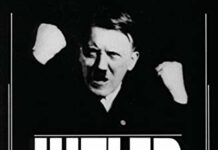
Ebook Info
- Published: 2019
- Number of pages: 1085 pages
- Format: PDF
- File Size: 79.81 MB
- Authors: Alan Bullock
Description
Forty years after his Hitler: A Study in Tyranny set a standard for scholarship of the Nazi era, Lord Alan Bullock gives readers a breathtakingly accomplished dual biography that places Adolf Hitler’s origins, personality, career, and legacy alongside those of Joseph Stalin–his implacable antagonist and moral mirror image.
User’s Reviews
Reviews from Amazon users which were colected at the time this book was published on the website:
⭐I just finished this 980 page book. From their early lives, their rise to power through manipulative, cynical, and plainly evil means, their unique but similar way of drudging up a class of enemy for their base to blame, be it the kulaks for Stalin or Jews for Hitler, their brutal, dehumanization of mankind whether it be by forced starvation in the case of Stalin or the nightmare machine-like process seen in Hitler’s concentration camps resulting in the deaths of tens of millions of people in Europe, one thing is emminently clear: these guys were a couple of jerks!
⭐A history teacher recommended this book to me, and initially I wasn’t sure a dual biography, particularly one of this length, would work, but Professor Bullock brings it off masterfully as he weaves together the political careers of Hitler and Stalin. Of course it helped in weaving their careers together that: their dictatorships overlapped significantly, they each had ruthless control of parties that aspired to control every aspect of society, they each singled out “enemies” of the state/party for particularly horrific treatment (“racial” enemies for Hitler, class enemies, e.g., Kulaks, for Stalin), they each viewed the other’s country as the ideological enemy, and then they engaged each other in the most terrible war (WW II’s eastern front) in human history. And yet while enemies, they seemed to have a grudging admiration for each other. Stalin noted approvingly Hitler’s bloody purge of the SA and political enemies in 1934 and followed with his own far more massive purges in 1936-1938; near the end of the war Hitler regretted he hadn’t done to his generals what Stalin did to the Red Army officer corps in 1937. And yet they never met each other.This book is for students of Soviet history, Nazi Germany, World War II, and 20th century European history and requires a substantial investment in time as the paperback version has 977 pages of densely-packed prose, but the investment is worth it. Bullock’s prose is smooth, and his descriptions at times are haunting, but most important his historical judgement is sober and unerring, or so it would appear to me. Writing in 1991, he had the benefit of decades of previous research to sort out the controversies of WW II, but even at that time the Soviet archives were just being opened so he readily admits that some Stalinist issues and events have not completely been clarified.Besides their similarities as ruthless dictators of totalitarian states with enormous resources under their control, Bullock shows how they exhibited pronounced differences as well. Hitler was a charismatic orator who was very effective in mass meetings while Stalin was an indifferent speaker who was essentially a bureaucrat but a very effective schemer; Hitler was more of a gambler who took great risks (e.g., his remilitarization of the Rhineland when the French Army was still stronger than his rearming Wehrmacht, his invasion of the Soviet Union before he had subdued Britain) while Stalin was more of a calculator and a shrewd evaluator of situations; Hitler, who considered himself an “artist”, worked indifferent hours and disdained paperwork while Stalin worked long hours and involved himself in paperwork and details (on one day he and Molotov signed over 4,000 death warrants during the purges). They both were ideologues; Stalin really believed in the tenets of Lenin’s Bolshevism (although he killed just about all of Lenin’s comrades) and Hitler really believed in the benefits of a “racially purified” German nation. They were completely indifferent to human life. Both Hitler and Stalin ordered their armies, time and again, to defend positions to the last man. Almost unbelieveably, Hitler in his political testament during his last day in the Berlin bunker rued the “fact” that he had been too “kind” as Fuehrer of Germany while Stalin has been quoted as saying that “one death is a tragedy, a million deaths is a statistic”. Bullock estimates in his final chapter that perhaps 50 million deaths can be attributed to Hitler and Stalin, so that while these monsters may or may not have been the most evil leaders in human history, their undivided command of two powerful countries combined with 20th century technology made their impact on human lives unparalleled.
⭐”Hitler and Stalin” places two of history’s most destructive figures side by side, telling their stories both individually and (periodically) in comparison. Bullock’s technique makes for some mighty interesting reading, with a thorough examination of just how so many people came to their deaths through the whims of two men. Using their political careers as a window into Hitler’s and Stalin’s personalities, Bullock emerges having drawn a portrait of the similarities and differences between the two men, and how their characters led to the the events that defined their lives. The book also paints the lives of the two men in human and historical terms, making sure to document just how they managed to cause suffering on such a grand scale.From their humble beginnings, Bullock examines how Hitler and Stalin managed to gain positions of absolute power over their respective countries. Stalin is portrayed as an almost shadowy figure, spending his early career lurking in the background behind the public figure of Lenin, waiting his chance while expertly playing the game of power politics. Hitler, on the other hand, is depicted as a gambler, taking chances he wasn’t expected to take, attempting to seize power through calculated boldness and his fiery public persona. With both men, however, Bullock stresses how they succeeded by going just a little farther than others, capitalizing on their enemies’ perceptions of what they would and would not do.Another comparison Bullock draws between Hitler and Stalin lies in the men’s complete lack of anything that could appropriately be described as human feeling or comparison. To both, as Bullock says, other people were simply objects to be manipulated or obstacles to be eliminated. To Stalin the objective was getting and keeping power, to Hilter achieving his wild dreams of a German empire, with neither goal leaving any room for consideration of others. It seems to be this one characteristic, above all others, that Bullock sees as motivating the two dictators’ action. The starving of the Russian peasants, the Holocaust, the purges, and the massive suffering of the war are all presented by Bullock as just extensions of Hitler’s and Stalin’s personal missions. He refers at one point to how casually Stalin was able to send to their deaths men with whom he had long worked, as if it required no more effort than the stroke of his pen. By discussing how easily both Hitler and Stalin brought such suffering upon others, Bullock provides a chilling view of just how inhuman these men were.Bullock tells the tale of these two despicable, yet compelling figures with an expert balance of detatchment and emotion. Although he typically discusses his topic in a very matter-of-fact manner, he will occassionally pause and tell tales of the horrors of collectivization, or the purges, or the Holocaust, bringing an appropriate tone of righteous indignation to these events. Clearly, Bullock’s intention in attempting to get inside these men’s heads is to expose how truly evil they were, rather than attempt to put down some psychobabble to explain their actions. And one can’t help but be moved in his epilogue, where he discusses his experiences in Jerusalem at the Holocaust memorials. If this book has a problem, it’s its incredible density, but this is a very minor flaw. 4.5 stars.
⭐Hitler and Stalin – Parallel Lives by Alan Bullock is a very good book about arguably the two dominant figures in twentieth century history. It is a well-written, informative and on the whole a well structured book. It does not try to make out that one was worse than the other but instead puts them into context and shows that although they rose to power in different ways and believed in different ideologies they both created totalitarian dictatorships which killed millions and subjugated even more. The few slight problems are the fact that at times because of the comparison between two histroical figures of this significance is that it does not focus on certain issues in great depth due to the confines of space. Also because it is a slightly strange structure for a book chronologically it does jump a round a little. As well as this it is also a rather large book and therefore requires a bit of effort to get through. Overall, though it is still a very good book.
⭐Good updated version
⭐Great value for money. Good condition.
⭐Top notch value and outstanding exploration of the mystery of how two monumental monsters were able to rise from almost nothing to the pinnacles of power. An amazing story that everyone should read.
⭐It is not that I am a FAN OF HITLER OR STALIN; I HAD THE BOOK AND IT GOT DESROYED IN A FIRE AND I THOUGHT I WOULD REPLACE IT. YOU DO NOT HAVE TO BE A FAN OF THESE TWO TO READ ABOUT THEM. I JUST WANTED THE BOOK FOR INFORMATION PURPOSES,AND WHAT I HAVE READ SO FAR I FOUND VERY INTEERESTING
Keywords
Free Download Hitler and Stalin: Parallel Lives in PDF format
Hitler and Stalin: Parallel Lives PDF Free Download
Download Hitler and Stalin: Parallel Lives 2019 PDF Free
Hitler and Stalin: Parallel Lives 2019 PDF Free Download
Download Hitler and Stalin: Parallel Lives PDF
Free Download Ebook Hitler and Stalin: Parallel Lives