

Ebook Info
- Published: 2007
- Number of pages: 398 pages
- Format: PDF
- File Size: 9.00 MB
- Authors: Julia M. H. Smith
Description
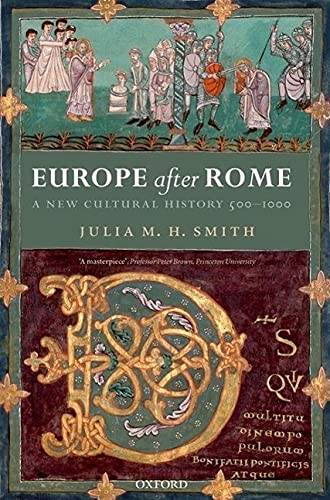
Europe after Rome: A New Cultural History 500-1000 is the first single-author study in more than fifty years to offer an integrated appraisal of the early Middle Ages as a dynamic and formative period in European history. Written in an attractive and accessible style, the book makes extensive use of original sources in order to introduce early medieval men and women at all levels of society–from slave to emperor–and allows them to speak to students in their own words. It overturns traditional narratives and instead offers an entirely fresh approach to the centuries from c.500 to c.1000. Rejecting any notion of a dominant, uniform early medieval culture, Europe after Rome argues that the fundamental characteristic of the early middle ages is diversity of experience. To explain how the men and women who lived in this period ordered their world in cultural, social, and political terms, it employs an innovative methodology that combines cultural history, regional studies, and gender history. Ranging comparatively from Ireland to Hungary and from Scotland and Scandinavia to Spain and Italy, the analysis highlights three themes: regional variation, power, and the legacy of Rome. In the context of debates about the social, religious, and cultural meaning of “Europe” in the early twenty-first century, this book seeks the origins of European cultural pluralism and diversity in the early Middle Ages.
User’s Reviews
Editorial Reviews: Review “This book is a masterpiece of condensed exposition. It is also a breakthrough–a truly New Cultural History–in the quiet determination of the author to approach very old themes from angles refreshingly different from those from which they have usually been approached . . . It is, above all, the first complete account of the early middle ages as a civilization in its own right. It catches the living texture of western Europe, from Rome to the Hebrides, for a half millennium of its history. It is truly the study of a civilization in its entirety. . .”–Peter Brown, Princeton University About the Author Julia Smith is Professor in Medieval History, University of Glasgow.
Reviews from Amazon users which were colected at the time this book was published on the website:
⭐Julia M H Smith, unfortunately, has taken her position as historian a bit too far here. If you desire an honest unbiased truth about the history of Europe after the Fall of Rome, I suggest you look elsewhere. It is extremely clear from her writing that she not only feels that women are much more important than men… which is rediculous as we are of equal importance to nature, but, also that the Christian religion is the root of all evil. It is unfortunate that in the year 2017 we are not able to be a bit more objective. The only reason I bought this book was for a course. Usually I am delightfully surprised at the quality I find in such books… this one, not even close. Hopefully, my review spares someone from buying such a liberal and biased account of the history of Europe. This is truly an unreliable account, historically speaking. As historians we are tasked with presenting the facts with as little opinion as possible. If only Ms. Smith had paid attention to this portion of her schooling.
⭐Thoughtful and masterfully researched. A really beautiful effort that contextualizes social and political trends emerging after the collapse of the Roman Empire.
⭐I bought this book hoping to expand my understanding of the post Roman period. Unfortunately I learned a great deal more about the author then I did about post Roman Europe. She is like many feminist “scholars”, more interesting in validating her own sterotypical ideas, than in understanding her subject matter. She also falls into the undergraduate writing trap, of using vocabulary which is unnecessarily filled with jargon and obscure words.
⭐I am taking a course in Medieval Europe. This book really added to my general knowledge.
⭐Fantastic and in-depth analysis. Great for reading or research.
⭐This book is not divided into chronological chapters but into thematic chapters, treating each particular aspect of “culture” as she sees it once and for all at one place in the book, much like Norman Davis did in his delightful history of Poland, “Heart of Europe”.There are four major sections, each with two chapters. I: Fundamentals, with the chapters Speaking and writing and Living and dying. II: Affinities, divided into Friends and relations, and Men and women. III: Resources, divided into Labour and lordship, and Getting and giving. IV: Ideologies, divided into Kingship and Christianity and Rome and the peoples of Europe. There follow an Epilogue on pp 293-297, and Notes on pp 298-313 which gives the sources for works quoted. The section Further Reading, occupying pp 314-343 is actually a so called commented bibliography, which I found valuable since it puts the reading list into a historiographic perspective and aids in picking out books that will interest me during further studies.The topic of the book being Europe in the years 500-1000 AD, which earlier used to be referred to as The Dark Ages, I found it positive, for instance, that she does away with the concept of Barbarians (as opposed to supposedly “civilised” Romans) in a way which Peter Heather (who insists that there was indeed a Fall of the Roman empire, and of civilisation with it) would probably find blasphemous. She shows convincingly that the Europe of AD 1000 was very different from that of AD 500, so obviously a lot of things happened in terms of development within European societies, even during supposedly Dark Ages. No signs of stagnation there !I noted some negatives. The lack of illustrations is rather unusual for a Cultural History. In fact, the only photo inside the book is the frontispiece (in b/w ! ), showing a Scottish decorated sarcophagus (whose importance is interpreted extensively on pp 7-9), plus there are two colour images on the front wrapper: the inside back flap shows a photo of the author. To give food not just for your thought but for your eyes you must clearly look elsewhere: Check out the (late) mediaeval world in pictures as offered by the Duke of Berry (France), in his commissioned work of exquisite miniatures in “Les très riches heures du duc de Berry” (alternatively called Les très belles heures in some editions; the Germans call this type of books a Stundenbuch, so you could search for all three synonyms to get your hand on copies of such literature). I wish I knew about some similar work covering the period of Miss Smith’s book (AD 500-1000) but I don’t. If someone out there knows, would you please post an update on this site ! Another feature is heavy-footed language at places, and long sentences (4-5 lines) are usual. But again, the intended readers of a work such as this will be indulgent towards such features.As you may guess from the above, this is not some lavish coffee-table publication but a high-brow book which gives the reader much food for thought, serving as your companion for the long haul, to argue and disagree with at times. I come away from the first reading with a sense of deep satisfaction, and a wish to continue my studies of Mediaeval Culture.Not being a professional historian myself I hesitate to mark this work: I might be unfair, but felt I should deduct one star from the maximum due to the slight deficiencies noted. But it might very well be regarded a 5-star work given its own premises, I guess.
⭐—The once called ‘dark ages’ is my favorite period of history. I love the idea of the world – Europe, that is – after the fall of the Empire. I want to know all about the early medievel kings. How did men become kings in the first place, after Rome lost authoritian control? She names any number of kings, but doesn’t tell us who they really were or where were their kingdoms. What authority did they have? Were they evil barbarian kings that waged constant war with each other or gentle law givers ushering in a thousand years of peace?—And how did the common people live? Mostly in cities or on small farms in remote forests, on mountain side or on the plains? How and how often did they came together at fairs, markets, dances, church. What did they do when they came together? On horses or on foot? With carts bringing crops to market? Selling knitting or crafts? I want to know what they wore and did for labor and fun. Am I confusing cultural history with social history?—Alas, ‘Europe after Rome’ told me nothing at all of what I wanted to know. As much as I admire anyone who can put together a scholarly volume, which this is, I guess, I must not be a scholar because this is not an edifying volume. It is irredeemably confused in its discussion and presentation. The author uses big words and long sentences in paragraphs without coherence or meaning. I could not follow it or keep awake.—The author was clearly dismissive of the role of the church in this period, though it was only the church, apparently, that kept learning alive at all. She was somewhat more clear in respect of some women’s issues. I take her to believe that women were not sufficiently empowered. I ken that she is concerned that abortion was not more readily available through ‘abortifacient’ herbs that were known.—I really shouldn’t be overly harsh, because a great deal of effort and research went into the work and Ms. Smith is a respected scholar. She deserves credit for her effort. But revising history from a woman’s liberation point of view, though it isn’t a large part of the book, is anachronistic in my mind and it rubbed me the wrong way.—If you want a copy, well, I won’t be going back to mine.
⭐Having just read a article by the author for my university degree and loving her writing style, I took the plunge and bought this book. it is accessible history at its best, well written, interesting and informative. it is divided into interesting topic headings, such as speaking and writing, living and dying, men and women, which is really drawing together some of the themes that i am studying about at the moment. I have yet to find any note of bias, sexism or catholic bashing yet, but as a raging feminist and secularist, i jolly well hope i do! There is nothing wrong with historians using their hard earned analytical skills to develop their own opinion on their chosen subject or right a few wrongs every now and again if they feel the need to set the record straight. I am looking forward to finishing this book and can’t wait to see what other gems Julia Smith has produced. keep up the good work!
⭐Concentrating on the relationships within society, Julia Smith’s example driven work strives to find patterns and differences within the territories of the former Western Empire from c. 500-1000. The themes dealt with are broken down asFundamentals: – Speaking and writing – Living and dyingAffinities: – Friends and relations – Men and womenResources: – Labour and lordship – Getting and givingIdeologies: – Kingship and Christianity – Rome and the peoples of EuropeSmith’s book is readable and revealing, and I particularly enjoyed the final chapter regarding Rome, now politically insignificant but “without [its] literature, legends and Christian religion, the peoples of Europe had no past, no present and no future”.
⭐Unnecessarily academic in style, which makes the book a bit of a wade-through. But the information is abundant and interesting; you just have to put up with the turgid writing.
⭐Mooi gebonden boek van een gerenommeerd historicus, gaaf en duidelijk nooit gelezen, voor een tientje! Ik ga kijken wat ze nog meer op voorraad hebben.
⭐
Keywords
Free Download Europe after Rome: A New Cultural History, 500-1000 1st Edition in PDF format
Europe after Rome: A New Cultural History, 500-1000 1st Edition PDF Free Download
Download Europe after Rome: A New Cultural History, 500-1000 1st Edition 2007 PDF Free
Europe after Rome: A New Cultural History, 500-1000 1st Edition 2007 PDF Free Download
Download Europe after Rome: A New Cultural History, 500-1000 1st Edition PDF
Free Download Ebook Europe after Rome: A New Cultural History, 500-1000 1st Edition