

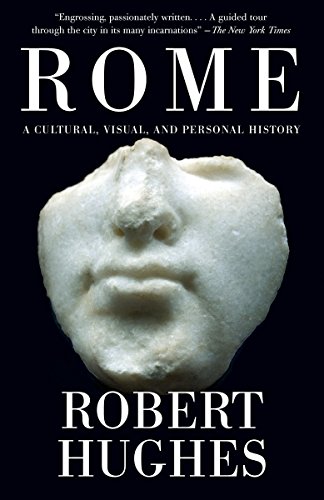
Ebook Info
- Published: 2012
- Number of pages: 544 pages
- Format: PDF
- File Size: 10.64 MB
- Authors: Robert Hughes
Description
From Robert Hughes, one of the greatest art and cultural critics of our time, comes a sprawling, comprehensive, and deeply personal history of Rome—as a city, as an empire, and as an origin of Western art and civilization. Starting on a personal note, Hughes takes us to the Rome he first encountered as a hungry twenty-one-year-old fresh from Australia in 1959. From there, he goes back more than two thousand years to the city’s foundation, one mired in mythologies and superstitions that would inform Rome’s development for centuries. He explores in rich detail the formation of empire, the rise of early Christianity, the Crusades, the Renaissance, and takes us up to the present, through the rise and fall of Mussolini’s fascism. Equal parts idolizing, blasphemous, outraged, and awestruck, Rome is a portrait of the Eternal City as only Robert Hughes could paint it.
User’s Reviews
Editorial Reviews: Review “Engrossing, passionately written. . . . A guided tour through the city in its many incarnations.” —The New York Times”Exhilarating. . . . History as portrait gallery . . . painted with unforgettable sharpness. . . . This is vintage Hughes.” —Simon Schama, Newsweek”Ambitious, [a] panoramic paean. . . . Reading [Rome] is like being taken around the Eternal City . . . by an entertaining, erudite, opinionated acquaintance with a gift for storytelling.” —Francine Prose, The New York Times Book Review”Sweeping. . . . [A] feast of information, opinion and fascinating detail. . . . With typical bravado, wit and rage, he puts art and architecture in sharp social, political, religious and historical context.” —Los Angeles Times“Eloquent. . . . An original, persuasive take on the Eternal City.” —The New York Review of Books “Vigorous. . . . Razor-sharp. . . . An indelible portrait of a city in love with spectacle and power. . . . Although [Hughes’] book is a biography of Rome, it is also an acutely written historical essay informed by his wide-ranging knowledge of art, architecture and classical literature, and a thought-provoking meditation on how gifted artists…and powerful politicians and church leaders …can reshape the map and mood of a city.” —The New York Times “Ever since Livy dipped his quill and Gibbon marked his proofs, histories of Rome have been a dime a dozen. But there is only one Robert Hughes. . . . Reading his strenuous, argumentative, vitally impassioned prose you are reminded just how insipid, prim, and nervously conventional most history and art history writing is. . . . So although the ostensible subject of his book is the Eternal City, the real tour d’horizon it offers is a walking tour of the hard-structured, brightly lit, and capacious expanse that is the Hughes brain.” —Newsweek “Hughes has a taste for big subjects. . . all intricately rooted in formative personal encounters. . . . [Rome] provides fascinating factual and anecdotal accounts of many of Rome’s artistic and historic landmarks.”—San Francisco Chronicle “Freewheeling, massive, magisterial. . . . Our guide conjures up a well-known work of genius and makes it new, moving effortlessly from biography to art to engineering as he illuminates its every detail.” —The New York Observer “A sweeping, personal history that races from the city’s beginnings to its current state as a woefully crowded tourist attraction.” —Los Angeles Times “A story that lasts almost 3,000 years and is pivotal to so much of Western civilization requires a chronicler of well-nigh unattainable erudition, who can write with the skill needed to prevent readers from succumbing to a literary version of Stendhal syndrome. Hughes comes as near as anyone to fulfilling that job description and for much of this wide-ranging volume he succeeds magnificently.” —The Economist “Robert Hughes couldn’t have chosen a better subject for himself than Rome. His cultural history of the city is superb. . . . Hughes devours art—and Rome offers a feast worthy of his gargantuan appetites. . . . If visiting Rome, you should certainly take this passionate, erudite bruiser’s Baedeker with you—a superbly rich blend of history, art and travelogue.” —The Sunday Times (London) “[Hughes] is a writer who does nothing by halves, and Rome positively crackles with his splenetic downrightness. We enjoy reading Hughes precisely because he avoids any of that corseted coyness which characterizes too much art-historical writing nowadays.” —The Literary Review About the Author Robert Hughes was born in Australia in 1938. Beginning in 1970 he lived and worked in the United States, where until 2001 he was chief art critic for Time. His books include The Shock of the New, The Fatal Shore, Nothing If Not Critical, Barcelona, Goya, and Things I Didn’t Know. He was the recipient of numerous awards and prizes for his work. Hughes died in 2012. Excerpt. © Reprinted by permission. All rights reserved. 1FoundationAlthough nobody can say when Rome began, at least there is reasonable certainty of where it did. It was in Italy, on the bank of the river Tiber, about twenty-two kilometers inland from its mouth, a delta which was to become the seaport of Ostia.The reason no one can pinpoint when the foundation took place is that it never ascertainably did. There was no primal moment when a loose scatter of Iron and Bronze Age villages perched on hills agreed to coalesce and call itself a city. The older a city is, the more doubt about its origins, and Rome is certainly old. This did not prevent the Romans from the second century b.c.e. onward coming up with implausibly exact-looking dates for its origins: Rome, it used to be asserted, began not just in the eighth century but precisely in 753 b.c.e., and its founder was Romulus, twin brother of Remus. Here a tangled story begins, with many variants, which tend to circle back to the same themes we will see again and again throughout Rome’s long history: ambition, parricide, fratricide, betrayal, and obsessive ambition. Especially the last. No more ambitious city than Rome had ever existed, or conceivably ever will, although New York offers it competition. No city has ever been more steeped in ferocity from its beginnings than Rome. These wind back to the story of the city’s mythic infancy.In essence, the story says that Romulus and Remus were orphans and foundlings, but they could claim a long and august ancestry. It stretched back to Troy. After Troy fell (the legendary date of this catastrophic event being 1184 b.c.e.), its hero Aeneas, son of Anchises and the goddess Aphrodite or Venus, had escaped the burning city with his son Ascanius. After years of wandering on the Mediterranean, Aeneas fetched up in Italy, where Ascanius (now grown up) founded the city of Alba Longa, not far from the eventual site of Rome, traditionally in about 1152 b.c.e.Here, Ascanius’ progeny began a line of kings, his descendants. The last of the line was called Amulius, who wrested the throne of Alba Longa from its rightful occupant, his elder brother, Numitor.Numitor had one child, a daughter named Rhea Silvia. Amulius the usurper used his convenient, newly seized power to make her a vestal virgin, so that she could not produce a son, who might be not only Amulius’s heir but also a deadly threat to him. But the war god, Mars, no respecter of either virginity or vestality, impregnated Rhea Silvia. Amulius, realizing she was pregnant, had Rhea Silvia imprisoned; presently she died of ill treatment-but not before delivering her twin sons, Romulus and Remus.We have the great historian Livy’s word for what happened next. Amulius ordered his men to fling little Remus and Romulus into the Tiber. But the river had been in flood, and its waters had not yet receded. So, rather than wade right out into the current and get uncomfortably wet, they merely dumped the babies into the shallower floodwater at the river’s edge, and went away. The level of the Tiber dropped some more, stranding the twins in the mud. In this state, wet but still alive, they were found by a she-wolf, which benignly nourished them with its milk until they were old and strong enough to be brought to adulthood by the royal herdsman Faustulus. (Most visitors, when they see the bronze sculpture in the Museo dei Conservatori of the Founding Babies sucking on the pendulous conical teats of the lupa, naturally think it is one original piece. It is not; the wolf is ancient and was cast by an Etruscan craftsman in the fifth century b.c.e., but Romulus and Remus were added c. 1484-96 by the Florentine artist Antonio del Pollaiuolo.)In any case, in the myth they eventually overthrew Amulius and restored their grandfather Numitor to his rightful place as king of Alba Longa. And then they decided to found a new settlement on the bank of the Tiber, where chance had washed them ashore. This became the city of Rome.Who would be its king? This was settled by an omen in the form of a flight of birds of prey. Six of them appeared to Remus but twelve to Romulus, thus marking him-by a majority vote from the gods above, as it were-as the indisputable ruler of the new city.Where exactly was it? There has always been some disagreement over the original, “primitive” site of Rome. There is no archaeological evidence for it. It must have been on one of the Tiber’s banks-which one, nobody knows. But the district is famous for having had seven hills-the Palatine, the Capitoline, the Caelian, the Aventine, the Esquiline, the Viminal, and the Quirinal. Nobody can guess which one it may have been, although it is likely that the chosen site, for strategic reasons, would have been a hill rather than flatland or a declivity. Nobody was keeping any records, so no one can guess which one of these swellings, lumps, or pimples was a likely candidate. “Tradition” locates the primitive settlement on the modest but defensible height of the Palatine Hill. The “accepted” date of the foundation, 753 b.c.e., is of course wholly mythical. There was never any possibility of authenticating these early dates-of course nobody was keeping any records, and since later attempts at recording the annals of the city, all belonging to the second century b.c.e. (the writings of Quintus Fabius Pictor, Polybius, Marcus Porcius Cato), only began to be made approximately five hundred years after the events they claim to describe, they can hardly be deemed trustworthy. But they are all we have.Supposedly, Romulus “founded” the city that bears his name. If things had gone differently and Remus had done so, we might now talk about visiting Reem, but it was Romulus who, in legend, marked out the strip of land that defined the city limits by hitching two oxen, a bull and a cow, to a plow and making a furrow. This was called the pomerium and would be the sacred track of the city wall. This, according to Varro, was the “Etruscan rite” for the founding of a city in Latium. Ritual demanded that the furrow, or fossa, the small trench of symbolic fortifications, should lie outside the ridge of earth raised by the plowshare; this ridge was called the agger or earthwork. The walls of the city were raised behind this symbolic line, and the space between it and the walls was scrupulously kept free of building and planting, as a defensive measure. The area within the pomerium would come to be called Roma quadrata, “square Rome,” for obscure reasons. Evidently Remus took exception to it, for reasons equally unknown. Perhaps he objected to Romulus’ assuming the right to determine the shape of the city. He showed his disagreement by jumping over the furrow-an innocent act, one might think, but not to Romulus, who took it for a blasphemous expression of hostile contempt and murdered his twin brother for committing it. History does not tell how Romulus may have felt about slaying his only brother over a perceived threat to his sovereignty, but it is perhaps significant that the sacred group that ran around the pomerium at intervals to assure the fertility of Roman flocks and women in later years was known as the Luperci or Wolf Brotherhood.So the embryo city, rooted in an unexplained fratricide, had one founder, not two, and as yet no inhabitants. Romulus supposedly solved this problem by creating an asylum or a place of refuge on what became the Capitol, and inviting in the trash of primitive Latium: runaway slaves, exiles, murderers, criminals of all sorts. Legend makes it out to have been (to employ a more recent simile) a kind of Dodge City. This can hardly be gospel-true, but it does contain a kernel of symbolic truth. Rome and its culture were not “pure.” They were never produced by a single ethnically homogeneous people. Over the years and then the centuries, much of Rome’s population came from outside Italy- this even included some of the later emperors, such as Hadrian, who was Spanish, and writers like Columella, Seneca, and Martial, also Spanish-born. Celts, Arabs, Jews, and Greeks, among others, were included under the wide umbrella of Romanitas. This was the inevitable result of an imperial system that constantly expanded and frequently accepted the peoples of conquered countries as Roman citizens. Not until the end of the first century b.c.e., with the reign of Augustus, do we begin to see signs of a distinctively “Roman” art, an identifiably “Roman” cultural ideal.But how Roman is Roman? Is a statue dug up not far from the Capitol, carved by a Greek artist who was a prisoner-of-war in Rome, depicting Hercules in the style of Phidias and done for a wealthy Roman patron who thought Greek art the ultimate in chic, a “Roman” sculpture? Or is it Greek art in exile? Or what? Mestizaje es grandeza, “mixture is greatness,” is a Spanish saying, but it could well have been Roman. It was never possible for the Romans, who expanded to exercise their sway over all Italy, to pretend to the lunacies of racial purity that came to infect the way Germans thought about themselves.Several tribes and groups already inhabited the coastal plain and hills around the Tiber. The most developed in the Iron Age were the Villanovans, whose name comes from the village near Bologna where a cemetery of their tombs was discovered in 1853. Their culture would mutate by trade and expansion into that of the Etruscans by about 700 b.c.e. Any new settlement had to contend, or at least reach an accommodation, with the Etruscans, who dominated the Tyrrhenian coast and most of central Italy-a region known as Etruria. Where they originally came from remains a mystery. In all likelihood, they had always been there, despite the belief held by some in the past that the Etruscans’ remote ancestors had migrated to Italy from Lydia, in Asia Minor. The most powerful Etruscan city close to Rome was Veii, a mere twelve miles to its north-though the cultural influence of the Etruscans spread so wide that they made themselves felt far in the south, in what later became Pompeii. Until they were eclipsed by the rising power of Rome, around 300 b.c.e., they laid down the terms of culture in central Italy.Never a centralized empire, they created city-states along the Tyrrhenian coast of Italy: Veii, Caere (now Cerveteri), Tarquinia, Vulci, and others, all of them ruled by high-priestly kings called Lucumones. Some of these settlements were linked in a loose federation, with ritual similarities and defense and trade agreements. Because of their military superiority-the Etruscan “tank” was a bronze- fitted chariot, and the basic unit of Etruscan warfare was a heavy- armored, close-knit phalanx, the ancestor of the Roman legion-they could dominate the less tightly knit forces of their tribal rivals, until the Romans moved in.Other minor tribal groupings held territory in the neighborhood of Rome as well, one of these being the Sabines. They seem to have been hill people and shepherds, and their settlement may have been on the Quirinal Hill. An expansionist from the beginning, Romulus seems to have decided to go after this territory first. In order to lure the Sabines and their women within reach, Romulus is said to have held some horse races during the Festival of Consus (in August). The whole Sabine population turned up, and at a signal the Romans abducted all the young women they could lay their hands on. This amounted to a declaration of war between the Romans and the infuriated Sabines. (All Romans were Latins, but not all Latins were Romans. Roman power, including the power to confer Roman citizenship, was vested in Rome, and citizenship became an esteemed honor.) The Sabine King Titus Tatius gathered an army and marched against the Romans. But, in another scene made legendary by later artists such as Jacques-Louis David, the kidnapped Sabine women flung themselves between the two sides of furious males-brothers, fathers, husbands-and persuaded them to make peace, not war.Peace and alliance between Sabine and Latin now prevailed. Romulus supposedly ruled the united tribes for another thirty-three years, and then dramatically vanished from the earth, wrapped in the thick darkness of a thunderstorm. Six kings are traditionally said to have succeeded Romulus, some Latin, others (notably the semi-legendary sixth-century rulers Tarquinius Priscus and Tarquinius Superbus, “Tarquin the Arrogant”) supposedly Etruscan. In legend, their succession began with Numa Pompilius, who reigned for forty-three years and established in Rome “an endless number of religious rites and temples.” He was followed by Tullus Hostilius, who conquered the Albans and the people of the Etruscan settlement of Veii; by Ancus Marcius, who added the Janiculan and Aventine hills to Rome; by Tarquinius Priscus, said to have established the Roman Games; by Servius Tullius, who added the Quirinal, Viminal, and Esquiline hills and finished off the Sabines; and by Tarquin the Arrogant, who murdered Servius. Servius’ son, Lucius Tarquinius Superbus, made peace between Latins and Etruscans. These kings established the mons Capitolinus, the Capitoline Hill, as the citadel and sacred center of Rome. Here the temples to the goddesses Minerva and Juno were raised, and, most sacred and important of all, the temple to Jupiter Optimus Maximus, “Jupiter Best and Greatest.” It was (supposedly) dedicated by King Tarquin in 509 b.c.e. Although little is known about Tarquin the Arrogant as a historical figure, he contributed to most languages an expression which lives and is used down to the present day. According to Livy (who was writing about half a millennium later), the king taught a lesson with it to his son, Sextus Tarquinius, the future rapist of Lucretia. Having just conquered an enemy city, Tarquin was strolling with his boy in their garden when he began to chop off the heads of the tallest poppies in it. This, he explained, was the thing to do with leading citizens of a fallen town, who might cause trouble in defeat. Hence the modern term, especially loved and all too often used by sneering Australians to level the society around them, “tall- poppy syndrome.”The authority of kings in Rome lasted about two hundred years. Succession was not hereditary. During this time, the kings were in essence elected-not by all classes of the Roman people, but by the city’s richest and most powerful elders, who (with their families) came to be known as the patricii, the patricians. These constituted a governing class, choosing and then advising the rulers of Rome. After the disappearance of the last king, Tarquinius Superbus, whom the patricians expelled and refused ever to replace, a system evolved that was designed never to put such authority in one man’s hands again. Supreme authority was granted not to one but to two chosen figures, the consules (consuls). Their powers were exactly equal, and one could overrule the other: thus the Roman state could take no action on any issue unless both consuls agreed on it. This at least saved the Roman state from some of the follies of autocracy. From now on, the prospect of “kingship” would be a political bogey to Romans; the consul Julius Caesar, to take the outstanding example, would be assassinated by a cabal of republicans who feared that he might make himself a king. Meanwhile, the religious powers of the kings were hived off and invested in a supreme priest, known as the pontifex maximus. Read more
Reviews from Amazon users which were colected at the time this book was published on the website:
⭐This is one of the best history books I ever read by far! Anyone who loves history will love this book.
⭐How do you fall in love with a city? I’ve fallen in love with a few of them: London, Venice, Istanbul. I fell in love with London before I ever got there, so when I did get there, I don’t think I even saw the London of today. It seemed as if I already knew it like the back of my hand. Everywhere I went, familiar names called out to me. Baker Street, Bloomsbury, Tower Bridge. The Clink. The Clink!? Well, that explains that. Istanbul. I’d built the Hagia Sofia right along with Guy Gavriel Kay as he was writing The Sarantine Mosaic, but it was also redolent with the magic of the crossroads, of ancient ways and closed courtyards. There wasn’t a cobblestone in Istanbul that didn’t remember more than I’ll ever be able to forget. Venice. I knew little to nothing of Venice. I was there for less than 24 hours. At least a third of that time asleep. The rest of the time it was raining. But I fell in love the way one does with a fleeting smile from a stranger you will never see again.Robert Hughes fell in love with Rome. He fell in love with Rome the same way I fell in love with London, with Istanbul. Through myth and legend and story:”For a time in my adolescence – not knowing Rome in any but the sketchiest way – I longed to be a Roman expatriate … I was nuts about the idea of Rome …”Most of all – and this is something that Rome has in quantities that my particular loves can only dream of – he fell in love with art:[An elderly Jesuit from his school in Australia, who traveled to Rome from time to time] “would bring back postcards, sedulously and with obvious pleasure gleaned from their racks in various museums and churches … : Caravaggios, Bellinis, Michaelangelos.”It was art that brought him, eventually, to Rome where, before laying eyes on so much as one Rafael, he realized that right there in front of him was the most important work of art in the entire city. The city itself. “Nothing exceeds the delight of one’s first immersion in Rome on a fine spring morning … The enveloping light can be of an incomparable clarity, throwing into gentle vividness every detail presented to the eye. First, the color, which was not like the color of other cities I had been in. Not concrete color, not cold glass color, not the color of overburned brick or harshly pigmented paint. Rather, the worn organic colors of the ancient earth and stone of which the city is composed, the colors of limestone, the ruddy gray of tufa, the warm discoloration of once-white marble and the speckled, rich surface of the marble known as pavonazzo, dappled with white spots and inclusions like the fat in a slice of mortadella.”I remember those colors, and if I’d had Hughes’ critical eye I might have seen them so. I might have fallen in love with Rome the way I fell in love with Venice. With the color of the stones and the quality of the light on a rainy day.Rome: A Cultural, Visual, and Personal History is all of that. Hughes gives us his personal history of Rome, from the fables of Romulus, Remus, and Aeneas to the fabulous Berlusconi, skimming swiftly over politics and personalities in order to settle down every few pages with a building, a fountain, a painting, a statue. With the stuff that matters. With the stuff that remains.
⭐Hughes’ Roman biography moves chronologically from the foundation of the city through events of the fascist era. While his previous book about Barcelona is social history, Rome combines cultural, visual and personal history with straightforward political and military narrative.The focus of Hughes analysis depends on the historical period under consideration. In his chapter on the founding of the city, Hughes confines himself largely to political developments including the first and second Punic wars, the rise and fall of Julius Caeser and the ascent of Octavius. Similarly, his history of the nineteenth century includes tales of Mazzini, Garibaldi, Cavour, Pope Pius IX, the Syllabus of Errors and ultramontanism. Along the way, Hughes pauses occasionally to provide the reader with aesthetic insights. He criticizes the Vittoriano monument, for example, on both aesthetic and historical grounds: “Neither in design nor in material does the typewriter look Roman, and, in point of fact, it is not.”In his chapter on the Renaissance, however, Hughes focuses almost exclusively on art and architectural history including discussion of Brunelleschi, Bramante, Raphael and Michelangelo. His work is especially illuminating in sections such as the one covering the Grand Tour and Neoclassicism. Here, Hughes brings to bear his formidable understanding of cultural history to reveal less widely known facts about Roman history. We meet leading English purveyors of inauthentic Italian antiquities Thomas Jenkins and James Byres, first choice for foreigners wanting Roman portraits Pompeo Batoni, master of more than 1,000 engravings of Roman architecture Giovanni Battista Piranesi and inventor of archeological categories Johann Jonachim Winkelmann. We are treated to Hughes sharp insights concerning all things Roman. He concisely describes the formidable nature of travel in 1780: “Abroad was bloody and foreigners were bastards.” More charitably, Hughes resurrects the reputation of painter Antonio Canova, calling him the “last of a line of geniuses who redefined art” beginning in the 14th century and ending with Canova.Hughes covers a long historical period and many subjects in this book. But the pace is brisk, the portraits of people and events are well chosen and the author’s voice is caring and incisive. Hughes acts as Bear Leader to the reader (as Grand Tour guides referred to themselves) and never lets his charges forget how strongly he feels about the city. Rome, says Hughes, is irksome, frustrating, contradicting, spectacular and secretive. It is, in sum, “an enormous concretion of human glory and human error.”For all its faults, the city is unique and full of wonder. “Nothing exceeds the delight of one’s first immersion in Rome,” advises the author in his loving introduction. If you have not visited the city in person, you could do far worse than to experience your first virtual immersion in the pages of this book.
⭐Wonderfully written informative and entertaining
⭐I’ve always enjoyed Robert Hughes’ books and “Rome” proved to be no exception.Filled with insight, love of the subject, and a fine historical perspective of Rome, the Romans, and the human and artistic condition of western civilization.Highly recommend it, especially if you plan on spending any length of time in the Eternal City.
⭐Very well written, but if you think to carry it around Rome with you to keep up with what you’re seeing, be prepared to bring a heavy bag.
⭐This book has made me want to go back to Rome today. Now that I know more about the history of the treasures of Rome I feel that I shall see them with fresh eyes.
⭐Great book disc
Keywords
Free Download Rome: A Cultural, Visual, and Personal History in PDF format
Rome: A Cultural, Visual, and Personal History PDF Free Download
Download Rome: A Cultural, Visual, and Personal History 2012 PDF Free
Rome: A Cultural, Visual, and Personal History 2012 PDF Free Download
Download Rome: A Cultural, Visual, and Personal History PDF
Free Download Ebook Rome: A Cultural, Visual, and Personal History