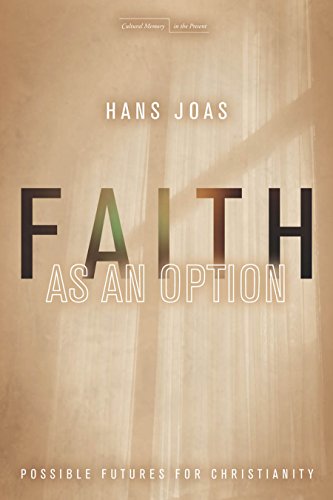
Ebook Info
- Published: 2014
- Number of pages: 206 pages
- Format: PDF
- File Size: 6.29 MB
- Authors: Hans Joas
Description
Many people these days regard religion as outdated and are unable to understand how believers can intellectually justify their faith. Nonbelievers have long assumed that progress in technology and the sciences renders religion irrelevant. Believers, in contrast, see religion as vital to society’s spiritual and moral well-being. But does modernization lead to secularization? Does secularization lead to moral decay? Sociologist Hans Joas argues that these two supposed certainties have kept scholars from serious contemporary debate and that people must put these old arguments aside in order for debate to move forward. The emergence of a “secular option” does not mean that religion must decline, but that even believers must now define their faith as one option among many.In this book, Joas spells out some of the consequences of the abandonment of conventional assumptions for contemporary religion and develops an alternative to the cliché of an inevitable conflict between Christianity and modernity. Arguing that secularization comes in waves and stressing the increasing contingency of our worlds, he calls upon faith to articulate contemporary experiences. Churches and religious communities must take into account religious diversity, but the modern world is not a threat to Christianity or to faith in general. On the contrary, Joas says, modernity and faith can be mutually enriching.
User’s Reviews
Reviews from Amazon users which were colected at the time this book was published on the website:
⭐This book felt a bit more like a “state of my thinking” document than a book (a fact reflected by the somewhat disjunctive title and subtitle), but it is full of interesting and useful theses.Joas challenges the teleological secularization thesis and offers an alternative “wave” model starting with the French Revolution and ending (for now) with the 1960s. He prefers to think of modernity as a condition of heightened “contingency” rather than one of increased disenchantment or disbelief, and suggests that there is a legitimate form of religious commitment in an age of contingency.He also reminds us that at the end of the day, “religions” or “civilizations” do not act for themselves, only individual agents do. This is especially important to remember in discussing the relation of religion and violence.I appreciate his nuance on ecumenicism and inter-religious dialogue. Finding common ground is both possible and necessary, but cannot and should not simply replace the particularity one’s religious experience and religious tradition. This process is necessarily an ongoing balancing act.I really enjoyed this book at the outset, but had a more mixed reaction by the end. One reason is that he crosses the line (which he comments in the book itself) between a purely scientific voice and the voice of the cultural commentator. In itself, this is fine, perhaps even appropriate. But these transitions in the text need to unambiguous. A second, more important reason is that the Christian future he recommends seems indifferent to some of his own sociological insights. He clearly wants an updated Christianity that is more purely “Axial.” In other words, he privileges a permanently self-critical ethical universalism under the sign of “love.” Although he does not say it, I feel like he is one more German romantic advocating a meta-Christianity as the religious form par excellence, which is little more than a form: a constantly self-revising universalism. The problem is that his own account of the genesis of values and religious commitments in experience, along with his defense of the particular, makes it unclear we would should buy into this ideal, which seems religious empty (like the churches that mostly closely approximate this ideal). It is shorthand for the liberal-democratic state (motivated somehow by “love”) and its international counterparts. It is telling in this regard when, right at the end of the book, he dismisses Catholic sexual ethics out of hand, and rejects the principle of “obedience to church doctrines” (135-36). For Joas, transcendence is a structural implication of religious experience, but is not the source of revelation. Instead, it is the space we imaginatively occupy for purposes of universalist self-critique.
⭐
⭐
Keywords
Free Download Faith as an Option: Possible Futures for Christianity (Cultural Memory in the Present) 1st Edition in PDF format
Faith as an Option: Possible Futures for Christianity (Cultural Memory in the Present) 1st Edition PDF Free Download
Download Faith as an Option: Possible Futures for Christianity (Cultural Memory in the Present) 1st Edition 2014 PDF Free
Faith as an Option: Possible Futures for Christianity (Cultural Memory in the Present) 1st Edition 2014 PDF Free Download
Download Faith as an Option: Possible Futures for Christianity (Cultural Memory in the Present) 1st Edition PDF
Free Download Ebook Faith as an Option: Possible Futures for Christianity (Cultural Memory in the Present) 1st Edition