

Ebook Info
- Published: 1992
- Number of pages: 324 pages
- Format: PDF
- File Size: 5.97 MB
- Authors: Shmuel N. Eisenstadt
Description
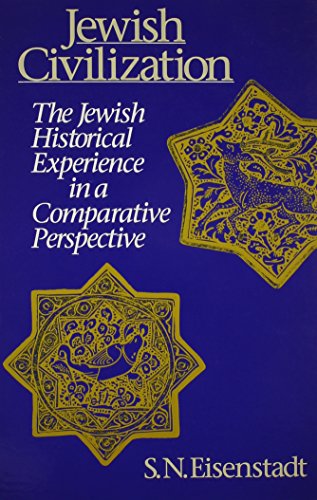
This book explains why the best way to understand the Jewish historical experience is to look at Jewish people, not just as a religious or ethnic group or a nation or “people,” but, as bearers of civilization. This approach helps to explain the greatest riddle of Jewish civilization, namely, its continuity despite destruction, exile, and loss of political independence.In the first part of the book, Eisenstadt compares Jewish life and religious orientations and practices with Hellenistic and Roman civilizations, as well as with Christian and Islamic civilizations. In the second part of the book, he analyzes the modern period with its different patterns of incorporation of Jewish communities into European and American societies; national movements that developed among Jews toward the end of the nineteenth century, especially the Zionist movement; and specific characteristics of Israeli society.The major question Eisenstadt poses is to what extent the characteristics of the Jewish experience are distinctive, in comparison to other ethnic and religious minorities incorporated into modern nation-states, or other revolutionary ideological settler societies. He demonstrates through his case studies the continuous creativity of Jewish civilization.
User’s Reviews
Editorial Reviews: About the Author S. N. Eisenstadt is Rose Issacs Professor of Sociology at The Hebrew University of Jerusalem. He is the editor of The Origins and Diversity of Axial Age Civilizations, also published by SUNY Press.
Reviews from Amazon users which were colected at the time this book was published on the website:
⭐When communicating with Einsenstadt having read this book some years ago, I remember writing to him asking for some of his writings on Multiple Modernties and the Axial Theory of Civilizations. It is a long time ago now, but I remember a friendly letter in which he was welcoming me to continue communicating with him. I mentioned my wife’s interest in History and how analytic she was. So he invited both of us as I recall to visit him. He was most generous to send me some articles and a list of references and a gigantic bibliography of his own writings on History, Sociology and what may be called the General Dynamical Theory of Civilizations. As I went through the bibliography the range is bewildering, speaking as someone who reads by usual standards very widely.I cannot summarize this book you just have to read it,but is the first book I came across that gave a scholarly picture of the Jewish Civilization devoid of bias, prejudice and incredibly well researched. Yet he was able to write with clarity and simplicity of a confident mind. I remember some of his comments about American History which had prompted me in the first place to write to him. I had never seen that history talked about in that way. It is possible to talk about History in a literary, sociological, mathematical, economic, computational and many many other ways. But these refer to methods, Einsenstadt had that exceptional quality along with great sociologist-historians of the past: the capacity to appreciate, understand, sympathize in some vast domain of historical phenomenon and have greatly interesting things to say about it.We may now say in a more recent language that: all history is a collection of interacting processes that may be approximated by a network of algorithms on a range of logics. In this picture there are vast true generalizations which may find translations into the language of the historian. We may test generalizations against historical facts or derive generalizations from historical facts (as in computer programs [such as Guha] that generate hypothesis that are true of a vast database of facts — that is to say of data and propositions). Einsenstadt mapped out the territory for these later possible developments that are yet to be explored.
⭐
Keywords
Free Download Jewish Civilization: The Jewish Historical Experience in a Comparative Perspective (SUNY series in Israeli Studies) in PDF format
Jewish Civilization: The Jewish Historical Experience in a Comparative Perspective (SUNY series in Israeli Studies) PDF Free Download
Download Jewish Civilization: The Jewish Historical Experience in a Comparative Perspective (SUNY series in Israeli Studies) 1992 PDF Free
Jewish Civilization: The Jewish Historical Experience in a Comparative Perspective (SUNY series in Israeli Studies) 1992 PDF Free Download
Download Jewish Civilization: The Jewish Historical Experience in a Comparative Perspective (SUNY series in Israeli Studies) PDF
Free Download Ebook Jewish Civilization: The Jewish Historical Experience in a Comparative Perspective (SUNY series in Israeli Studies)