

Ebook Info
- Published: 2009
- Number of pages: 336 pages
- Format: PDF
- File Size: 1.23 MB
- Authors: Marco Bersanelli
Description
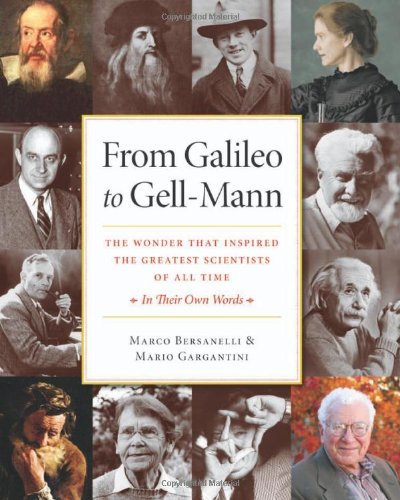
From time to time, the diligent science student huddled over dense volumes of research findings and highly technical data will stumble upon a truly rare treasure: the author’s answer to the question of, “Why?” Why did the authors of these volumes commit themselves so ardently to life in the laboratory? What was it that motivated them to keep their eye to microscope for years on end? Why did the world’s greatest scientists devote their lives to research—an endeavor where failure is the exponentially more likely outcome than success?In their new anthology, From Galileo to Gell-Mann, Marco Bersanelli and Mario Gargantini have gathered the answers to these fascinating questions from over one hundred of the brightest scientific minds from our past and our present. It is a goldmine of insight that previously could only to be found hidden deep within thousands of scattershot pages of footnotes from out-of-print journals, rare books, and unpublished papers. Throughout the work, Bersanelli and Gargantini also offer insightful commentary and discussion on the readings.Among the most remarkable similarities that emerge when one considers together these writings from the likes of Albert Einstein, Gregor Mendel, Marie Curie, and others, is the sense of wonder and outright awe at what the study of the natural world can reveal. From Galileo to Gell-Mann makes it clear that science and all parallel attempts to understand our human existence—including fields like philosophy to theology—are viewed as nothing less than grand adventures to those that are probing the limits of what we know.
User’s Reviews
Editorial Reviews: From the Back Cover “A remarkably interesting collection of writings by scientists, setting their formally impersonal discipline in a rich context of humane experience and understanding. The book is an important contribution to a deeper understanding of the character of science and it deserves to be widely read.”—John Polkinghorne, author of Theology in the Context of Science “This is an inspirational anthology of the thoughts and vision of scientists through the ages. A much needed antidote to the current dehumanizing of scientific discovery. A book which questions the very basis on which modern science is conducted and to take us back to the values and vision of why we investigate and try to explain the world in which we live.”—John Wood, professor, Imperial College, London; Chair of the European Research Area Board In From Galileo to Gell-Mann, Marco Bersanelli and Mario Gargantini have gathered writings from over one hundred of the world’s brightest scientific minds on the question of “Why?”—specifically, why did these great scientists commit themselves so ardently to life in the laboratory? What was it that kept them dedicated to their research endeavors for years on end? This new anthology is a goldmine of insight that previously could only to be found hidden deep within thousands of scattershot pages of footnotes from out-of-print journals, rare books, and unpublished papers. Among the most remarkable similarities that emerge when one considers together these writings from the likes of Albert Einstein, Gregor Mendel, Marie Curie, and others, is the sense of wonder and outright awe at what the study of the natural world can reveal. About the Author Marco Bersanelli is professor of astrophysics at the University of Milan. He has worked as a visiting scholar at the Lawrence Berkeley Laboratory, University of California and is a member of the science team of the Planck Surveyor Space Mission, the European Space Agency project to study the early universe. He is also president of EURESIS, a scientific and cultural association promoting interdisciplinary dialogue on frontier topics in science.Mario Gargantini is an electronic engineer, a scientific journalist, and the director of Emmeciquadro, a journal on science teaching. He was also a high school physics teacher for twenty years. He has authored several books and essays on science and religion, history of science, and education; he has also been curator of a dozen of scientific exhibitions. In 1987 he won the Glaxo Award and in 1990 he won the Federchimica Award, both for science communication.
Reviews from Amazon users which were colected at the time this book was published on the website:
⭐It gives a wide spectrum of views from many different scientists (many who I had never heard of before). It is interesting to hear from the scientists themselves of how hours of collecting data (hopefully) result in a neat theory being verified.
⭐Well written book, enjoyable. Comment from scientists in their own words is uniqueand allows one to develop an independent opinion.One of the best science history books I’ve read recently
⭐Not for me.
⭐This book is a wonderful anthology that captures the awe and wonder that is at the core of scientific exploration and spiritual growth. I like how the book is organized and also the wide selection of writings from scientists from various areas of science. I think one of the best qualities of this book is that it touches the subject of human curiosity and journey through the experience of some brilliant scientists who do not exclude the nature of the divine or God.
⭐
Keywords
Free Download From Galileo to Gell-Mann: The Wonder that Inspired the Greatest Scientists of All Time: In Their Own Words in PDF format
From Galileo to Gell-Mann: The Wonder that Inspired the Greatest Scientists of All Time: In Their Own Words PDF Free Download
Download From Galileo to Gell-Mann: The Wonder that Inspired the Greatest Scientists of All Time: In Their Own Words 2009 PDF Free
From Galileo to Gell-Mann: The Wonder that Inspired the Greatest Scientists of All Time: In Their Own Words 2009 PDF Free Download
Download From Galileo to Gell-Mann: The Wonder that Inspired the Greatest Scientists of All Time: In Their Own Words PDF
Free Download Ebook From Galileo to Gell-Mann: The Wonder that Inspired the Greatest Scientists of All Time: In Their Own Words