

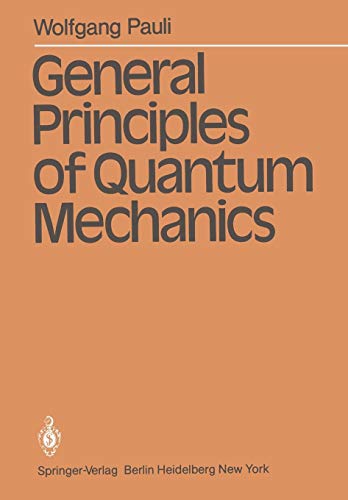
Ebook Info
- Published: 1980
- Number of pages: 224 pages
- Format: PDF
- File Size: 11.54 MB
- Authors: Wolfgang Pauli
Description
I am very happy to accept the translators’ invitation to write a few lines of introduction to this book. Of course, there is little need to explain the author. Pauli’s first famous work, his article on the theory of relativity in the Encyklopädie der Mathematischen Wissenschaften was written at the age of twenty. He afterwards took part in the development of atomic physics from the still essentially classical picture of Bohr’s early work to the true quantum mechanics. Thereafter, some of his work concerned the treatment of problems in the framework of the new theory, especially his paper on the hydrogen atom following the matrix method without recourse to Schrodinger’s analytic form of the theory. His greatest achievement, the exclusion principle, generally known today under his own name as the Pauli principle, that governs the quantum theory of all problems including more than one electron, preceded the basic work of Heisenberg and Schrodinger, and brought him the Nobel prize. It includes the mathematical treatment of the spin by means of the now so well known Pauli matrices. In 1929, in a paper with Heisenberg, he laid the foundation of quantum electrodynamics and, in doing so, to the whole theory of quantized wave fields which was to become the via regia of access to elementary particle physics, since here for the first time processes of generation and annihilation of particles could be described for the case of the photons.
User’s Reviews
Reviews from Amazon users which were colected at the time this book was published on the website:
⭐The topic of quantum mechanics is replete with excellent, modern textbooks. These textbooks span the gamut, from elementary to advanced. Where to start, where to finish ? I do not believe that a student ever “finishes” a topic. The topic of quantum mechanics is no exception. There are many ways to begin your studies, other ways to continue your studies, yet never really finishing your studies ! Your library should include Wolfgang Pauli alongside other classics: Physical Principles of Quantum Theory (Werner Heisenberg), Foundations of Quantum Mechanics (Hendrik Kramers), Principles of Quantum Mechanics (Paul Dirac), Mathematical Foundations of Quantum Mechanics (John von Neumann). If Pauli should prove difficult at any juncture, the textbook by Kurt Gottfried provides assistance, as his chapters (one, two and four) are “merely, a poor man’s Pauli.” Charles Enz wrote a biography, No Time To Be Brief, read: “But, in spite of the great authority of this work the terminology that Pauli proposes…has never been adopted by the physics community.” (page 249, 2002). Words from Pauli:(1) “The distinction between indeterminacy and ignorance, and the connection between the two concepts, are decisive for the whole of quantum mechanics.” (page 7).(2) “The superposition principle is essential for a consistent formulation of the notion of measurement when the coupling of the system with the measuring apparatus is itself described quantum-mechanically.” (page 24).(3) “The purely symbolic nature of the wave-function of Schrodinger is quite different from the wave-functions of the classical theory (surface waves of liquids, elastic waves, electromagnetic waves).” (page 31).(4) “The matrix-calculus is convenient if we are dealing with a sub-space of finite dimensions.” (page 59).(5) “Only observation determines to which state the system has actually gone to, and the discontinuity imposed by the finiteness of the quantum-of-action lies exclusively in the reduction of the wave-packet, necessary for the separation of the system observed from the means of observation.” (page 85).(6) “The limiting transition from quantum mechanics to classical mechanics is formally analogous to the transition from wave optics to geometrical optics.” (page 91).(7) “A relativistic quantum theory must go over into known theories in two limiting cases: namely, the non-relativistic quantum mechanics on the one hand and the classical relativistic mechanics of particles on the other (characterized as speed-of-light approaches infinity and Planck’s constant approaches zero, on the other).” (page 172).(8) ‘General Principles’ is covered in 200 pages. Indeed, “general principles” are expounded: superposition, linearity, measurement. Note: “It has not been proved in general that every quantity can be measured in an arbitrary short time, even when one permits measurements of the second kind. On account of this, we prefer, in contrast to the dogmatic basis of transformation theory, not to introduce the statement 11.7 as an axiom.” (page 89-90, Statement 11.7 refers to “ asking for the probability that at a definite instant of time, a certain quantity assumes a particular value F, if earlier it had assumed a value G…” ).(9) Concluding: my review is comparatively brief. I offer two reasons for this brevity. First, to compel the reader to commence study of this monograph and second, the reader should then compare it with those other classics: Dirac, Heisenberg, Kramers, von Neumann. Clearly, my review is inadequate in detailing all of the nuances of this monograph. If an elementary quantum mechanics course is behind you (Griffiths or Saxon) then Pauli is within grasp. Do not forget to study the fine textbook by Kurt Gottfried as an adjunct to Pauli’s exposition.Wolfgang Pauli is highly recommended.
Keywords
Free Download General Principles of Quantum Mechanics 1st Edition in PDF format
General Principles of Quantum Mechanics 1st Edition PDF Free Download
Download General Principles of Quantum Mechanics 1st Edition 1980 PDF Free
General Principles of Quantum Mechanics 1st Edition 1980 PDF Free Download
Download General Principles of Quantum Mechanics 1st Edition PDF
Free Download Ebook General Principles of Quantum Mechanics 1st Edition