Ebook Info
- Published: 2003
- Number of pages: 596 pages
- Format: PDF
- File Size: 5.66 MB
- Authors: Mikio Nakahara
Description
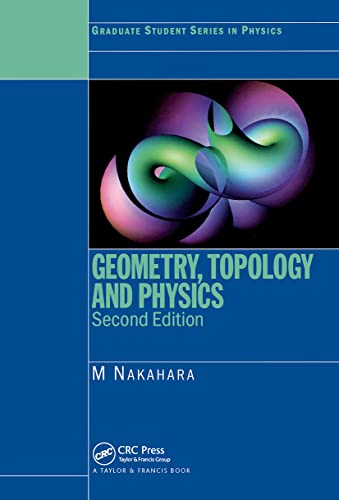
Differential geometry and topology have become essential tools for many theoretical physicists. In particular, they are indispensable in theoretical studies of condensed matter physics, gravity, and particle physics. Geometry, Topology and Physics, Second Edition introduces the ideas and techniques of differential geometry and topology at a level suitable for postgraduate students and researchers in these fields.The second edition of this popular and established text incorporates a number of changes designed to meet the needs of the reader and reflect the development of the subject. The book features a considerably expanded first chapter, reviewing aspects of path integral quantization and gauge theories. Chapter 2 introduces the mathematical concepts of maps, vector spaces, and topology. The following chapters focus on more elaborate concepts in geometry and topology and discuss the application of these concepts to liquid crystals, superfluid helium, general relativity, and bosonic string theory. Later chapters unify geometry and topology, exploring fiber bundles, characteristic classes, and index theorems. New to this second edition is the proof of the index theorem in terms of supersymmetric quantum mechanics. The final two chapters are devoted to the most fascinating applications of geometry and topology in contemporary physics, namely the study of anomalies in gauge field theories and the analysis of Polakov’s bosonic string theory from the geometrical point of view.Geometry, Topology and Physics, Second Edition is an ideal introduction to differential geometry and topology for postgraduate students and researchers in theoretical and mathematical physics.
User’s Reviews
Editorial Reviews: Review “…a very impressive book.” -Australian and New Zealand Physicists “The clarity of the presentation is enhanced by explicit calculations and diagrams; the proof of a theorem is given only when it is instructive and not very technical. There is also a large number of exercises and problems, and last but not least, an index … superb layout…” – Zentralblatt fur Mathematick un ihre Grenzgebiete “I believe that the book will not only boost modernization of the traditional courses of theoretical physics but will prompt the specialist in topology and differential geometry to have a closer look at the applications. So I welcome this second edition.” -Christopher Gilmour
Reviews from Amazon users which were colected at the time this book was published on the website:
⭐I think this book is great. Really superlative.First, let’s admit the only drawback: Some of the reviewers have complained about typos and mistakes in the text. I agree there are some. Not enough to distract from the presentation though I think.In all other respects though, I have the highest praise for the book. In many ways it is quite similar to Frankel’s Geometry of Physics. It covers very similar topics and the overall format and presentation is very similar. Frankel would sometimes omit or shy away from deeper technical topics – an example would be Atiyah-Singer Index theorem – that this book considers. Also, Nakamura has a slightly more formal technical feel to it I think. In some books, that would make it harder to understand, but I don’t feel that here; I think Nakamura has done a great job in the exposition to essentially extend what Frankel did but in about the same page count. This was important to me because I’m trying to understand the material more thoroughly and with more nuance than I was able to get out of Frankel. I especially like the sections on characteristic classes which have been hard for me to get intuition about.At the end of the day, this is an advanced area of mathematics and to learn it well you really need to have several references from which you can gain different perspectives and combine for deeper understanding. For that purpose, I definitely think Nakamura should be one of those books on your list.
⭐Nakahara is quite a clear book. The logic is very tight and organized and the exercises are nice – they are short and easy, just to check your understanding. It is a good idea to do all of the exercises because there are not many of them. It is one of the more rigorous “math for physicists” books I have read.There are indeed some mistakes, but you should be able to find them. One good thing is that Nakahara points out the physical interpretation of things, like homotopy, so you can get a intuitive feel. A great book!The only complaint I have is that the references are pretty bad. Nakahara likes to cite Japanese books which I do not have access to and, anyway, are in Japanese. I wish he would cite classic books that everyone uses.
⭐This is the best book of its type, that is, a book that contains almost all if not all the advance mathematics a theoretical physicist should know. I have studied chapters 2-9 and it has the perfect balance between rigorous presentation of topics and practical uses with examples. The level is for advance graduate students. The range of topics covered is wide including Topology topics like Homotopy, Homology, Cohomology theory and others like Manifolds, Riemannian Geometry, Complex Manifolds, Fibre Bundles and Characteristics Classes. I believe this book gives you a solid base in the modern mathematics that are being used among the physicists and mathematicians that you certainly may need to know and from where you will be in a position to further extent (if you wish) into more technical advanced mathematical books on specific topics, also it is self contained but the only shortcoming is that it brings not many exercises but still my advice, get it is a superb book!
⭐The book is well explained. Topics are introduced in a progressive way, allowing the reader to adjust to new concepts before applying them in more elaborate scenarios. The author often mention practical applications of mathematical concepts that otherwise look disconnected to physics or any other field. There are few typos and, from my point of view, many figures need a better caption-description.
⭐Seriously, this book has every piece of mathematical knowledge i’ve ever needed to know to understand my graduate texts on Quantum Field Theory and String Theory. To top it all off the book has excellent examples and exercises and literally the best notation i’ve ever seen used to the topics. I think every theoretical physicist, graduate student, and mathematician interested in physics should probably have a copy. This book will probably never leave my office.
⭐A mandatory book on physics that covers all elemental and advanced topics in geometry and topology. I recomend this volume for ungraduate and graduate students in physics and mathematics.
⭐I am surprised that amidst all the glowing reviews, there is only one reviewer who points out the unacceptable number of errata in this book. A couple of misprints here and there throughout the whole book (or even per chapter) would be acceptable, but I agree with the other reviewer that at times, the misprints are as much as one per page. In addition to the error on page 56 (equation 1.241d should have curl B), here are just a few that I found (I’m just going to list the page numbers): 8, 9, 21, 28, 66, 84, 179, 186, 192, 193, 196, 203, 245, 247, 255…. Look, I could go on and on. But this is not my job. I certainly didn’t pay 60+ bucks for this. Physicists deserve better than this. What this book really needs (attention: author or publisher) is an online database of errata. That’s the least they could do.
⭐The book is easy to read; provides a lot of examples.
⭐My entire Differential Geometry course was based upon this book so I relented and splashed out a bit to get myself my own copy that I can annotate freely. I bought a second hand copy for ~£52 and it came in perfect condition. My seller was kind enough to wrap it tightly in plastic to prevent any damage during transport and the pages were not marked or damaged at all.I personally really enjoy the way this text has been written there’s enough detail in the theory to the point were it satisfies me as reader but not so much repetition that it becomes drab. Concise, detailed and thorough in the theorems and proofs presented. Enough exercises to satisfy the passing reader but I guess you can always wish for more 😀 Hopefully those will get supplemented by your professor. But as always with most graduate student books they are there as a detailed ‘dictionary’ if you will – not so much as an exercise book.If you want something that covers all bases in your beginners quest of Differential Geometry this is the book for you!
⭐I must say that this edition contains some severe errors. In several places the mathematics has been wrongly transferred over from the old edition in key definitions such as those of the wedge product (those should be tensor products on the RHS) and topological spaces (that’s a J in (ii), not a T) and elsewhere in the book. I’m not sure how many there are in total so I write this as a caution that if you aren’t sure what you’re doing it might be wise to check out an older edition. I don’t know how it’s happened but it has.Other than that, classic book and extremely useful for a starting-out theoretical or mathematical physicist.
⭐The book is good,but the delivery is not good、the book is broken and dirty…
⭐If you, as a pathetic physics student that stopped taking maths classes after undergrad topology, have ever wanted a mathematical physicist to beat you about the head with a blunt instrument until you understood how to express physics ideas in the language of Riemannian geometry then this is the book for you. 10/10 would get flexed on by Nakahara again
⭐In comparison to Frankel this book is much more rigorous, while at the same time being much more brief. I also find that certain topics are missing in the text such as integrable manifolds/frobenius theorem. The topics seem to be chosen so that a reader can have a launching point into string theory. So if that “theory” is interesting to you then this may be a very good book to buy.
Keywords
Free Download Geometry, Topology and Physics (Graduate Student Series in Physics) 2nd Edition in PDF format
Geometry, Topology and Physics (Graduate Student Series in Physics) 2nd Edition PDF Free Download
Download Geometry, Topology and Physics (Graduate Student Series in Physics) 2nd Edition 2003 PDF Free
Geometry, Topology and Physics (Graduate Student Series in Physics) 2nd Edition 2003 PDF Free Download
Download Geometry, Topology and Physics (Graduate Student Series in Physics) 2nd Edition PDF
Free Download Ebook Geometry, Topology and Physics (Graduate Student Series in Physics) 2nd Edition