Ebook Info
- Published: 2004
- Number of pages: 490 pages
- Format: PDF
- File Size: 6.37 MB
- Authors: Bernard Schutz
Description
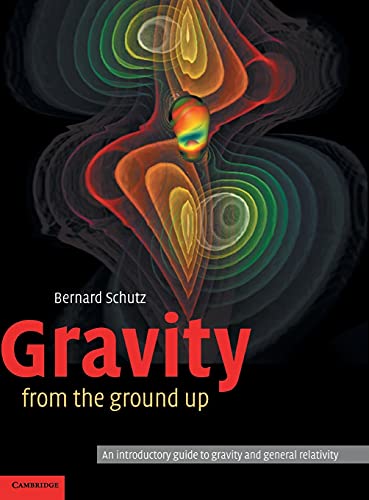
This book provides an accessible introduction to astronomy and general relativity, aiming to explain the Universe, not just to describe it. Written by an expert in relativity who is known for his clearly-written advanced textbooks, the treatment uses only high-school level mathematics, supplemented by optional computer programs, to explain the laws of physics governing gravity from Galileo and Newton to Einstein.
User’s Reviews
Editorial Reviews: Review “…the text is…inviting, with exercises that have real-world application, such as exploring the energy of photons that cause sunburn.” Stuart J. Goldman, Sky & Telescope”Delightfully throrough yet easy to read.” American Scientist Book Description An accessible introduction to astronomy and general relativity, requiring only high-school level mathematics. About the Author Bernard Schutz has done research and teaching in general relativity and especially its applications in astronomy since 1970. He is the author of more than 200 publications, including Geometrical Methods of Mathematical Physics and A First Course in General Relativity (both published by Cambridge University Press). Schutz currently specialises in gravitational wave research, studying the theory of potential sources and designing new methods for analysing the data from current and planned detectors. He is a member of most of the current large-scale gravitational wave projects: GEO600 (of which he is a PI), the LIGO Scientific Collaboration, and LISA. Schutz is a Director of the Max Planck Institute for Gravitational Physics, also known as the Albert Einstein Institute (AEI), in Potsdam, Germany. He holds a part-time chair in Physics and Astronomy at Cardiff University, Wales, as well as honorary professorships at Potsdam and Hanover universities in Germany. Educated in the USA, he taught physics and astronomy for twenty years at Cardiff before moving to Germany in 1995 to the newly-founded AEI. In 1998 he founded the open-access online journal Living Reviews in Relativity. The Living Reviews family now includes six journals. In 2006 he was awarded the Amaldi Gold Medal of the Italian Society for Gravitation (SIGRAV), and in 2011 he received an honorary DSc from the University of Glasgow. He is a Fellow of the American Physical Society and the Institute of Physics, an Honorary Fellow of the Royal Astronomical Society, and a member of the Learned Society of Wales, the German Academy of Natural Sciences Leopoldina and the Royal Society of Arts and Sciences, Uppsala. Read more
Reviews from Amazon users which were colected at the time this book was published on the website:
⭐The software is (as of this writing) still available. Software details below for those that want them (hopefully saves you searching like I did); it is not at all obvious that the software is a major requirement to enjoy the book, though.Be aware that the website for the book also has a PDF of solutions to the problems, which is great for someone doing self-study.Also, I have not read that much of the book yet, but it is a quality item and a good read so far – well typeset, pictures, 400+ pages of fairly small print (but not too massive to read in bed), good binding, unlike many expensive physics texts these days. I am giving this 5 stars just to balance out the other review that dinged it due to the software link being broken – the book is 8 years old, the SW is free & not put out by the publisher, Schutz has moved institutions; it’s not reasonable to hate on the guy for not having the links all straight.FYI, while the math may be accessible to a high-schooler, the writing style is more in the style of a standard undergrad physics text. It would need to be a pretty advanced, self-motivated high school student (at least by US standards) to get through much of this for that reasons, despite the math being only algebra.As to the software, it’s called `triana’, and is some sort of java front end. In fact, the idea seems to be that one might use this as an opportunity to teach oneself (or ones’ students) java by messing with the code if you want… which actually seems like a very nice idea. Anyway, Most of what you need can be found at the book’s website, but all the links to the main software package itself are broken – don’t get you even close to a place you could find it. Amazon usually seems to delete all typed links, so I will try to enter them below in a way that won’t get trashed by a `bot: w^3 should be obvious, dd means “dot”, ss means forward slash. They are:Book: w^3 dd gravityfromthegroundup dd orgThis link has color images, the PDF of the problem solutions, etc.Software:w^3 dd gravityfromthegroundup dd org ss programs ss index dd htmlthis is java code, help files, descriptions of everything (actually, code is nicely documented). Probably worth downloading it all in case it goes away. WORTH BOOKMARKING for later use.w^3 dd trianacode dd org ss gettingstarted dd htmlthe actual triana software place; this page has directions. Note: I got the SW (see below), extracted it, put it in a folder as specified on c drive, used set TRIANA=C:triana at the command prompt, and then ran the `triana app snapshot’ executable jar file without doing any of the other things I was supposed to do, and it works fine. So consider just extracting the files, putting them where you want, & running that file – ignore everything else. Seems like the SW no longer requires a full build on your own. *** the version I used already had the toolboxes installed – no need to download those separately either. Ironically, except for the broken links, things have gotten EASIER re: SW install.w^3 dd trianacode dd org ss triana4 ss download ssparent dir for the code. I used the triana-4.0.0 zip, since it didn’t require a lot of mucking about with tar files or gzips. Easy as pie on Win 7. Nb: this version didn’t seem to have the source for the java, but that is in the help pages listed in the 1st link above under “Software”. NB#2: You MUST have java installed before doing all this. Most people do, but if not search for `java’, download, & install it first.Last notes: when you run triana, you get a program window with an “Untitled1” subwindow with nothing in it. To get started:- open the `gftgu’ folder on the left side (gftgu = title of the book…)- drag `cannontrajectory’ over to the grey `Untitled1′ window & drop it there- open the `output’ folder on the left side- drag `SGTGrapher’ over to the `Untitled1′ window- if it doesn’t happen automatically, left-click on the little black tab on the `cannontrajectory’ box, and drag a connector to the tab on the `SGTGrapher’ box.- right click each box, and click on the `properties’ tab to open the control and graph windows- when changing parameters here, click `apply’, not `OK’ – the latter closes the windows.- click `run’ (or the “play” button on the toolbar for the main window). A plot will appear in the graph window.- Nb: this plot never seems to change when you change parameters… unless you uncheck the `x-autoscale’ and `y-autoscale’ in the graph window :)From there you’ll have the idea. The help files available at the 1st link under `Software’ above seem sort of necessary to understand some of the modules, and `F1′ does not bring up help on my triana install, so that page is worth bookmarking.All in all, pretty easy to deal with, though – the instructions above make it sound a lot harder than it actually is.
⭐This textbook on gravity is astounding! While limiting the mathematics to algebra and trigonometry (no calculus) it covers the physics of both Newtonian and Einsteinian gravity with depth and sophistication. I have a PhD in atmospheric physics and work in the field, so I am no stranger to either advanced math or physics. I have been trying to teach myself general relativity both for the pleasure of it and because when I retire (soon) I plan to incorporate it into a sci-fi novel I have planned. I have bought, read, and fought my way through relativity texts using the tensor calculus and developed a limited understanding of the math but little of the physics. I bought this book based on a review in Physics Today or Science News (can’t remember which). When I first browsed it I thought it was going to be too elementary because of the lack of calculus. I was dead wrong.From the opening chapter the book introduces the fundamental physical concepts: Invariance, coordinate transformations, conservation laws (invarients as contrasted with invarience) with serious quantitative exercises, physical examples and cross-references to other parts of the book where the results or concepts will be revisited. It covers major topics in orbital mechanics, stellar dynamics and structure (including neutron stars and black holes) and cosmology. The level of the math may be freshman, but the level of the physics is graduate school. In terms of readability, the writing is not only intensly informative, but also entertaining. It is simultaneously witty and deep. This book is brilliant!
⭐Great book to learn about gravity and soooo many things related, from the tiny neutrino to the massive supernova. Technical although advanced math (calculus) is not required.
⭐Overall this book is a true gem. As someone with no background in physics or calculus, this book was both challenging and accessible and has truly given me a much deeper understanding of relativity than one could get from a math-free book. Ultimately, this book has made me excited about physics, which is something I never thought I’d say.I would give this book 5 stars except there are some serious copy editing issues. Comparing problems with the solution set (found on the book’s website) some of the exercises are just plain wrong. At one point he has a 4pi thrown into a problem that shouldn’t be there. Unfortunately the exercise solutions run into the same problem; one solution assumes a water molecule has two oxygens as well as two hydrogens.I have no idea if the author plans to put out a new edition of this book, but if he does I hope it has a better editor.
⭐How many authors of popular science books begin their books by boasting that they can teach real science to readers who have no math–or no math beyond basic algebra? And then what do you get? Either a tub full of metaphors sloshing about promiscuously or else a math course so compressed it would leave Newton saying, “Duh?” But not in this book. Bernard Schutz takes the reader by the hand and leads him gently on. There is scarcely a bump in the road; yet, by the end of the book, you’ve not only learned a good deal of physics, astrophysics and cosmology, you’ve also gotten an inkling of how a physicist thinks. How does Schutz manage to succeed where failure is the rule? Well, partly by magic, I think. But partly by the clever use of simple computer simulations (downloadable for free) and partly by means of a very carefully thought out pedagogical strategy. This gentleman is a teacher par excellence. If you’re only going to read one science book in your life, read this one. Just be prepared to spend some time with it.
⭐Great
⭐Besser kann man Gravitation nicht erklären. Jeder, den das Thema interessiert muss dieses Buch lesen. Eine geniale Einführung, für weiterführende Lektüre.Good book, almost covers the whole of physics sans quantum theory.
⭐Book bought as Xmas gift, not able to comment on content.
Keywords
Free Download Gravity from the Ground Up: An Introductory Guide to Gravity and General Relativity 1st Edition in PDF format
Gravity from the Ground Up: An Introductory Guide to Gravity and General Relativity 1st Edition PDF Free Download
Download Gravity from the Ground Up: An Introductory Guide to Gravity and General Relativity 1st Edition 2004 PDF Free
Gravity from the Ground Up: An Introductory Guide to Gravity and General Relativity 1st Edition 2004 PDF Free Download
Download Gravity from the Ground Up: An Introductory Guide to Gravity and General Relativity 1st Edition PDF
Free Download Ebook Gravity from the Ground Up: An Introductory Guide to Gravity and General Relativity 1st Edition