

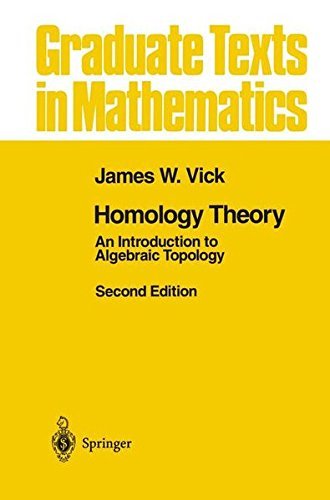
Ebook Info
- Published: 2012
- Number of pages: 259 pages
- Format: PDF
- File Size: 16.51 MB
- Authors: James W. Vick
Description
This introduction to some basic ideas in algebraic topology is devoted to the foundations and applications of homology theory. After the essentials of singular homology and some important applications are given, successive topics covered include attaching spaces, finite CW complexes, cohomology products, manifolds, Poincare duality, and fixed point theory. This second edition includes a chapter on covering spaces and many new exercises.
User’s Reviews
Reviews from Amazon users which were colected at the time this book was published on the website:
⭐good
⭐I didn’t read the book yet.but generally it looks great
⭐I’ve studied and refreshed my understanding of algebraic topology from lots of books over the years, and I always come back to this one. It’s the best of the lot by far, for me — easy to read, beautifully geometrically motivated, and displaying as light a touch as possible with algebraic and categorical details (which are introduced in digestible pieces as the need for them arises). I’d say that anyone with a good facility for basic group theory, even with a quite minimal background in point-set topology, can come to understand homology theory quite easily by following this book. I love the fact that Vick takes the reader straight into the thick of things, quickly getting to computations of homology groups of spheres and deducing a slew of nice geometric theorems from them (invariance of dimension, invariance of domain, Brouwer’s fixed point theorem, the “hairy ball” theorem, the Jordan separation theorem, etc.) — and that he doesn’t waste any time with the tedium of simplicial complexes, the simplicial approximation theorem, and all that. It has always seemed perverse to me that beginning books tend to start with the simplicial theory; true, it’s conceptually very basic, but its technical details are very easy to get bogged down in. Vick begins with singular homology, which is far easier to set up on a technical level than its simplicial cousin. After a number of very worthwhile deductions from the singular theory, he introduces CW complexes and shows that their homology is the same as that obtained from the singular theory. His treatments of products and Poincare duality are also outstanding. The best thing about this book is that it’s genuinely accessible to the beginning graduate student. You don’t need to have had a course in category theory to read and understand this book. (In fact, seeing some things in a concrete setting here, like direct limits, will undoubtedly help people understand their more abstract categorical versions later on in graduate school). I will make one criticism of this book’s way into homology theory, and that is that Vick neglects to prove Hurewicz’s result that the first homology group of a path-connected space is the abelianization of the fundamental group. Although this result is nowhere needed in the book, to me it’s really essential for understanding the geometric content of the integer coefficient of a given singular n-simplex within a given n-chain, at least in the easily visualized case n = 1. (It also helps in solving one of the exercises in this book, where one has to construct a map from the n-sphere to itself with any given integer as its degree; once you understand the Hurewicz result, it’s easy to find such a map on the circle in the complex plane, and then repeatedly iterate the suspension operator to increase the dimension of the sphere.) Apart from this detail, I love everything about this book. There are some typos, but that’s true in most books, and they didn’t bother me that much. I recommend this book to any novice student of algebraic topology, and especially to any who feel that their background in abstract algebraic machinery (category theory, homological algebra) is somewhat lacking. You’ll learn it well from this book. Enjoy it.
⭐This was the textbook for the first third of a year-long algebraic topology sequence at Oregon State in 1973-4. We were told by the prof that Vick was a student of Stong and that the book was essentially Stong’s course written up with his blessing. It’s hard to ask for a better pedigree than that, as Stong was a legend for his teaching (as well as his research).Although there are some minor quibbles (noted in the 4-star reviews), I still haven’t found a better treatment of the key results, nor a more direct path. The proof of Poincare duality in particular is that of Hans Samelson, another legend in the field for both teaching and research.Checking the references, one finds that this was not the only such example where Vick sought out what was then regarded as the best proof available for beginners. It is also noteworthy that community consensus on which are best has not changed much, if any, since then.The plethora of typos may be a “feature” of the reprint, since I don’t recall that many in the original Acad. Press edition we used, and I still have.As should be clear, this one is a real keeper.For more modern/advanced study, continue with Switzer and Brayton Gray. By then the journals should be reasonably accessible.
⭐This is a terrific book on homology theory, covering all the standard topics, plus some nice topics that are hard to find in other introductory books. The motivation for theory is presented in both algebraic/categorical and geometric flavors. The structure of the book is mostly solid, getting straight to the point with singular homology instead of wasting time with simplicial homology and its results (a rarity with algebraic topology books). My only complaints are that the book is riddled with typos and chapter 5 (on products in homology and cohomology) is quite messy.
⭐My professor used this book on the theory that studying out of a poorly written book prepares one to read research papers, which are, he claims, often written poorly. It is incredibly difficult to follow, full of typos, and I never really managed to learn anything out of it. It is arranged in a bizarre fashion, with the more abstract Homology Theory coming before the easier to understand Homotopy Theory. Also, within Homology Theory, he skips simplicial homology, which is by far the easiest to understand of the homology theories. I recommend Allen Hatcher’s book instead, which is available for free online – I never would have passed my qualifying exam if I hadn’t discovered Hatcher’s book.
⭐This introduction to singular homology combines a strong historical sense with an easy mastery of modern methods. The massive contributions of Poincare and Brouwer are credited, and their geometrical motivations are clear. At the same time the book neither minimizes nor apologizes for modern algebraic machinery, but treats categories and acyclic models and more as natural means to simplify the subject. The book goes through Poincare duality and a good account of the Lefschetz fixed point theorems. It is at once very visual and algebraically slick. The only problem with this approach is that the author seems a bit uncomfortable descending into the nuts and bolts of the longer proofs of two key results (the acyclic model theorem, and the duality theorem). He handles the details unevenly and makes some actual mis-statements. Here the reader needs the experience and confidence to make some corections.
⭐That was a request from my Grandson last Year! He was very please with it love it !
Keywords
Free Download Homology Theory: An Introduction to Algebraic Topology (Graduate Texts in Mathematics (145)) 2nd Edition in PDF format
Homology Theory: An Introduction to Algebraic Topology (Graduate Texts in Mathematics (145)) 2nd Edition PDF Free Download
Download Homology Theory: An Introduction to Algebraic Topology (Graduate Texts in Mathematics (145)) 2nd Edition 2012 PDF Free
Homology Theory: An Introduction to Algebraic Topology (Graduate Texts in Mathematics (145)) 2nd Edition 2012 PDF Free Download
Download Homology Theory: An Introduction to Algebraic Topology (Graduate Texts in Mathematics (145)) 2nd Edition PDF
Free Download Ebook Homology Theory: An Introduction to Algebraic Topology (Graduate Texts in Mathematics (145)) 2nd Edition