

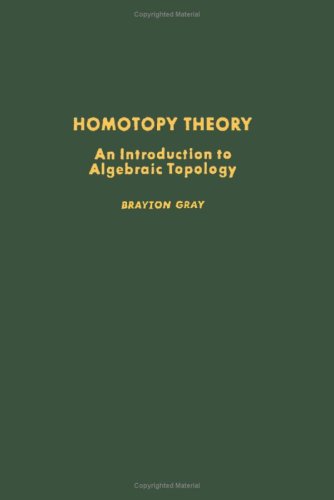
Ebook Info
- Published: 1975
- Number of pages:
- Format: PDF
- File Size: 14.08 MB
- Authors: Brayton Gray
Description
User’s Reviews
Reviews from Amazon users which were colected at the time this book was published on the website:
⭐Rather than giving an overview or summary outline, I’ll just give a few points which may help you see motivation for proofs or developments in the text. Of great importance is the use of categories and functors. These methods originated chiefly from the work of Eilenberg and Steenrod. The objects of one category are topological spaces or pairs(like in the the fundamental group or 1st homotopy group, you use the topological space and a subspace which in this case is a distinguished point used as the base point) and its morphisms or mappings between these objects are the continuous maps. A functor maps objects from one category to another and morphisms are also set into correspondence. The second category will consist of algebraic objects in particular the homotopy groups with morphisms being homomorphisms. These groups roughly will represent properties invariant under homotopy for the space for which they are calculated. The determinative property of this functoriality is that commutative diagrams in the first category must map to commutative diagrams in the second or target category. A topological problem is posed in the form of a commutative diagram in the topological category (example is the retraction of a ball onto its boundary sphere) and the diagram in the group category must also commute (Eureka!). This usually will translate to restrictions(usually dimension requirements) in the first diagram or no-goes,i.e., if commutativity does not hold in second diagram it cannot be true in the first diagram. This category/functor method of course also works for homology. But in our context we have the need to calculate the homotopy groups. The fundamental group is the easiest and the Van Kampen theorem is proved and used here. The higher homotopy groups are much more difficult to calculate and the deep Blakers-Massey theorem is proved and used to this end. Prior to Blakers-Massey, the Hurewicz theorems were a guide (some guesswork) in calculating the higher homotopy groups via relations with calculable homology groups. In this text these theorems are shown to be easy corollaries of Blakers-Massey. This text is one of the chief references for this theorem. Its first form is given in chapter or section 13 and a generalized form is given in chapter 16. Oh, the example, the no-retraction theorem is done with your assistance toward the end of chapter 13. After this it’s pretty much a standard algebraic topology text.
⭐Homotopy theory is one of the hardcore topics in algebraic topology that usually takes a formidable amount of technical machinery in order to progress in its development. This is somewhat paradoxical considering that defining homotopy groups is very straightforward. The author has given the reader a fine introduction to homotopy theory in this book, and one that still could be read even now, in spite of the developments in homotopy theory that have taken place since the book was published (1975). The book emphasizes how homotopy theory fits in with the rest of algebraic topology, and so less emphasis is placed on the actual calculation of homotopy groups, although there is enough of the latter to satisfy the reader’s curiosity in this regard. In the book the author states that “the deeper one gets into mathematics, the closer one sees the connections”. This is readily apparent in his coverage, as he gives a good general view of how algebra and topology are intertwined in the study of homotopy theory. The calculation of the fundamental group in homotopy theory is done by first considering covering spaces. Noting that this approach is useless in proving that a space is simply connected, the author moves on to the van Kampen theorem, and he uses it to show that the n-dimensional sphere is simply-connected. The calculation of the nth homotopy group for n > 1 is done using locally trivial bundles, which are the simplest generalizations of covering spaces. These bundles have the homotopy lifting property, and one can use this to relate the homotopy on the fibers to that of the base of the bundle. The author also shows how to get homotopy information from projective space fiberings. That the n-th homotopy group can be given a group structure is done in the context of compactly generated Hausdorff spaces by first using the reduced suspension as the domain. The group structure is alternately defined using an H-space structure on the range. The duality between these points of view is then proved by the author. In the simplicial category, the author proves the Blakers-Massey Theorem. The homotopy groups of spheres in certain selections of dimensions are then calculated. The homotopy theory of spaces more general than simplicial complexes, the CW complexes, is treated in detail by the author. The notion of weak homotopy equivalence is introduced, and a proof of the Whitehead theorem, showing that weak homotopy equivalence between CW complexes is the same as homotopy equivalence, is proven. The author does a fine job of discussing K(pi,n)’s and Postnikov systems, which are introduced as tools to find a space that will realize a sequence of homotopy groups. Geometric intuition takes its leave here, the reader now being properly embedded in the true abstraction of algebraic topology. Obstruction theory makes its first appearance here. Spectra, one of the most esoteric of topics in homotopy theory, also makes its appearance in this book. Its relation to homology and cohomology is brought about via the suspension functor. The homology of CW complexes is discussed, along with the generalization to more general spaces, using singular homology, which is defined in terms of spectra. This approach is different than what is usually done in books on algebraic topology. Homotopy theory is related to ordinary homology in 0 and higher dimensions and the Whitehead theorem, giving a homotopy equivalence if the homology of simply connected CW complexes is an isomorphism, is proven. The multiplicative properties of cohomology is discussed in detail, and the author brings in the heavy guns from homological algebra. These tools are all used to analyze orientation and duality issues in paracompact topological manifolds. The author introduces duality as a generalization of that in Euclidean n-space, wherein one can find an (n-k)-dimensional subspace for each k-dimensional subspace. Cohomology operations, which are the modern tour-de-force of algebraic topology, are discussed first as coefficient transformations, and then as natural transformations between spectra. The cup and cap products, and their generalizations in the Steenrod squaring operations , are discussed in fair detail. Spectral sequences are not used in the book, and so they are only assumed in order to study the algebra of stable operations over the integers modulo 2. This is done with the assistance also of Adem relations, which are relations among the Steenrod squares. K-theories, which are introduced as examples of ‘extraordinary’ cohomology theories, are discussed briefly, in the context of vector bundles, but the Bott periodicity theorem is not proven. Instead, the author uses it to solve the Hopf invariant and vector field problems. The Gauss map is defined and then used to give the classification theorem for vector bundles. The Whitney sum of vector bundles, along with the Grothendieck construction, give the K-theory functor. Applications of K-theory to Lie groups are delegated to the exercises. The author also includes a brief discussion of cobordism, which is done with the assistance of some notions from differential topology, such as the normal bundle and the concept of a tubulur neighborhood. The cobordism ring is shown to be graded, and assuming the Whitney embedding theorem, the Thom isomorphism between the cobordism ring and the homotopy of MO, where MO(k) is the tangent bundle over the universal k-plane bundle over BO(k). The homotopy of MO is calculated by first calculating the cohomology of BO and MO over the integers modulo 2. The Stiefel-Whitney classes are introduced here, and used to show that real projective 2n-space can be viewed as a ring generator of the cobordism ring. A most interesting discussion, as it shows to what extent the homology and cohomology derived from unoriented cobordism is different from ordinary homology and cohomology over the integers modulo 2. As is shown, every homology class over the integers modulo 2 is represented by a map from a manifold.
Keywords
Free Download Homotopy theory: an introduction to algebraic topology, Volume 64 (Pure and Applied Mathematics) in PDF format
Homotopy theory: an introduction to algebraic topology, Volume 64 (Pure and Applied Mathematics) PDF Free Download
Download Homotopy theory: an introduction to algebraic topology, Volume 64 (Pure and Applied Mathematics) 1975 PDF Free
Homotopy theory: an introduction to algebraic topology, Volume 64 (Pure and Applied Mathematics) 1975 PDF Free Download
Download Homotopy theory: an introduction to algebraic topology, Volume 64 (Pure and Applied Mathematics) PDF
Free Download Ebook Homotopy theory: an introduction to algebraic topology, Volume 64 (Pure and Applied Mathematics)